
Volleyball stat sheet explained: how to read a box score
The short answer
On a volleyball stat sheet, K is a kill, E an attack error, TA total attempts, A an assist, SA a service ace, SE a service error, RE a reception error, DIG a successful dig, and BS or BA a solo or assisted block. When you score live, Koach counts points, errors, aces, assists and serve receive, but not attempts or digs.
Need a volleyball stat sheet explained? K, E, TA, SA, BS, BA and a number like .237 can look like code, but you can read a box score in a minute once you know what each column counts. Below you'll find every abbreviation, one player's line worked through, and the part of that sheet Koach builds for you after a match.
What is a box score in volleyball?
A box score is the table you see after a match: one row per player, one column per skill. The format comes from American sports statistics, which is why stat apps, tournament results and livestream graphics use the same English abbreviations almost everywhere. Every skill in the game gets its own columns: attacking, setting, serving, serve receive, digging and blocking, with the player's points at the end.
In European and international leagues you often see a different layout: for each skill (serve, reception, attack and block) the number of attempts, the errors and the points, plus the share of good passes on reception. The labels differ, but the question behind every column is the same: how often did a player do it, how often did it go wrong, and how often did it win the point outright?
This article explains the abbreviations. Which numbers you actually need as a coach, and what to do with them, is covered in understanding and using volleyball statistics as a coach.
Volleyball stat sheet explained: every abbreviation in the box score
Attacking: K, E, TA and PCT
- K (kill): an attack that wins the point outright.
- E (error): an attack error. The ball goes out or into the net, or gets blocked so it lands on your side of the net. Other errors have their own columns.
- TA (total attempts): every attack combined, so the kills, the errors and the attacks the opponent keeps in play.
- PCT or Hit%: the hitting percentage, (K minus E) divided by TA, written with three digits after the decimal point. A player with 14 kills, 5 errors and 38 attempts hits .237. With more errors than kills, the number goes negative. Note that not every source calculates it this way. Kills divided by attempts, without subtracting the errors, is often called an attack or kill percentage too. Both versions are in calculating and improving your attack percentage.
Setting: A
A (assist) is the set or pass a teammate turns straight into a kill. On most teams the setter collects the assists, but a libero or hitter who puts up the ball for a kill gets one too.
Serving and passing: SA, SE and RE
- SA (service ace): a serve that wins the point outright, because the receiver either doesn't touch it or can't keep it playable.
- SE (service error): a serve into the net, out of bounds or with a foot fault.
- RE (reception error): a pass the opponent scores from directly. It is the mirror image of an ace. Some sheets add the number of receptions and an average on a 0 to 3 scale; how that scale works is explained in tracking serve receive quality.
Defense and blocking: DIG, BS, BA, BE and BHE
- DIG: an opponent's attack you defend so the ball stays in play. Receiving a serve does not count as a dig; that is reception. Why this column says so much about your defenders is covered in defense as a statistic.
- BS (block solo): a block point one player makes alone.
- BA (block assist): a block point two or three players make together. Each blocker gets a BA.
- BE (block error) and BHE (ball handling error): an error while blocking, such as touching the net, and a technical error when playing the ball, such as a double contact.
Totals: SP and PTS
SP (sets played) is the number of sets the player took part in. PTS is the player's point total: kills, aces and block points. In a US box score each BA counts as half a point, because the blockers share it. Points from opponent errors go on nobody's line.
One line from a box score, worked through
Say an outside hitter has this line: SP 4, K 14, E 5, TA 38, PCT .237, A 1, SA 2, SE 3, RE 1, DIG 9, BS 1, BA 2, PTS 18. Here is how to read it:
- Attacking. Four sets played and 38 swings. 14 of them were kills, 5 were errors and 19 stayed in play. Kills minus errors is 9, and 9 divided by 38 gives the .237.
- Setting. Once, this player set up a ball a teammate put away: the A 1.
- Serving and passing. Two aces against three service errors: at the service line this player gave away more than they won. Once, the opponent scored directly off their pass.
- Defense. Nine times they kept an opponent's attack in play.
- Blocking. One solo block, and two shared with a teammate.
- Points. 14 kills, 2 aces, 1 solo block and two half points from the BAs: 18 in total.
What this line doesn't tell you: how good the passes were when they weren't errors, and what happened to the 19 attacks that stayed in play. How to interpret a line like this as a coach, and talk it through with a player, is covered in reading player statistics after a match.
Which part of the box score does Koach build for you?
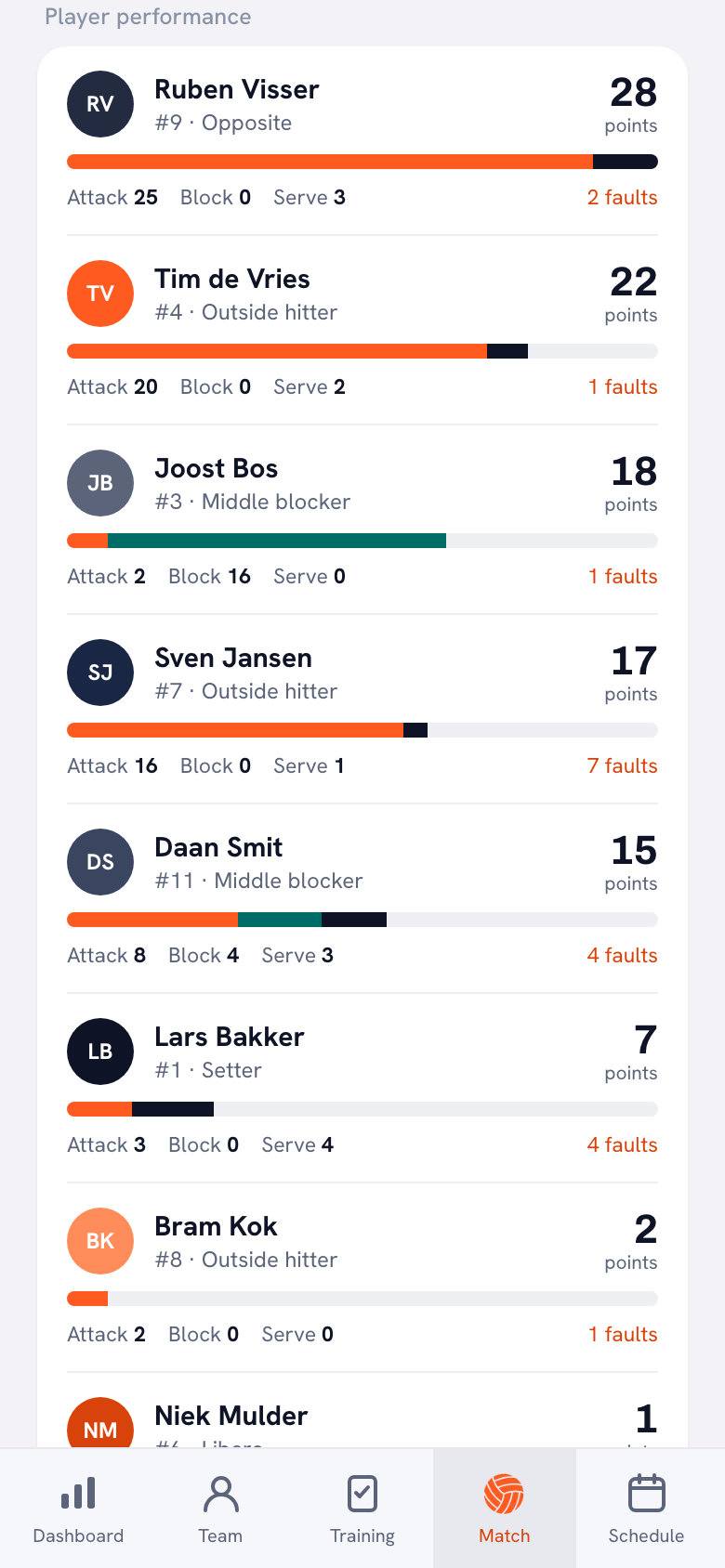
We make Koach, an app for volleyball coaches, so read what follows as the makers' explanation. You score the match live on your phone. When your team wins a point, you pick the player under Who scored the point? and then, under How was the point scored?, choose Attack, Block or Serve / Ace. If the point came from an opponent's mistake, you tap Opponent error. When the opponent wins a point, you pick the player under Fault by whom? and then the type of error, such as Attack fault, Service fault or Bad pass. When the opponent serves, you rate the reception on the 0 to 3 scale and pick who received the ball.
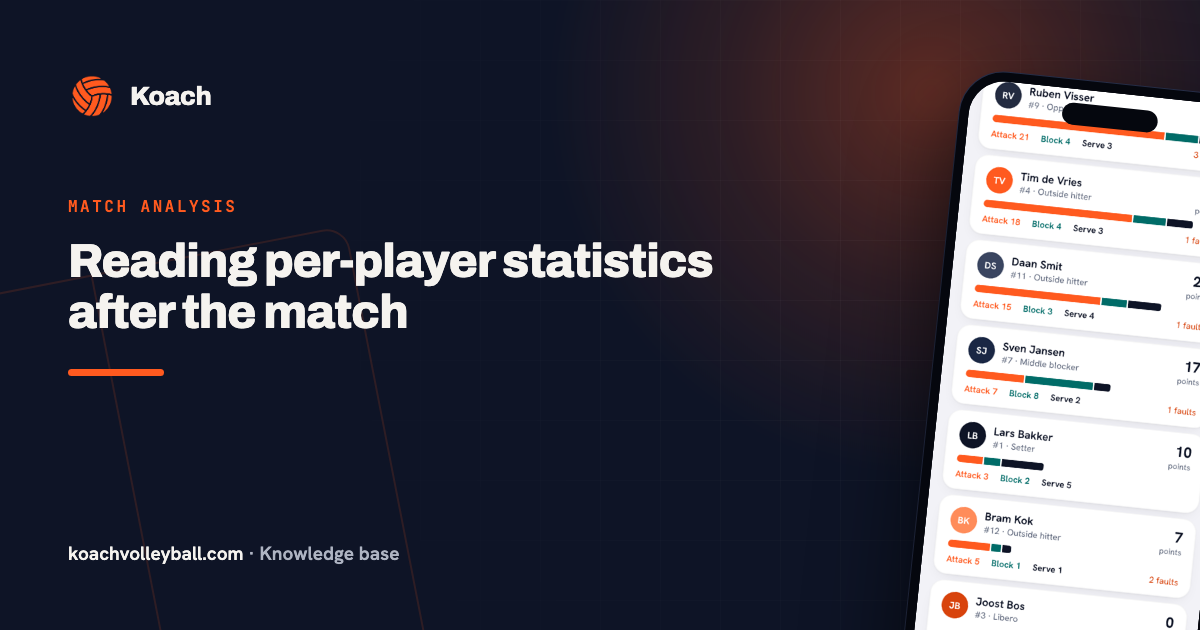
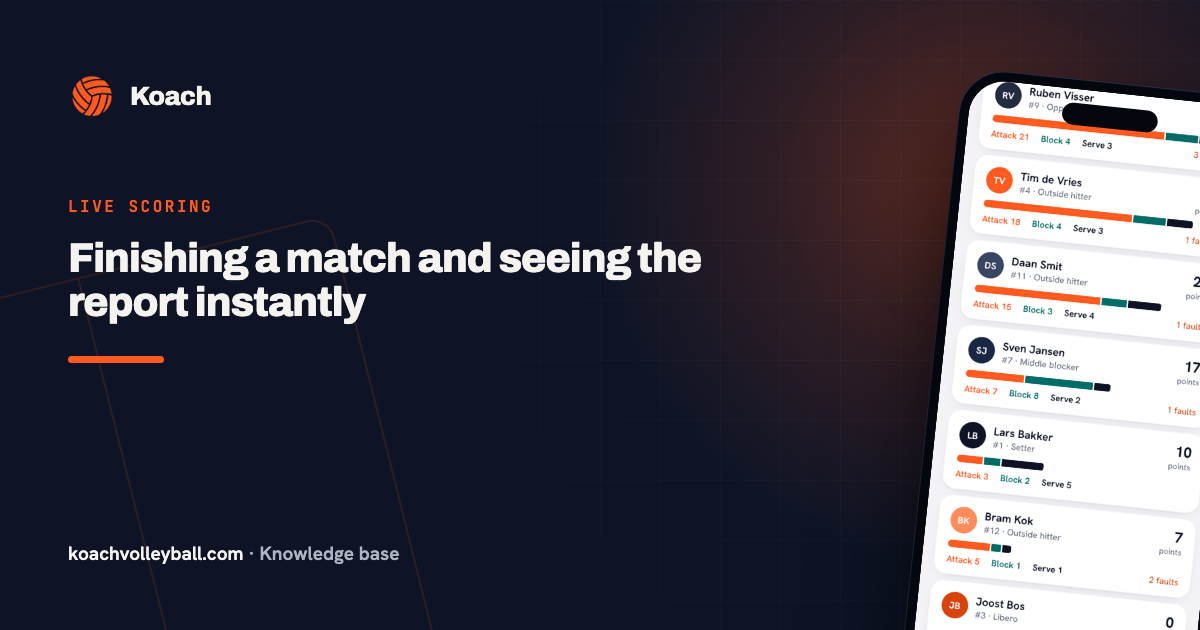
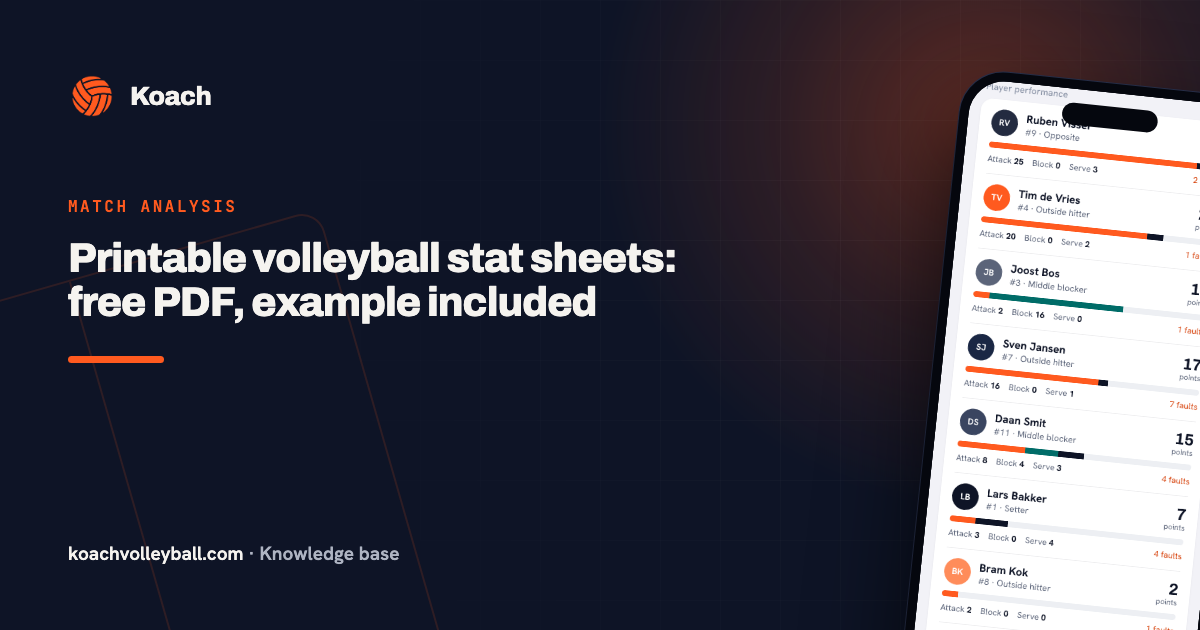
After the last point, the match shows each player's total points under Player performance, split into Attack, Block and Serve, with the number of errors next to them. That is the core of a box score, without anyone adding up tally marks afterwards. The Total, Set 1, Set 2 buttons and so on show the same numbers set by set. What happens when you close the match is explained in finishing a match and seeing the report right away.
14 days free, no credit card. Score your next match and read every player's attack, block, serve and errors as soon as the last point is played.
Try Koach at your next matchAbbreviation by abbreviation: what Koach counts and what it doesn't
The table shows, for each column of the box score, whether you find it in Koach and under which name.
| Abbreviation | Meaning | In Koach |
|---|---|---|
| SP | Sets played | Yes, under Playing time, with the rallies played |
| K | Kill | Yes, as Attack |
| E | Attack error | Yes, as Attack fault |
| TA | Total attempts | No |
| PCT | (K minus E) divided by TA | No, because the app doesn't count attempts |
| A | Assist | Yes, automatically for your setter |
| SA | Service ace | Yes, as Serve / Ace |
| SE | Service error | Yes, as Service fault |
| RE | Reception error | Yes, as Bad pass and as a 0 under Reception |
| DIG | Successful dig | No |
| BS and BA | Solo or assisted block | Partly: each block point goes to one player |
| BE and BHE | Block error and ball handling error | Partly: as Net fault or Other |
| PTS | Player points | Yes, attack plus block plus serve, without half points |
Three things stand out. Koach counts assists automatically: every kill by another player while the setter you named in the lineup is on the court. That is an approximation, because the app doesn't know who played the second ball. You find the season's assists in your setter's profile under Setting distribution. Errors by type are shown for the whole team under Fault distribution, and per player for the season in their profile. And a block point in Koach counts in full for the player you tap: where a US box score gives two blockers half a point each, Koach gives one player the whole point.
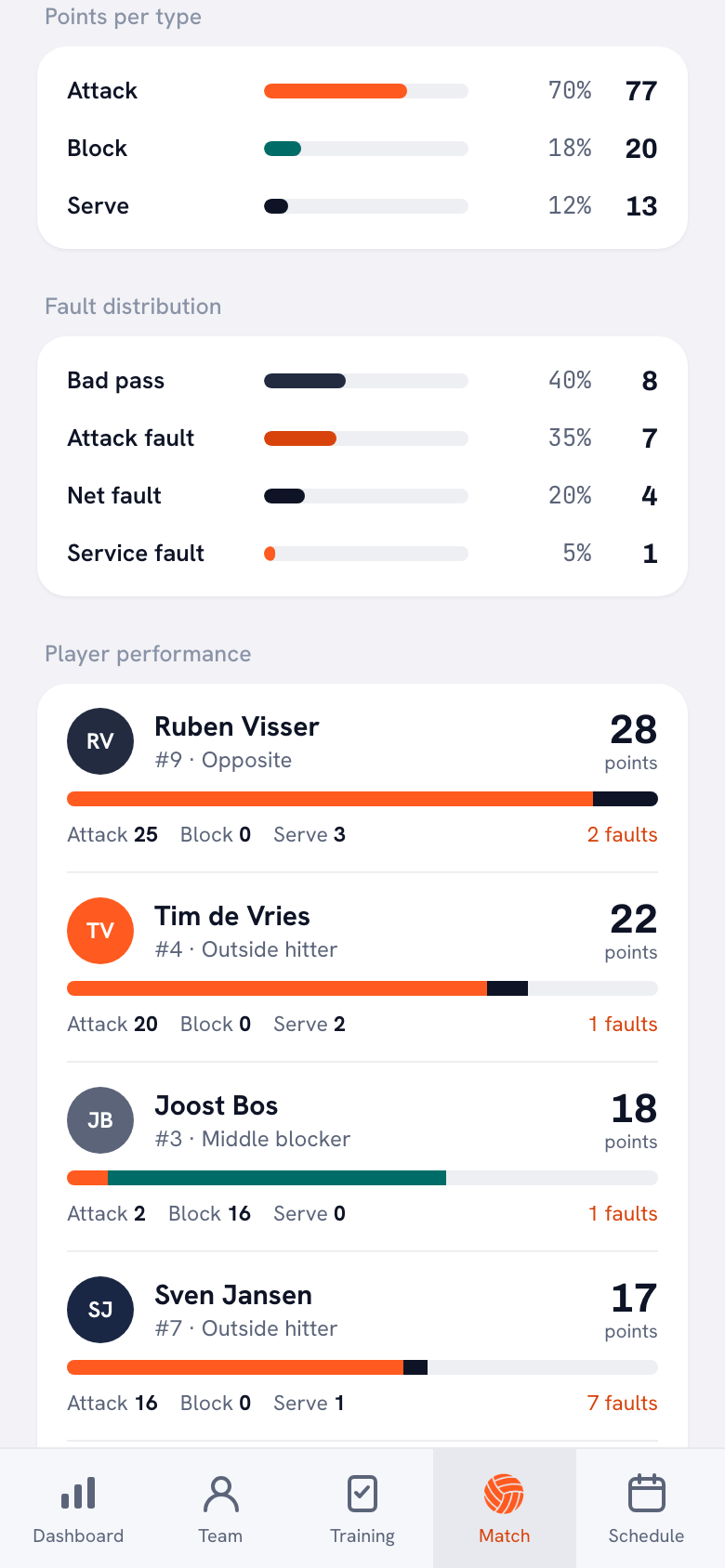
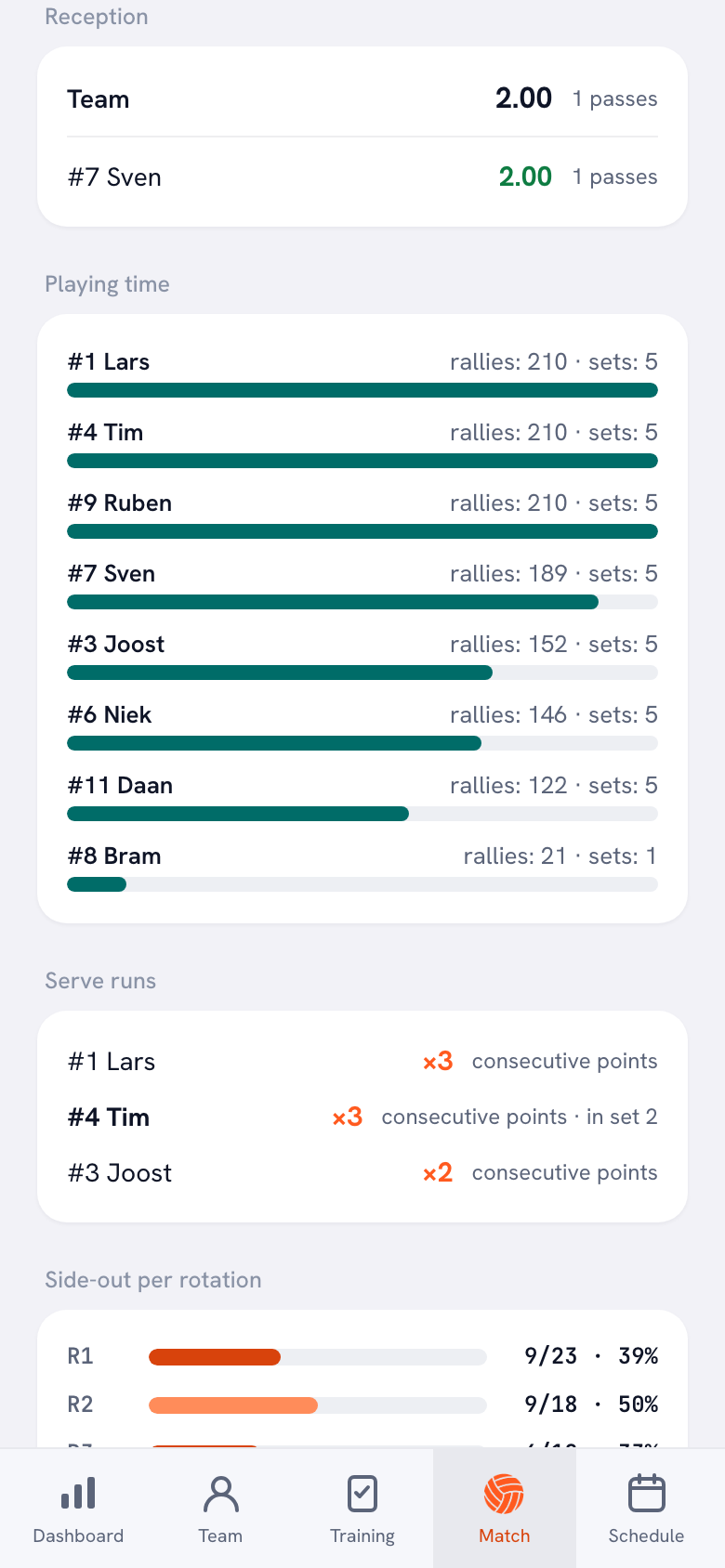
Below the players is Reception: the team average and each player's average on the 0 to 3 scale, with the number of passes. A 0 is an ace against you, so that is the RE column. Below that is Playing time, with the rallies and sets each player played: the SP column, only more precise. Reception, playing time and assists only come from live scoring. If you fill in a match later with Enter stats afterwards, you get points and errors per player.
What Koach doesn't count: attempts, hitting percentage and digs
A full US box score needs someone to record every attack and every dig, including the ones where the rally keeps going. Koach records how each rally ends (who won the point and how, or who made the error) and, when the opponent serves, the reception. What happens in between, the app doesn't count. So there are no attack attempts, and therefore no PCT. Digs aren't there either, and block points aren't split into BS and BA. If you want those columns, you need a second person who does nothing but keep stats, with a paper sheet or with software that scouts every touch. The free printable volleyball stat sheet has room per player for serving, reception on the 0 to 3 scale, attacking, blocking and other errors; attack attempts and digs are not on it. Which approach fits your situation is covered in the best way to track volleyball stats: paper, spreadsheet or app.
Who is this for, and who isn't it for?
- A good fit: you coach alone or with one assistant, you want to see where each player's points and errors came from, and you want to track serve receive without someone next to you keeping tallies. Players see their own line in the app under Your performances.
- Not a fit: you need a complete box score with TA, PCT and DIG, for example because your league or club asks for it, or you want to scout the opposing team's players. Then a dedicated statistician with a scouting sheet or scouting software is the better choice.
What does Koach cost?
You can try Koach free for 14 days, with no credit card and every feature included. After that you choose Coach for €2.99 per month (one team, two coaches) or Club for €9.99 per month (unlimited teams and coaches). With a yearly plan you pay €2.49 or €8.33 per month. Players and parents use the app for free. In the App Store and Google Play you see the price in your own currency. All prices are on the pricing page.
Assign every error to a player. If you choose Unknown / unassigned under Fault by whom?, the error still counts in the team's fault distribution, but it isn't on any player's line. That is exactly where the E, SE and RE columns per player come up short.
Frequently asked questions
What do K, E and TA mean in volleyball stats?
K stands for kill: an attack that wins the point outright. E is an attack error: the ball goes out, into the net, or gets blocked for an opponent's point. TA is total attempts, so kills, errors and attacks the opponent keeps in play combined. With those three you calculate the hitting percentage. Koach counts K and E, but not attempts.
How do you calculate hitting percentage in volleyball?
Subtract the attack errors from the kills and divide the result by the total attempts: (K minus E) divided by TA. With 14 kills, 5 errors and 38 attempts you get 9 divided by 38, so .237. The number goes negative when a player has more errors than kills. Koach doesn't calculate it, because the app doesn't count attack attempts.
What is the difference between a block solo and a block assist?
A block solo (BS) is a block point one player makes alone. A block assist (BA) is a block point two or three players make together, and each blocker gets one. In a US box score a BA counts as half a point in the player's PTS. Koach doesn't make that distinction: a block point goes to the player you tap.
Does a dig count as a point in volleyball stats?
No. A dig is a defended attack from the opponent: the ball stays in play, but no point has been scored yet. That is why DIG has its own column and doesn't count toward PTS, and why a strong defender or libero often sits low in the points column. Koach doesn't count digs; if you want to track them, you need someone who watches for nothing else.
Can an app create my team's box score automatically?
For a large part, yes. In Koach you score the match live, and after the last point each player's points from attack, block and serve, their errors, their reception on the 0 to 3 scale and their playing time are ready. Attempts, hitting percentage and digs are not counted. You can try it free for 14 days with no credit card; after that Coach costs €2.99 per month for one team.
See every player's numbers after your next match
14 days free, no credit card. After one match you'll know which columns you no longer have to tally by hand.
Get started with KoachOr read first what the volleyball coaching app does.