
Summer volleyball workout: six weeks to start the season fit
The short answer
A good summer volleyball workout starts with two to three weeks of rest in which you keep moving. Then you build up over six weeks: strength, jumps and conditioning two or three times a week, with beach or ball work on top. That way you start preseason fit instead of worn out.
A summer volleyball workout is not about being in top shape in July. The goal is that you can join the first practice after the summer without your body protesting. Here is the program you run yourself as a player: rest first, then six weeks of building up, with a plan for every week.
Why a summer workout makes sense for volleyball players
After a summer without sport your technique is still there; you do not forget how to pass or how to run your approach in a few weeks. What does drop off is your conditioning, your strength and how used your tendons and muscles are to jumping and landing. That is where the risk lies: in the first practice you hit as hard as at the end of the season, except your body has not done that for weeks. What disappears over a summer and how the coach builds up the first practices afterwards is covered in preseason training after the summer break. This article is about your side: what you do yourself between the last whistle and the first.
The plan below assumes a summer break of eight to ten weeks. If your break is shorter, cut the rest weeks short or start phase 2 earlier. More important than the exact plan is the order: recover first, then build a base, and only then jumps and speed.
Phase 1: rest first, but do not sit still
A season is long. Two to three weeks without volleyball and without a plan give your body and your head some room. Rest does not mean lying on the couch here: bike, swim, walk, play another sport. Anything you enjoy and that does not feel like training counts.
- Let small aches settle down. A nagging knee or shoulder gets the chance to calm down in these weeks.
- Play another sport. Cycling, swimming, tennis or soccer with friends keeps your fitness up and loads your body differently than volleyball does.
- Plan phase 2 now. Choose the days you will train and put them in your calendar. A plan that is already set is easier to stick to.
Does a problem keep coming back even after a few weeks of rest, or is it severe? Then have it checked by a doctor, sports physician or physical therapist before you start building up. A problem you carry into preseason rarely gets better there.
Phase 2: six weeks of building up, week by week
During the build-up you train two or three times a week, with at least one rest day between two hard sessions. The sample plan below is our own example for a healthy player aged about sixteen and up. Adjust it to your level: if you cannot do an exercise cleanly, do fewer reps, not sloppier ones. Muscle soreness after a new exercise is normal; pain in a joint or tendon that has not gone away after a few days is not. In that case stop that exercise and have it checked by a doctor, sports physician or physical therapist.
| Weeks | Focus | Sample week |
|---|---|---|
| 1 and 2 | Base: bodyweight strength, easy conditioning, mobility | The strength circuit twice, plus 30 to 40 minutes of easy cycling, running or swimming once |
| 3 and 4 | Heavier strength work, first jump and sprint work | Strength twice, each followed by a short jump block, plus intervals once |
| 5 and 6 | Volleyball movements: jumping, agility, ball contact | Strength once, jumps and agility once, beach or ball work once; a little less in week 6, so you start fresh |
The strength circuit
Six exercises, each 2 to 3 sets of 10 to 12 reps, with a minute of rest between sets. All you need is a mat and a resistance band.
- Squat. Feet hip-width apart, knees over your feet, back straight.
- Lunge. Alternate left and right; the front knee stays over the foot.
- Glute bridge. On your back, feet flat, hips up until your body forms a straight line.
- Calf raise. On the edge of a stair, slowly up and even more slowly down. Your calves and Achilles tendon absorb every landing; why that tendon deserves attention is covered in the Achilles tendon in volleyball.
- Shoulder with a band. Elbow against your side, rotate your forearm outward. Your hitting arm takes a lot over a season; this strengthens the muscles around your shoulder.
- Plank. On your forearms and toes, 20 to 40 seconds, body straight as a board.
From week 3 you make it harder: slower on the way down, a backpack with some weight in it, or on one leg. If you have access to a weight room and supervision, you can take it further there; what does and does not work is in strength training for volleyball players. If you are younger than about fifteen and training without supervision, stick to bodyweight and lots of play, and ask your coach what suits you.
Jumps, sprints and conditioning
Volleyball is not an endurance sport: you make short, explosive efforts with breaks in between. So train your conditioning the same way.
- Intervals. For example 8 to 10 rounds of 20 seconds running hard back and forth between two lines, with 40 seconds of rest. Build up the number of rounds, not the pace.
- Jumps. Start in week 3 with few jumps and focus above all on the landing: on two feet, soft through the knees, knees not caving in. Count the jumps per session and increase the number gradually. A complete jump program is in jumping higher in volleyball.
- Agility. Shuffling sideways, a block step along a line, quick changes of direction. Short and sharp, with full rest between reps.
- Ball contact. Passing and setting against a wall keeps your touch sharp. Drills without a net or a partner are in volleyball drills at home.
Test yourself in week 0 and week 6. Mark your highest jump reach on the wall and count how many back-and-forth sprints you manage in 30 seconds. After six weeks you do the same. Progress you can see for yourself keeps you on the plan better than a good intention.
Beach volleyball as summer training
Beach is a good addition in summer: you play, you touch a lot of balls and you train your legs in a way that feels different from indoors. Two caveats:
- Sand is hard on calves and feet. You land softer, but your calves work harder on every push-off. So build up your hours on the sand just as gradually as your jump work.
- Heat and sun. Drink more often than you think you need to, put on sunscreen and preferably play in the morning or late in the afternoon.
After a summer of beach you often have better ball control and read the game better, and in the first weeks indoors your timing at the net feels different. That usually settles after a few practices. In the plan, beach counts as your third session in weeks 5 and 6, or as an extra in the quiet weeks, as long as you do not play every day.
How the summer fits into your season
In season planning, the summer is the transition phase between two seasons; how coaches work with such phases is covered in volleyball periodization. For you as a player it means: at the end of the summer you are ready to train, not ready to peak. The coach then builds on that during preseason; when preseason starts differs by country and competition. How the rest of the season runs is in the checklist organizing the volleyball season.
At the first practice, tell your coach what you did: trained or not, played beach, had any aches. Then your coach knows whether you can jump right in or should take a step back.
Your summer drills in Koach
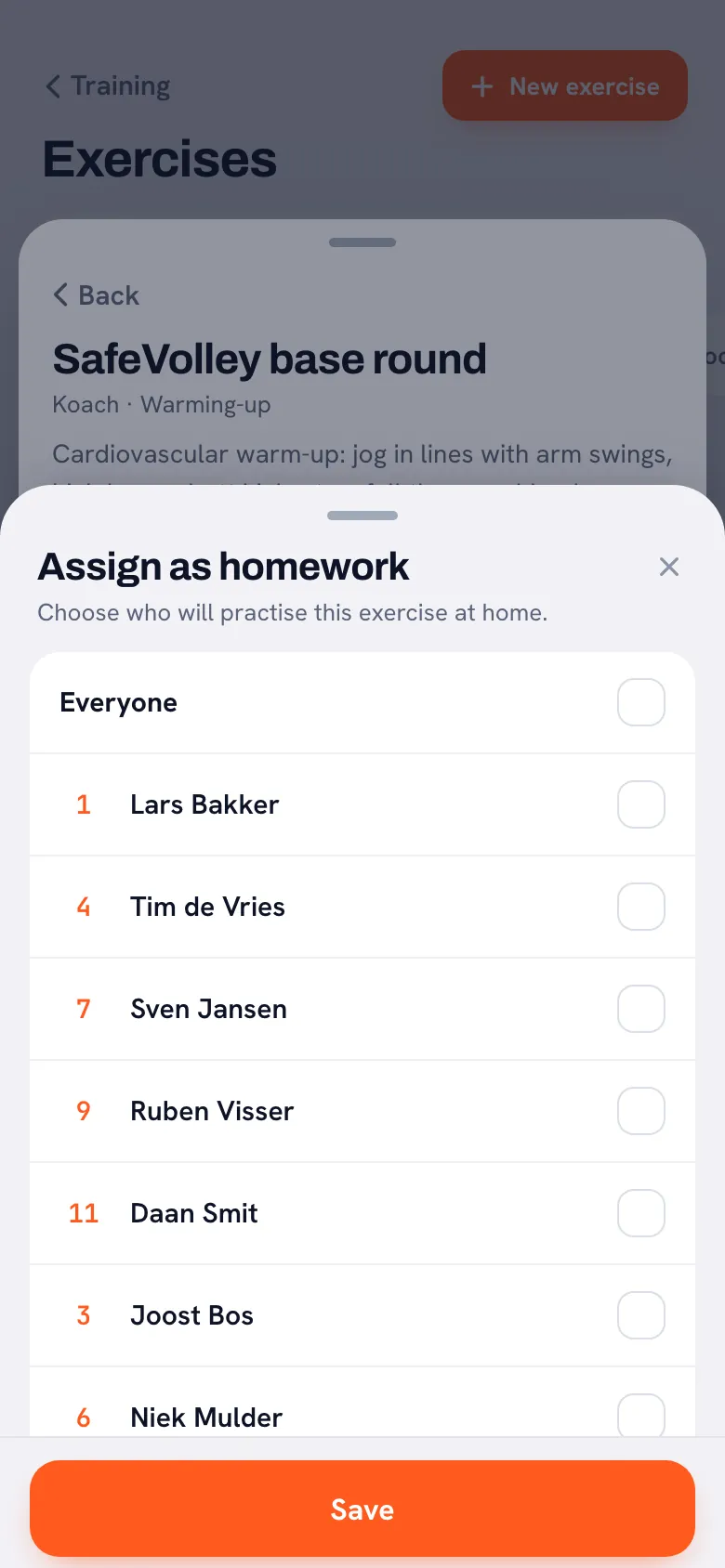
If your coach uses Koach, they can give you drills to take into the summer. On a drill in the exercise library they tap Homework and choose the players who will do it at home. The drill then shows up on your dashboard under Homework; tap it and you see the diagram and the animation of every phase, so you still remember how it went in the middle of the summer. Koach does not build a complete summer plan for you: you put that together yourself, with this article or with your coach.
After the summer the practices are back in the schedule and you sign up or let your coach know you cannot make it in the app, so your coach knows in advance who is there in the first weeks. As a player you pay nothing: your account falls under the team's subscription. Your coach can try Koach free for 14 days; what it costs after that is on the pricing page.
14 days free, no credit card. Give your players one drill to take into the summer and see right after the break who is back.
Try Koach with your teamFrequently asked questions
How much rest do you need after the volleyball season?
Many players take two to three weeks without volleyball and without a plan. During those weeks you do keep moving: cycling, swimming or another sport. After that you start the build-up gradually. If you still have problems after that rest, have them checked first by a doctor, sports physician or physical therapist.
Is beach volleyball good summer training?
Yes, as an addition. You touch a lot of balls, read the game better and train your legs in a different way. Sand does ask a lot of your calves and feet, so build up the hours gradually and do not play every day. Combine it with strength work, and in the sun pay attention to drinking enough and sunscreen.
Can you improve your vertical jump over the summer?
You can, if you combine strength and jump work and build it up gradually over several weeks. Six weeks is short; mostly you lay the base you keep building on during the season. Focus on a good landing on every jump and increase the number of jumps gradually, otherwise your knees or Achilles tendon are more likely to start complaining.
What if you did nothing all summer?
Tell your coach at the first practice and do not try to make up for it in one week. Join the first practices at a lower intensity, skip the hardest jump series and build up over two to three weeks. Players who go all out right away are more likely to end up with sore muscles and aches than players who ease back in.

Give your team a summer drill
14 days free, no credit card. After the summer you see right away who is back.
Get started with KoachOr read first what the volleyball coaching app does.