
Technical timeout in volleyball: does it still exist?
The short answer
A technical timeout in volleyball was an automatic 60-second break as soon as the leading team reached 8 and 16 points, in sets 1 to 4 of official FIVB competitions. It is no longer in the indoor rules from the 2021-2024 edition on. In beach volleyball it still exists, at 21 combined points in sets 1 and 2.
You may know the technical timeout in volleyball from older matches on TV: at 8-5 both teams walked to the bench without anyone asking for it. Here you read what the rule was, when it disappeared from the rules, where you still come across it and how to coach without those fixed breaks.
What was the technical timeout?
The technical timeout was a timeout nobody asked for. The FIVB Official Volleyball Rules 2017-2020 put it like this (rule 15.4): in FIVB world and official competitions, sets 1 to 4 had two additional technical timeouts of 60 seconds, applied automatically when the leading team reached its 8th and 16th point. The deciding fifth set had no technical timeout; there each team only had its two regular timeouts of 30 seconds. During every timeout, the technical one included, the players in play went to the free zone near their bench.
The purpose was in the definitions at the back of the same rulebook. The technical timeout was there to promote volleyball, to analyze the game and to make room for commercial moments. It was only mandatory in FIVB world and official competitions. For other competitions it was not part of the rule; a federation could add it to its own regulations, though.
Because the leading team in a set to 25 always passes 8 and 16 points, every set from 1 to 4 had exactly two. A four-set match thus got eight minutes of technical timeouts, on top of the regular timeouts and the intervals between sets.
When did the technical timeout disappear?
It is no longer in the Official Volleyball Rules 2021-2024. Those rules applied to competitions starting after January 1, 2022. It does not appear in the current Official Volleyball Rules 2025-2028 either. They now say:
- Each team may request a maximum of two timeouts and six substitutions per set (rule 15.1).
- All requested timeouts last 30 seconds. In FIVB competitions the length can be changed if the FIVB approves a request from the organizer (rule 15.4.1).
- During a timeout, the players in play go to the free zone near their bench (rule 15.4.2).
- There is an interval of three minutes between sets (rule 18.1).
The rest of the rulebook is summarized in volleyball rules at a glance.
Shortly before the switch, the FIVB was still experimenting. At the men's Club World Championship in December 2021, according to Volleyball World, the FIVB tested a format with one technical timeout of 60 seconds when the leading team reached 12 points, and one regular timeout per team per set. Whether a national league still has a technical timeout today is in that league's regulations. That differs by country and by level.
Where does the technical timeout still exist?
On the sand. The Official Beach Volleyball Rules 2025-2028 still have it (rule 15.4.2): in FIVB world and official competitions, sets 1 and 2 get one additional technical timeout of 30 seconds when the two teams have scored 21 points combined. There is none in the third set (rule 15.4.3). On top of that, each beach team has one timeout of its own per set (rule 15.1). The other beach rules are in beach volleyball rules.
| Indoor until 2022 | Indoor now | Beach now | |
|---|---|---|---|
| Technical timeout | At 8 and 16 for the leading team | No | At 21 combined points |
| Length | 60 seconds | Not applicable | 30 seconds |
| In which sets | Sets 1 to 4 | Not applicable | Sets 1 and 2 |
| Own timeouts per set | 2 of 30 seconds | 2 of 30 seconds | 1 of 30 seconds |
The indoor until 2022 column is about FIVB world and official competitions; the technical timeouts on the sand also apply only there.
Not a timeout for technical reasons
The name sometimes misleads people. A technical timeout has nothing to do with an injury, a ball from the next court or a light that goes out. The rulebook calls such stoppages exceptional game interruptions (rule 17), and they do not cost you a timeout:
- Injury. If a serious accident happens during the rally, the referee stops play and the rally is replayed. If the player cannot be substituted, they get three minutes of recovery time, no more than once per player per match (rule 17.1).
- External interference. A ball from the next court or someone walking onto the court: play stops and the rally is replayed (rule 17.2).
- A prolonged interruption. If the lights fail or the match has to move to another court, the first referee and the organizer decide how it continues (rule 17.3).
Coaching without a fixed break at 8 and 16
With the technical timeout, every set had two fixed moments when you could talk to your team, even when things were going well. Those moments are gone. An opponent's run is no longer interrupted automatically, and you are the only one who can stop the set. Four things help.
- Create your own checkpoints. Around 8 and 16 points, look deliberately at the score, the runs and the rotation you are in, or agree that with your assistant. Then you decide whether a timeout is needed, instead of waiting until it goes wrong. You do not have to take one at that moment.
- Use your two timeouts deliberately. One to break a run and one for the end of the set is a common split. When and how is covered in using timeouts.
- One message in 30 seconds. A technical timeout lasted twice as long. In 30 seconds there is room for one point, not three. How to fill those seconds with numbers is covered in what to say in a timeout.
- Teach your team to reset on its own. Fewer breaks from outside means players have to adjust between rallies themselves: a quick huddle after every point, and a captain who speaks up after two errors in a row. Train that as well as you train passing. Your role on the sideline during the rest of the match is covered in match coaching.
Mark 8 and 16 on your clipboard sheet. Draw a mark at those scores and at that moment look at one thing: how many points in a row have gone against you. If there is a run of three or more, that is your moment for a timeout, with or without a technical break.
Tracking your timeouts in Koach
In the Koach live screen, the Timeout button has a counter per set, and the app refuses a third timeout in the same set. Tap it and the timeout screen opens with the score, a one-line conclusion, the number of rallies, the momentum wave of the set, and the blocks Most errors and Weakest rotation. At your second timeout you also see how the set has gone since the first.
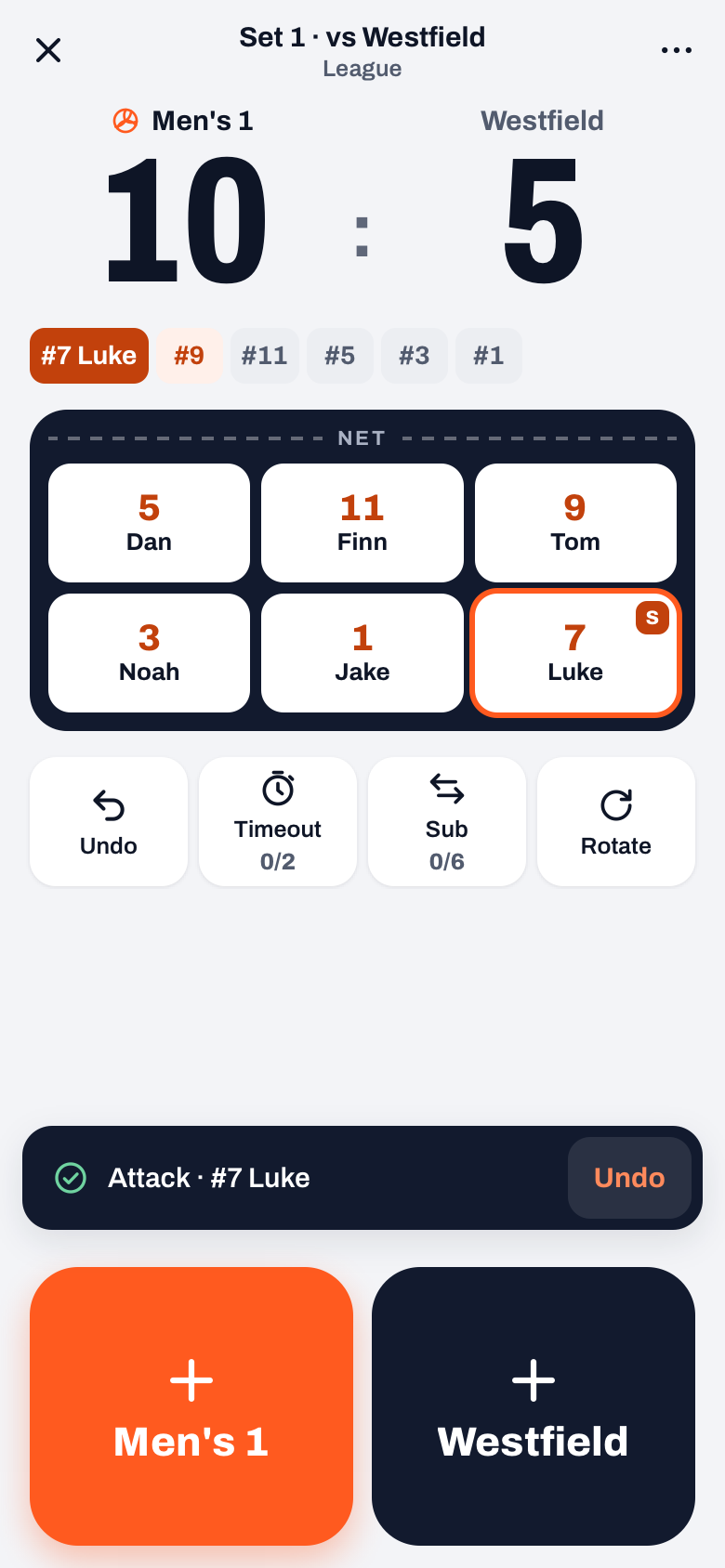
Afterward, the match stats show the row After a time-out (3 rallies) under Momentum: how many rallies you won and lost in the three rallies after each timeout. Over a few matches you see whether your timeouts achieve anything, even without a fixed break at 8 and 16. What Koach costs after the 14 free days is on the pricing page.
14 days free, no credit card. Take your next timeout with the numbers of the set in front of you, and see afterward what it achieved.
Try Koach at your next matchFrequently asked questions
Does the technical timeout still exist in volleyball?
Not in the FIVB indoor rules: it has not been in them since the Official Volleyball Rules 2021-2024, and it is not in the rules for 2025-2028 either. In beach volleyball it still exists: in official FIVB competitions, sets 1 and 2 get a technical timeout of 30 seconds when the teams have scored 21 points combined. A national league can have its own rules.
How long was a technical timeout in volleyball?
Indoors it was 60 seconds, twice per set in sets 1 to 4: at the 8th and the 16th point of the leading team. A regular timeout lasts 30 seconds. In beach volleyball, the technical timeout that still exists also lasts 30 seconds.
How many timeouts do you get per set in volleyball?
Indoors, each team may request two timeouts of 30 seconds per set, also in the deciding fifth set. They expire after the set, so you do not carry them over to the next one. In beach volleyball each team has one timeout per set.
Why was the technical timeout abolished?
The FIVB rulebook gives no reason. What is clear: without two 60-second breaks per set, a four-set match is eight minutes shorter, and a team's run is no longer interrupted automatically. The old rulebook named promotion, analysis of the game and commercial moments as the purpose of the technical timeout.


Take your timeouts with the numbers in hand
14 days free, no credit card. After a few matches you see what your timeouts achieve.
Get started with KoachOr read first what the volleyball coaching app does.