
Volleyball ball cart or ball bag: storing and carrying the balls
The short answer
A volleyball ball cart belongs in the gym: the balls sit at hip height next to whoever is feeding, and you roll them to where you need them. For away matches and the car, a ball bag is handier. The agreements matter more than the model: who looks after the balls, where the cart goes and who counts after practice.
A volleyball ball cart or ball bag seems like a side issue, until after three months only seven of the twelve balls are left. Here you read how a cart, a bag and a mesh bag differ, what to look for, how to place the cart safely at practice and which agreements keep the set of balls complete.
Ball cart, ball bag or mesh bag: the differences
There are three ways to store and carry a team's balls. Each does something else well:
| Type | Strong | Less strong |
|---|---|---|
| Ball cart | On wheels, balls on top within reach, handy for feeding balls and for a big group | Takes up space, does not fit in every car and is awkward on stairs |
| Ball bag | Portable, closed, fits in a car trunk; good for away matches | Holds fewer balls, and balls at the bottom are slower to grab |
| Mesh bag | Light and folds up small; fits in any sports bag | Does not protect the balls from dirt and knocks, and wears out if you drag it across the floor |
Many clubs have all three: a cart per team or per gym that stays in the equipment room, and a bag or mesh bag for the road. We leave out brands and prices; those vary too much by country and by store. What other training equipment belongs in the gym, and in what order to buy it, is in volleyball training equipment.
What to look for in a volleyball ball cart or ball bag
Start with the number of balls. How many balls a practice needs depends on your drills; work it out with more ball contacts per practice. Then pick a cart or bag that holds those balls with some room to spare; the manufacturer states how many a model holds. Beyond that:
- Height and opening. The top of a cart is ideally at hip height or higher, with a wide opening, so whoever is feeding can grab a ball without bending down.
- Wheels. They should turn smoothly and be clean, so they do not leave marks on the gym floor. A cart with a brake or a locking wheel stays put when someone bumps into it. Ask the facility manager whether there are requirements for equipment on the floor.
- Folding or not. A folding cart fits into a smaller storage room or a car trunk, but has hinges where fingers can get caught.
- Sturdiness. A cart that tips over when someone leans on it also tips over when a player runs into it during a drill. Push firmly against it when you choose one.
- Lockable. If several teams share an equipment room, a cart that locks keeps your balls from ending up in someone else's practice.
- For a bag: sturdy straps, ideally as a backpack, and fabric you can wipe clean.
The cart at practice: placement and safety
- Next to the feeder, on the side of the hand they grab with. Then they grab and toss in one motion, without turning around.
- Outside movement paths and landing zones. Do not put the cart under the net or where players land after an attack or a dive. A cart in a defender's path is a collision you could have seen coming.
- Wheels locked. Put the brake on or push the cart against the wall. A cart that rolls away after a bump is suddenly on the court.
- One container per station. If you work with stations, give each station its own cart, bag or mesh bag. Then the balls stay at their station and nobody has to walk across the gym.
- With kids: no climbing in or on the cart and no racing with it. Fold and unfold a folding cart yourself.
At a match, the cart or bag stands on your own side during the warm-up, outside the court. After the warm-up it goes out of the free zone around the court, so it is not in the way at the bench or between substitutes who are warming up. What exactly is allowed in the gym is up to the organizer and the referee.
Stick a contents list on the cart. A card with the team name, the number of balls that belong in it and what else goes in it, such as a pump. Whoever puts the cart back after practice sees at a glance whether it is complete, even if it is a stand-in or a different coach.
Who looks after the balls at the club?
Balls often go missing because nobody feels responsible. So agree on four things and put them somewhere they will not sink out of sight; arrangements in a group chat cannot be found again after a week, see why the WhatsApp group stops working.
- One name per team. A player or parent who looks after the team's cart: counts the balls, reports what is broken and makes sure the bag comes back after an away match. On top of that, one person or committee for the equipment of the whole club.
- A fixed spot. Each cart has a place in the equipment room, with the team name on it. Whoever practices after you finds the gym empty and your cart locked.
- Broken balls go separately. A ball with a bulge or a leak does not go back in the cart, but into a separate bin, with a note for the person in charge. Sometimes it can still be saved; see how to fix a volleyball.
- A check at the end of the season. Count all the balls, check them and store them clean for the break. How to clean and store them is in how to clean a volleyball.
Counting after practice
Count while packing up, not afterwards. Have the players put the balls in the cart or bag in fives, or count out loud; with kids you can turn it into a contest. If the number does not match the contents list, search right away. Balls hide in the same places:
- behind a dividing curtain or in the other part of the gym;
- under the bleachers or behind a bench along the wall;
- between the mats or the cabinets in the equipment room;
- in the locker room or in a sports bag already standing by the door.
At an away match, count twice: before the warm-up and before you leave. In an unfamiliar gym, balls of the same model quickly get mixed up, and a ball left behind there does not always come back.
How many balls to bring: in Koach
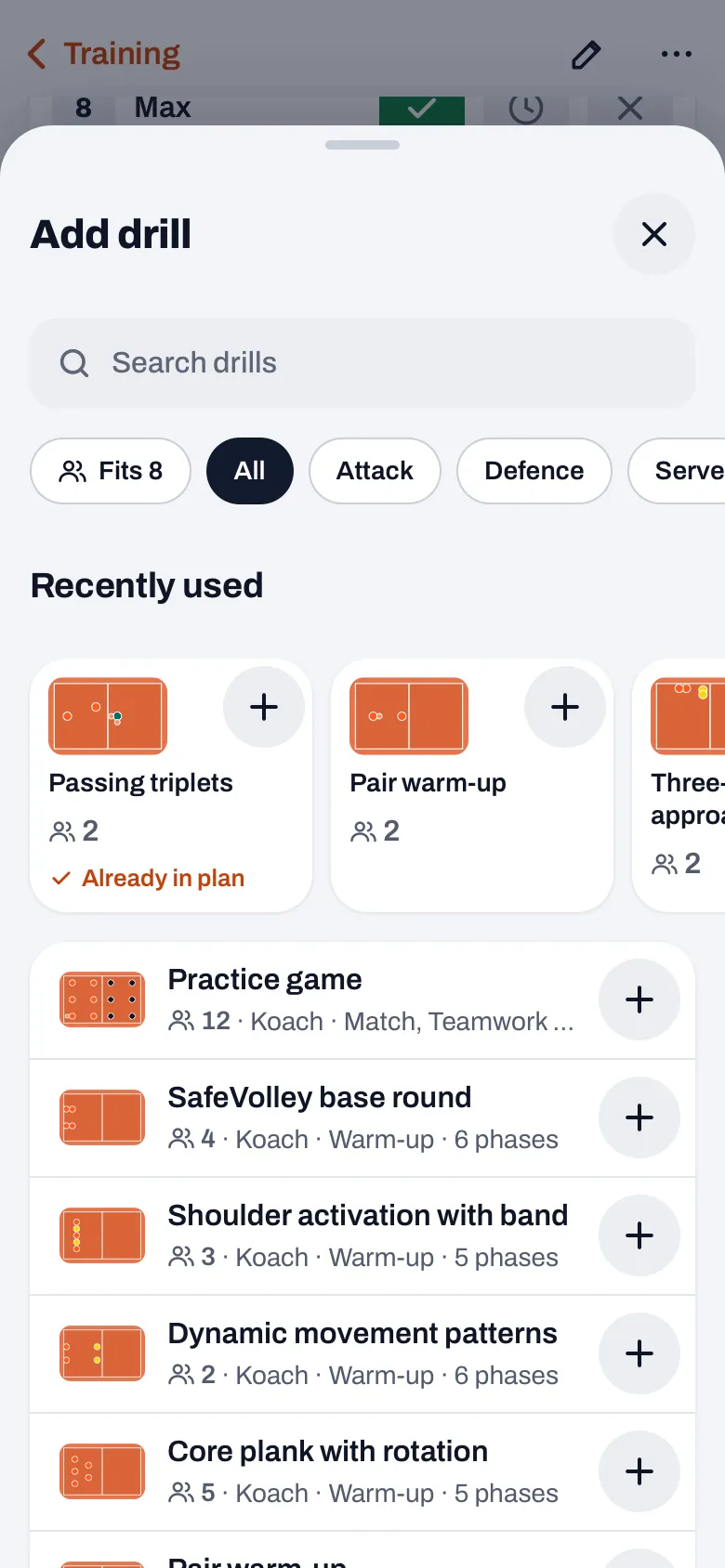
Koach does not track equipment and does not count your balls. But you do know in advance how many players are coming, and so how many groups and balls you need. When you add a drill to a practice, the Fits chip, with the number of players who are coming, shows only drills that do not need more players than that. So when you pack the bag, you already know which drills you will run, and so how many balls need to come along.
Who brings the ball bag to the away match, you post as a task in the announcements on the dashboard; whoever takes it taps I’ll do it. If your club works with Koach Club, the board can record under Organisation who is on the equipment committee; you pick from the players on the club teams. Only the board sees that list, so also put the name of the person in charge of equipment on the cart.
14 days free, no credit card. Set up your next practice and see in advance how many players are coming and which drills fit.
Try Koach with your teamWhat Koach costs after the trial is on the pricing page.
Frequently asked questions
What is better for a volleyball team: a ball cart or a ball bag?
In the gym, a ball cart: the balls sit at hip height next to whoever is feeding, and you roll them to where you need them. For away matches and transport by car, a ball bag, which is closed and fits in a trunk. Many clubs have both: a cart that stays in the equipment room and a bag for the road.
How many volleyballs fit in a ball cart?
That depends on the model; the manufacturer states it. First count how many balls your team uses in a practice, and choose a cart that holds them with some room to spare. Also look at the height, the wheels and whether the cart locks, because those decide how well you can use it more than a few extra balls do.
Who is responsible for the balls at a volleyball club?
Agree on one name per team, a player, coach or parent, who looks after the cart, counts the balls and reports what is broken. On top of that, the club has one person or committee for all the equipment. Without fixed names nobody feels responsible, and then the balls disappear without anyone noticing.
How do you keep volleyballs from getting lost?
Stick a contents list with the number of balls on the cart, count while packing up and search right away if one is missing: behind curtains, under bleachers, between the mats and in the locker room. At away matches, count before the warm-up and before you leave, and lock the cart in a fixed spot after practice.

Know in advance how many players are coming
14 days free, no credit card. After a week you know whether your practice fits the players who show up.
Get started with KoachOr read first what the volleyball coaching app does.