
Volleyball for kids age 10 to 12: how to train them
The short answer
Volleyball for kids age 10 to 12 is about the real skills: forearm passing, overhead passing and the serve, with a light ball and in small-sided games. Train in short blocks with lots of reps inside a game, let everyone play every spot and play 2 against 2 up to 4 against 4 on a small court.
Volleyball for kids age 10 looks different from volleyball for six-year-olds: the ball gets caught less and less, real rallies appear and kids want to know whether they are getting better. This article is for the coach of a group aged 10 to 12: what they can do, which skills click now, how to build a practice and when the full court comes into view.
What can a child of 10 to 12 do with a volleyball?
A lot changes in a short time between ten and twelve. A child now reads the flight of a ball well enough to get under it without catching it, can repeat the same movement many times in a row and wants to notice that they are improving. The game of throwing and catching fades into the background; now the volleyball they see on TV begins, with forearm passing, overhead passing and a serve that has to clear the net.
At the same time, a child of this age is not a small adult yet. Strength is limited, so most of them cannot yet serve across a full-size court. They can concentrate for longer than younger kids, but an explanation of three minutes is still too long. And the differences are big: in one group, a child who is already growing fast stands next to a child who will only start in a year or two. On average, girls start their growth spurt earlier than boys. So look at what a child can do, not at the year they were born.
These years are often called the golden age of skill learning. That is too strong: the evidence for fixed windows in which a child learns something extra fast is thin, and no window closes. A fourteen-year-old who never learned to set properly can still learn it. What is true is that kids of this age can handle a lot of repetition, and for many of them the growth spurt has not started yet. That makes it a good time to offer plenty of technique. What the research says about that is in long-term athlete development in volleyball.
Which skills do you train with 10- to 12-year-olds?
Four skills form the core, with movement as a fifth: without getting to the ball in time, none of the four works. Train them with every child, because a fixed position does not belong at this age yet; why is explained in when to choose a fixed position. How that shifts per age group is in coaching youth volleyball by age. As a direction, not as a standard:
| Skill | Around 10 | Around 12 |
|---|---|---|
| Forearm passing | Playing a gently tossed ball back to the tosser | Passing a serve to a fixed spot |
| Overhead passing | Playing a high ball above the forehead over a short distance | Playing to a fixed spot, also after moving a few steps |
| Serve | Underhand, from a few meters behind the net | Underhand from the end line of their own court, overhand from a bit closer |
| Attack | Approach and hit on a tossed ball | Approach with a jump on a ball someone else plays high |
| Movement | Getting to the ball and being still before contact | Being in place before the ball drops, also sideways and backwards |
Overhead passing deserves extra attention: if the hand shape is wrong, it hurts the fingers, and a child who expects pain starts to avoid the ball. A progression in six steps is in teaching kids to set. Use a light youth ball for all technique blocks, such as a size 4 or a light size 5.
What can wait: a system with a fixed setter, a libero and blocking agreements. The block comes by itself once kids reach above the net. Until then, a good pass gets you more than any system.
How to build a practice for ages 10 to 12
A fixed structure helps: kids know what is coming and you have less to explain. An example of a 75-minute practice:
| Part | What you do | Min. |
|---|---|---|
| Warm-up with the ball | A tag or running game, then a ball each: keeping it up, tossing and playing | 10 |
| Technique in pairs | One skill, toss and play, with a count | 15 |
| Technique in threes | The same skill with movement or a second contact added | 15 |
| Water break | Explaining the game | 3 |
| Small-sided game | 2 against 2 or 3 against 3 with a task, such as three contacts required | 15 |
| Scrimmage | 4 against 4 with serving and rotating | 15 |
| Wrap-up | What went well, what do we do next week | 2 |
Four rules of thumb keep a practice like that lively:
- Short blocks. After ten to fifteen minutes the format changes, even when it is going well.
- Technique with a goal. Not "pass twenty times", but "how many of your passes can your partner catch above their head without moving a step?".
- Everyone plays everything. Whoever sets today passes tomorrow. Everyone serves, too.
- No lines. Better pairs and threes with a ball each than twelve kids behind one tosser.
For the warm-up and the games you can draw on the volleyball games for kids aged 8 to 11; the harder variations also work with twelve-year-olds.
Three drills that build the game at this age
- Passing to the hands. In pairs, A tosses the ball high to B, and B passes it back so that A can catch it above their head without moving a step. Ten good ones in a row means a step back. Harder: A tosses a meter to the left or right, so B has to move first.
- Three touches. Threes on one side of the net. The first one tosses the ball up and passes to the second, who sets it high, and the third plays it over the net. Count how often the three make all three contacts; then everyone rotates one spot. This is the bridge from separate skills to a real game.
- Three against three, three contacts required. A small court, and a point only counts if your team played the ball three times before it went over. Kids start passing to each other by themselves instead of hitting the ball straight back. Easier: the first ball may be caught and thrown.
Which game format suits kids aged 10 to 12?
In many countries, kids of this age do not yet play six against six on the full court of 18 by 9 meters, but 2 against 2, 3 against 3 or 4 against 4 on a smaller court, with a lower net and a lighter ball. Elsewhere they already play six against six, but with a lower net. How big that court is, how high the net hangs, whether there is a maximum number of serves in a row and whether the ball may sometimes still be caught differs by federation and by competition. Check the rules of your own federation for that.
What you do decide yourself as a coach is playing time. Let everyone play roughly the same amount, counted over a few matches and not per set. Let everyone serve, including the child who often misses. And give a match one focus point, such as "we play every ball three times", instead of only the result.
Write down the best count. Kids of this age want to know whether they are getting better. Put the best count of every pair on the whiteboard and ask next week whether they can beat it. That works better than general praise.
When is a child ready for the full court?
Look at the game, not at the birthday. A child is ready for six against six when they:
- pass an easy serve to the setter's spot more often than not;
- set a high ball to a fixed spot, also after moving a few steps;
- get the serve over the net from the end line of their own match court;
- look for the three contacts themselves instead of playing the ball straight back;
- know where to stand when the team rotates.
Around twelve, the step to six against six on a bigger court with a higher net often follows; your federation decides exactly when. That is a big change: more court per player, serving from further away and rotation rules that really count. How to guide that move is covered in moving from the small court to the full court, and how to train that transition year in volleyball drills for 12- to 14-year-olds.
A group aged 10 to 12 in Koach
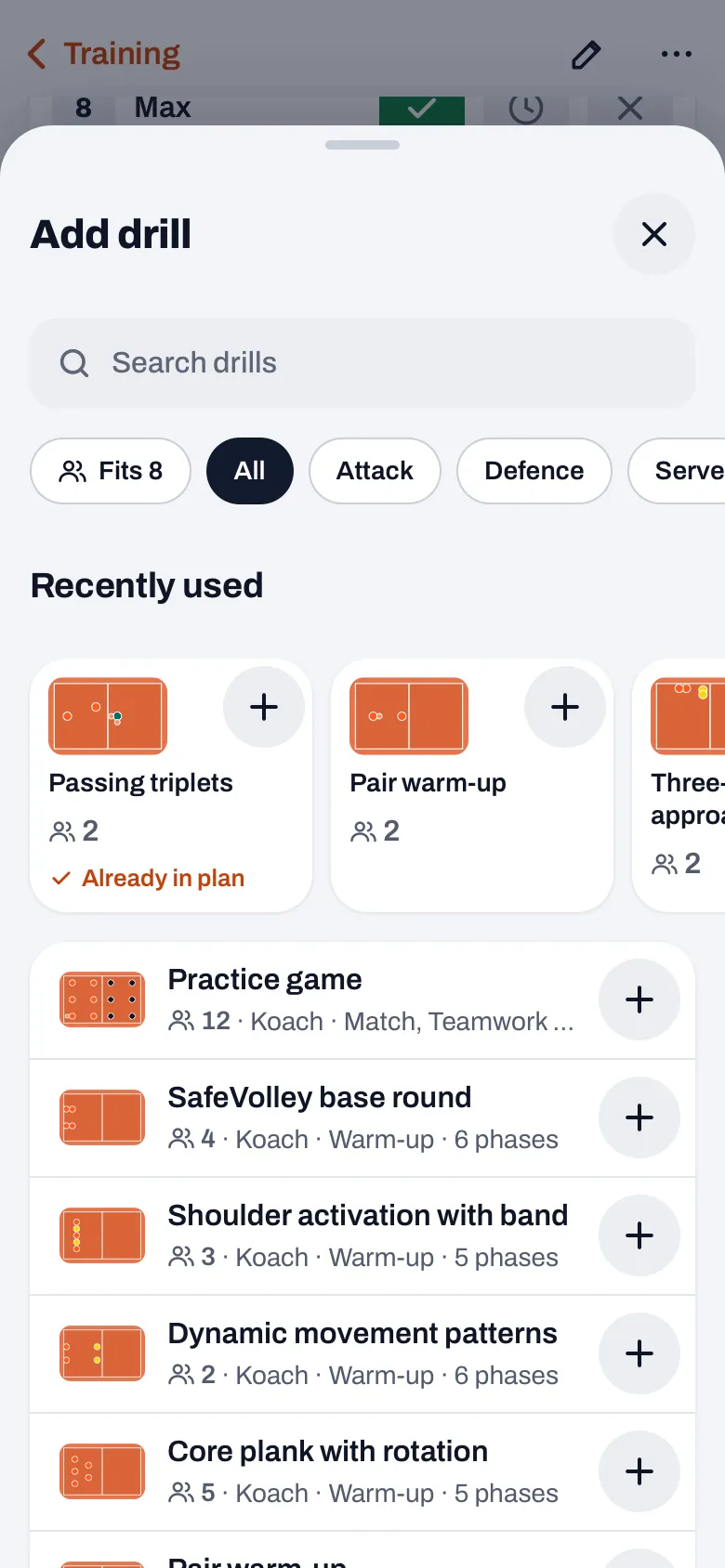
In Koach you set up the practice as a plan, with each part as a section with a name and minutes. In Add drill, the drills you used most recently are at the top, and with the Fits chip you only see drills for which enough kids are coming: if eight have signed up, the drills for more than eight players drop out. Every Koach drill has a court with phases that you play back, handy for showing a drill instead of explaining it. If the practice worked, bring it back next week with Copy plan.
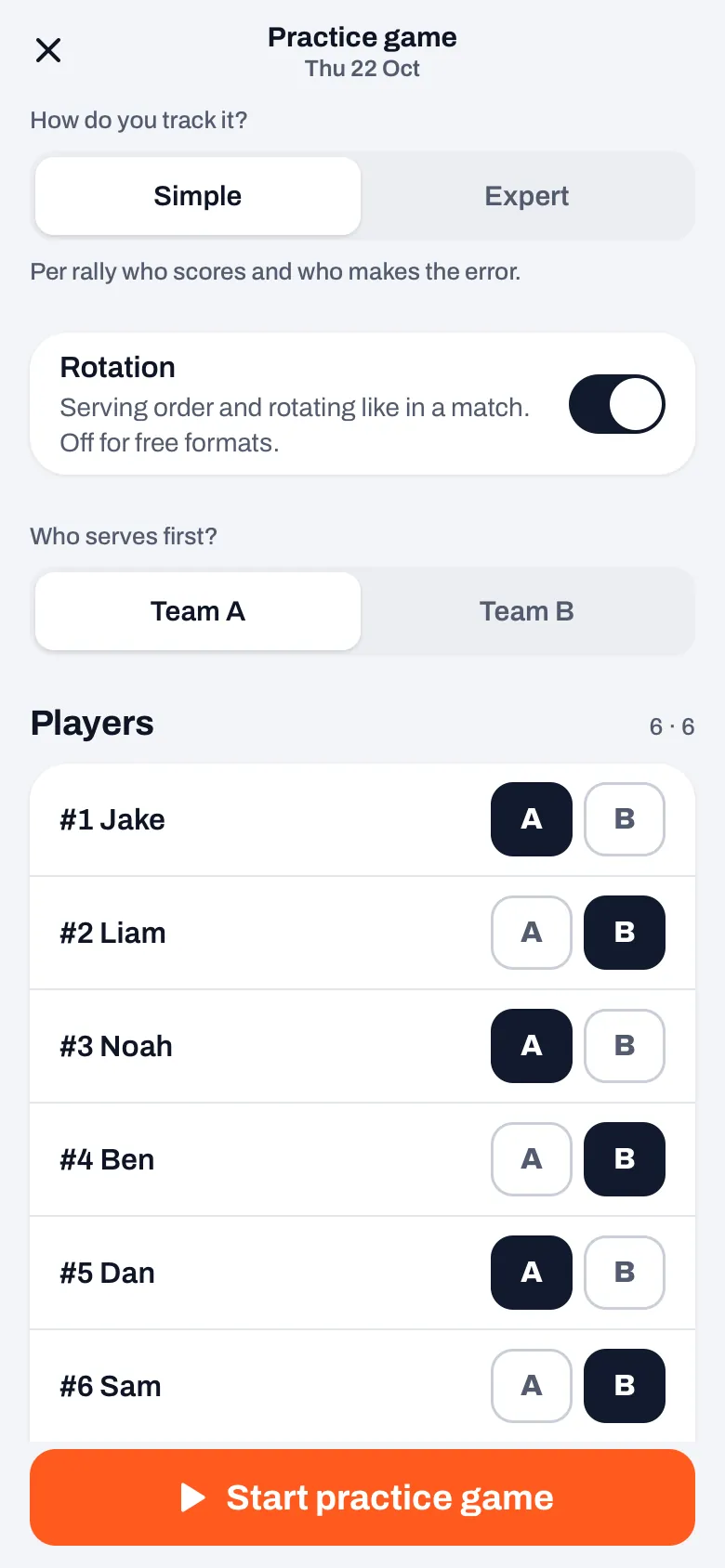
You can track the 4 against 4 scrimmage as a practice game: Team A against Team B, even with fewer than six players per team. You start it from the Practice game section in the plan. With the Rotation switch on, everyone serves in turn and the team rotates as in a match, so kids already know the rotation before they step onto the full court. Players and parents do not see the numbers, and they do not count as a match.
14 days free, no credit card. Set up your next youth practice as a plan and see after a few weeks which drills keep working.
Plan your youth practice in KoachParents sign their child in or out on their own dashboard, so you know before practice how many kids are coming. What Koach costs after the 14 free days is on the pricing page.
Frequently asked questions
How long should a volleyball practice for 10-year-olds be?
An hour to an hour and a half is common; the example in this article takes 75 minutes. More important than the length is how much time kids actually spend with the ball. Change the format after ten to fifteen minutes, keep explanations short and play in pairs and threes rather than in a long line behind one tosser.
Can a 10-year-old spike?
An approach and a hit on a tossed ball are already within reach for most ten-year-olds, and they often find it the most fun part of practice. A real spike over a net at match height comes later, when kids jump higher and time the ball better. So train the approach first without a net or with a lower net, on a ball that a coach or teammate tosses high.
Can an 11-year-old serve overhand?
Yes, once the underhand serve reliably gets over the net. Start a few meters closer to the net, so the technique is right before the distance grows. Whether the overhand serve is required, allowed or limited in your competition is in the rules of your own federation.
How do I know whether my group of 10- to 12-year-olds is improving?
Count instead of guessing. In a fixed drill, keep track of how many good contacts in a row a pair makes, and how often a three makes all three contacts. Repeat the same drill every few weeks and compare the best count. In the scrimmage, watch whether kids more often play the ball three times by themselves instead of hitting it straight back.
Is 10 too late to start volleyball?
No. Ten to twelve is a good age to start, because kids then read the ball well enough to play real rallies quickly. A child who already played other ball sports brings ball sense and movement along. Let a new child get plenty of ball contact in the first weeks, in a pair with a patient partner.

Set up your youth practice tonight
14 days free, no credit card. After a few weeks you know which drills keep working.
Get started with KoachOr read first what the volleyball coaching app does.