
Volleyball strength and conditioning coach: what the job involves
The short answer
A volleyball strength and conditioning coach makes sure players are strong, fast and resilient enough. They test, build strength and jump programs, monitor load across the week and guide the return after an injury together with the physiotherapist. If your team has none, the head coach takes over part of those tasks.
A volleyball strength and conditioning coach, also called a strength coach or conditioning coach, is the person on the staff responsible for the players' bodies. What exactly do they do, how do you work together without the sessions clashing, and when does your team or club need one?
What does a strength and conditioning coach do for a volleyball team?
The head coach is in charge of the volleyball: technique, tactics, the lineup and the match. The strength and conditioning coach makes sure the players can handle that volleyball physically for a whole season. Their tasks:
- Testing. At the start of the season and a few times after that, they measure jump, sprint and agility, so they know where each player stands. Which tests suit volleyball is covered in the volleyball fitness test.
- Strength and jump power. They write the strength program, teach the exercises and make sure technique holds up as the weights get heavier. What goes into such a program is in strength training for volleyball players.
- Monitoring load. Volleyball players jump a lot, and the load lies in the sum of practices, matches and strength work. They keep an eye on how much jumping there is and adjust it in busy weeks. What is known about the number of jumps is in how many times a volleyball player jumps.
- Warm-up and injury prevention. A fixed warm-up with exercises for ankles, knees and shoulders, which the team can also do without them.
- Return after an injury. Once the physiotherapist or doctor has given the green light, they build the player up from separate exercises to full participation in practice.
- Teaching players to train on their own. A program for the summer, for a player who can train less for a few weeks, or for at home.
Strength coach, physiotherapist and head coach: who does what?
These three roles overlap, and that is exactly where things go wrong if nobody agrees on anything. A division to start with:
| Who | In charge of | Decides on |
|---|---|---|
| Head coach | The volleyball and the plan for the whole week | Who plays, how hard the volleyball practice is, the lineup |
| Strength and conditioning coach | Strength, jump power, speed, conditioning and how they are built up | The physical program, within the agreements with the head coach |
| Physiotherapist or sports physician | Injuries: assessment, treatment and advice | Whether a player may train or play, and with which restrictions |
A strength and conditioning coach does not diagnose or treat injuries. If they are unsure whether a complaint is more than muscle soreness, they refer the player on: persistent or severe complaints belong with a family doctor, sports physician or physiotherapist. The other way round, the strength and conditioning coach translates what the physiotherapist advises into a progression in the gym and the weight room.
How does a strength and conditioning coach work with the head coach?
An expert group of the International Olympic Committee (IOC) wrote in 2016 that there is growing evidence that poorly managed load is a major risk factor for injury. By load it also means rapid changes in training and competition, a congested competition calendar, psychological load and travel. It gives guidelines for monitoring training, competition, psychological load, well-being and injuries (source: IOC consensus statement on load in sport and risk of injury, British Journal of Sports Medicine, 2016). The statement is about elite athletes, but the lesson applies to every staff: one plan for the week, not two.
- Plan the week together. No heavy jump or strength training on the day before a match. And count the volleyball practice too: a heavy strength session after an evening full of attacks and blocks is a different load from the same session after a technical practice.
- Agree on the minutes. How much of practice belongs to the strength and conditioning coach, and when: the warm-up, a block at the end, or a separate session.
- Share what you see. The strength and conditioning coach sees a player who is tired or lands differently; the head coach knows something is going on at home or at school. A short check-in after practice prevents one person from planning without knowing what the other knows.
- One voice to the team. A player who hears from one coach that they must rest and from the other that they must join in will choose for themselves. Agree who has the final say when in doubt; with an injury that is the physiotherapist or doctor.
Similar agreements about who owns what apply to an assistant coach; see the duties of an assistant coach.
When does your team or club need a strength and conditioning coach?
Far from every team has one, and that is fine. In these situations it does make a difference:
- Many training hours. A team that practices three or four times a week and does strength work on top needs someone who keeps track of the total.
- Talent and select teams. Young players who train a lot and are still growing benefit from guidance by someone who knows what suits a growing body; see strength training for young athletes.
- The same injuries again and again. If ankles, knees or shoulders come back every season, have someone look at the progression and the load.
- A club with several teams. One strength and conditioning coach can set up a warm-up and a basic program for the whole club and teach the coaches how to run it.
Without a strength and conditioning coach: what you do yourself as head coach
- A fixed warm-up with exercises for ankles, knees and shoulders, the same at every practice, so the team can do it on its own.
- A short strength block once or twice a week, with body weight and good technique.
- Dosing the jumps. Not every drill with an approach and a jump, and less jumping in a week with two matches.
- Getting help once. Ask a physiotherapist or strength coach to set up the program with you at the start of the season. After that you run it yourself.
- Knowing who is struggling. Keep track of which players are injured or coming back, and adjust their part of practice.
Make one weekly schedule for the whole staff. List volleyball practices, strength sessions and matches one below the other and mark the days with a lot of jumping. If two heavy days fall back to back, you see it before the team feels it.
What training does a strength and conditioning coach have?
There is no fixed route, and titles and requirements differ by country. Possible backgrounds are a degree in sport or exercise science or in physical education, a certification in strength and conditioning, or physiotherapy. Ask your federation whether it offers a course or continuing education for strength and conditioning coaches in volleyball. How the regular coaching courses are structured is covered in volleyball coaching certification.
When you choose someone, look for experience with jumping sports and with the age of your players, whether they can demonstrate and correct exercises well, and whether they know when to refer.
On match day, space on the bench is limited. According to the FIVB rules, a team's staff for a match may consist of one coach, a maximum of two assistant coaches, one team therapist and one medical doctor. Only those listed on the scoresheet may normally enter the competition area and take part in the official warm-up and the match (rule 4.1.1). A strength and conditioning coach who wants to sit on the bench therefore takes one of those places, for example that of assistant coach. Competitions run by your own federation may have different rules.
The strength and conditioning coach in Koach
In Koach you add a strength and conditioning coach to your team as a coach. Open your Profile, go to My teams and tap your team; under Coaches tap Add and share the invitation link. With the Coach plan two coaches work in one team, you and one colleague. If you also have an assistant, a third coach requires the Club plan. A coach on your team sees the roster, the practices, the player notes and the absence reasons.
They put their part of practice in the plan: with Add section a block of their own with a name and a duration, such as a fifteen-minute strength block, or with Add drill a drill from the library. That includes warm-up drills too, such as shoulder activation with a band. After practice each section shows whether it was done.
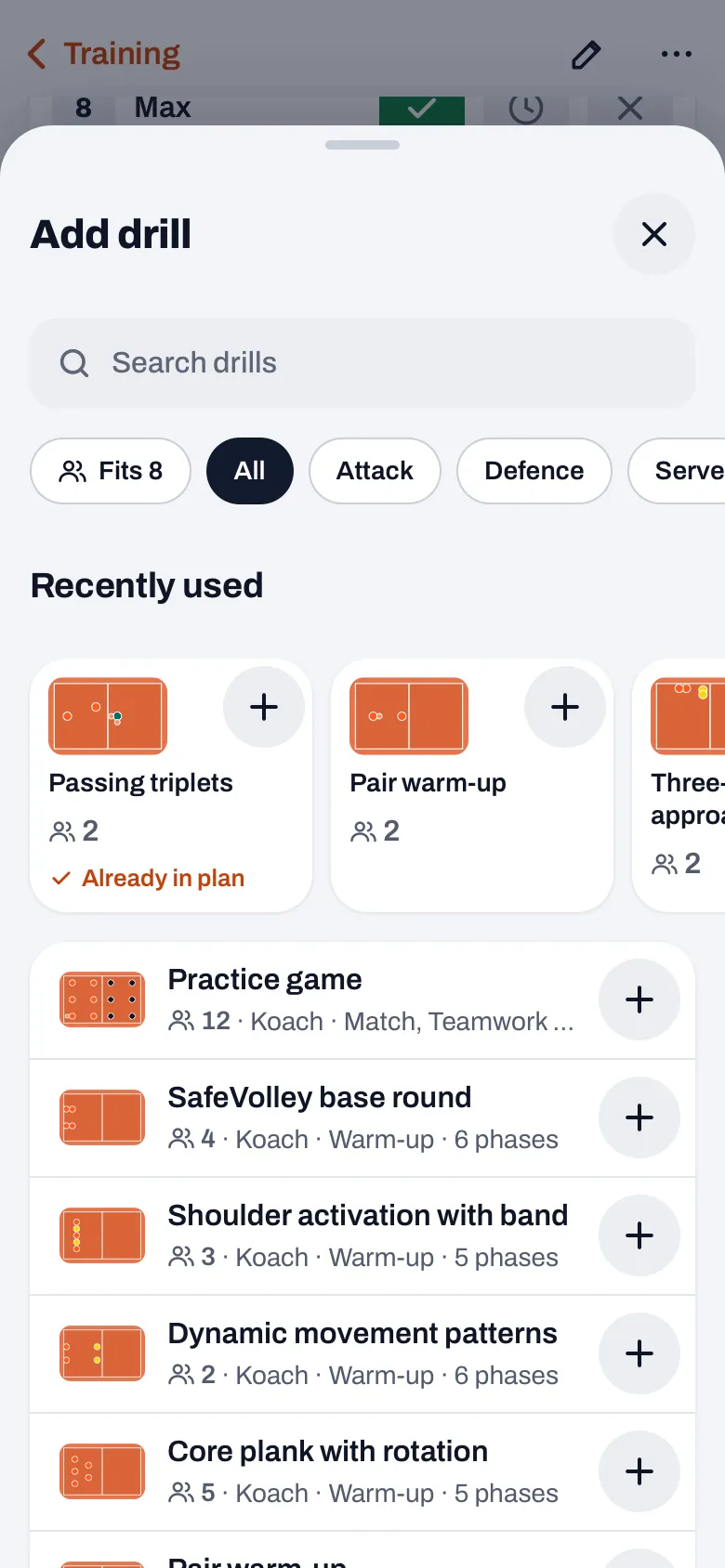
If a player is injured, open them in the Team tab, tap the pencil and set the Status to Injured. That then shows next to their name in the player list, and when you make a substitution during live scoring they appear grayed out on the bench. Players see Absent instead of Injured for a teammate, so injury information stays with the coaches. You record test results as a note on the player, as described for the fitness test. Koach has no separate module for strength programs or for measuring load. What Koach costs after the 14 free days is on the pricing page.
14 days free, no credit card. Put the warm-up and the strength block in the plan of your next practice, and invite your strength and conditioning coach.
Try Koach with your staffHow a strength and conditioning coach fits into the rest of the work around your team is covered in managing a volleyball team as a coach.
Frequently asked questions
What does a strength and conditioning coach do during a match?
They can lead the pre-match warm-up, watch for players who feel something during the match and take care of the cool-down and recovery afterward. The head coach decides on substitutions and the lineup. Who may sit on the bench is limited: according to the FIVB rules, the staff besides the players can consist of one coach, a maximum of two assistant coaches, one team therapist and one medical doctor. Competitions of your own federation may have different rules.
Does a youth team need a strength and conditioning coach?
Not necessarily. With young players it is mainly about moving a lot, learning to land well, a fixed warm-up and strength work with body weight, and a coach can offer that themselves. A strength and conditioning coach makes sense for talent teams that train a lot, for a player in a growth spurt who needs an adjusted progression after an assessment by a doctor or physiotherapist, or when the club wants a program set up for all youth teams and wants the coaches to learn how to run it.
Can a physiotherapist also run the physical training?
Sometimes. A physiotherapist knows the body and injuries, and some also have a lot of experience with strength and jump training for healthy athletes. Ask about that experience, because treating and training are different skills. In any case, agree when they treat and when they train, so players know who to go to with which question.
How often does a strength and conditioning coach work with the team?
That depends on the level and the number of practices. For a team that practices twice a week, a fixed warm-up plus a short block in every practice can be enough. A team with more practices may add a separate strength session. More important than the number is that the physical work and the volleyball practices are in one weekly schedule.


Put the physical work in your practice plan
14 days free, no credit card. Warm-up, strength block and volleyball in one plan for the whole staff.
Get started with KoachOr read first what the volleyball coaching app does.