
Volleyball fitness test: measuring jump, sprint and agility
The short answer
A volleyball fitness test measures what the sport asks for: how high you jump, how fast you accelerate over a few metres, how agile you are and how well you recover. A practical battery is a wall jump test, a 5 and 10 metre sprint, the T-test, a medicine ball throw and a 20 metre shuttle run.
A volleyball fitness test shows whether your preseason is paying off, but only if you measure what the sport asks for and do it the same way every time. Here is a test battery that fits into one practice, with how to run each test, a test card, where to find norms and when to test.
What should a volleyball fitness test measure?
A volleyball rally consists of short, explosive actions with breaks in between: jumping, accelerating over a few metres, braking and changing direction. A timed lap run says little about that. So measure the four things that count in the gym: jumping power, acceleration over short distances, agility and, as an extra, the ability to recover between efforts. How to train those qualities is in conditioning for volleyball players.
The battery below is not our own invention. An Australian study of junior players at three levels used the same components: standing reach, jump from standing and with an approach, an overhead medicine ball throw, a 5 and 10 metre sprint, the T-test and a shuttle run (Gabbett and Georgieff, 2007). Be honest about what a test tells you, though. In a follow-up study of talented junior players, the physical tests did not predict who was selected; the assessment of passing and serving technique did (Gabbett, Georgieff and Domrow, 2007). A fitness test measures the body, not the volleyball player.
The test battery: five tests in one practice
| Test | What it measures | What you need |
|---|---|---|
| Standing reach, block reach and attack reach | Jump from standing and with an approach | Wall, tape measure, chalk |
| 5 and 10 metre sprint | Acceleration | Tape, stopwatch or phone |
| T-test | Agility: forwards, sideways, backwards | Four cones, stopwatch |
| Medicine ball throw | Explosive overhead power | Medicine ball, tape measure |
| 20 metre shuttle run | Recovery and endurance | 20 metres of free space, the audio file |
1. Reach and wall jump
First measure standing reach, then block reach (jump from standing with two hands) and attack reach (jump with a full approach, one hand). Reach minus standing reach is the jump. Three attempts, the best one counts. The full protocol, and what the difference between the two jumps tells you about your player, is in jumping higher in volleyball.
2. Sprint over 5 and 10 metres
Standing start with the front foot behind the line, no run-up. Measure the time at 5 and at 10 metres. Three attempts with full rest in between, the best one counts. Hand timing is less accurate than timing gates; so always have the same person time it, or film from the side with a phone's slow-motion mode and count the frames afterwards.
3. The T-test
Set four cones in a T: A is the start, B is 9.14 metres (10 yards) straight ahead, C and D are 4.57 metres (5 yards) to the left and right of B. The player sprints from A to B and touches the cone, shuffles sideways to C, then to D, back to B, and backpedals to A. Sideways without crossing the feet, backwards without turning. Three attempts with at least two minutes' rest, the fastest one counts. On a volleyball court, C and D then sit just outside the sidelines.
Agility is more than straight-line speed. A study of a shorter version of the T-test found only a weak link with sprint and jump, and points to coordination as a factor of its own (Sassi et al., 2009). If a player is fast over 10 metres but slow in the T-test, his gains lie in footwork and braking, not in running faster.
4. Overhead medicine ball throw
The player throws a medicine ball with two hands overhead as far forward as possible, standing behind a line or sitting with his back against the wall. Measure where the ball first lands. Choose one ball weight and one position and stick to them the whole season, or you are comparing apples with oranges.
5. 20 metre shuttle run
The well-known beep test: back and forth over 20 metres at the pace of an audio signal. The pace starts at 8.5 kilometres per hour and goes up by half a kilometre per hour every minute, until the player can no longer keep up (Léger et al., 1988). Note the last level and shuttle. This is a maximal test: do it last in the evening or on a different day, and only with players who are healthy and free of complaints.
How to organise the testing session
The order goes from fresh to heavy: first the jumps and the sprint, then the T-test and the throw, and the shuttle run at the end. With twelve players and two helpers you end up at seventy minutes, plus the time to change stations:
- Warm-up (15 minutes), the same one every testing session.
- Three stations of 10 minutes in groups of four: the wall, the sprint lane and the T-test. Rotate after each station.
- Medicine ball throw (10 minutes), two players at a time.
- Shuttle run (15 minutes) with the whole group, with one helper per six players counting who reaches the line in time.
Keep the conditions the same: the same gym, the same shoes, the same moment in the week and no hard practice the day before. On the test card below, also note a remark for each player such as "has a cold" or "just back from an ankle injury". Without that remark, you will misread a poor result three months from now.
A difference only counts if it is bigger than the difference between attempts. Say a player's three jumps on one evening are 3 centimetres apart. Then 2 centimetres higher three months later is not yet progress. Only look at differences bigger than what he already varies within one evening.
The test card: what to note for each player
Use the same card for every testing moment, on paper or in a spreadsheet. At the top the name, the date, the gym, the shoes and a remark about illness or complaints; then these rows per test:
| Test | Note | Attempts |
|---|---|---|
| Standing reach | Centimetres | 1 |
| Block reach and attack reach | Centimetres, the best | 3 per jump |
| 5 and 10 metre sprint | Seconds, the best | 3 |
| T-test | Seconds, the fastest | 3 |
| Medicine ball throw | Metres, the furthest, with ball weight | 3 |
| 20 metre shuttle run | Last level and shuttle | 1 |
Norms: what do you compare the result with?
A table from the internet says little, because age, sex, level and the exact protocol strongly shape the result. Compare in this order:
- With the player himself. Your first yardstick is his previous measurement, with the same protocol. That is where you see whether your training works.
- With published reference values, if the group is comparable. Gabbett and Georgieff (2007) give values per level and per sex for junior players at national, state and novice level. Results were generally better the higher the level, and boys scored higher than girls on speed, agility, jumping power and estimated aerobic capacity. For adult recreational players those numbers are no yardstick.
- With your own club norms. If you test the same way every season, after two seasons you have your own reference per age group. That is worth more than any table, because it was made with your gym, your protocol and your players.
One result from the same Australian research group is useful to know: after eight weeks of training with mainly technique and game-based drills, talented junior players got faster over 5 and 10 metres and more agile, but jumping power, throwing power and aerobic capacity did not change (Gabbett et al., 2006). If you want the jump to improve, you have to train it specifically.
When do you test? The moments in the season
| Moment | Why | Which tests |
|---|---|---|
| After the build-up of the preseason | Starting point for the season | All five |
| Midseason | Is maintenance holding up? | Wall, sprint, T-test |
| End of the season | What the year delivered | All five |
Do not test in the first week after the summer break: then you are measuring the holiday, not your player. Wait until after the first build-up weeks, as described in the preseason after the summer break. Skip a testing moment in a week with two matches. If you have just started as a coach, begin with the wall and the sprint and add the rest the following season; what else lands on your plate in your first season is in starting as a volleyball coach.
With young players who are growing, a jump result can stall for a while even as their reach goes up. That is no reason to train harder. And a player coming back from an injury only joins the test once his doctor or physiotherapist has cleared him. If someone gets chest pain or feels dizzy during a test, or complaints persist after the test, stop and have it assessed by a doctor, sports physician or physiotherapist.
Recording test results in Koach
Koach has no separate testing module and does not chart test results. What does work: put the testing session in the schedule as a practice and, in the plan, use + Add section to make a "Test battery" block with the stations in the description. After the test, add a note per player with his results under Player notes for that practice. That note belongs to the player and to the practice, and appears with the date in his profile under Notes. At the next testing moment you bring the plan back with Copy plan, and the previous and new results sit one below the other in his profile.
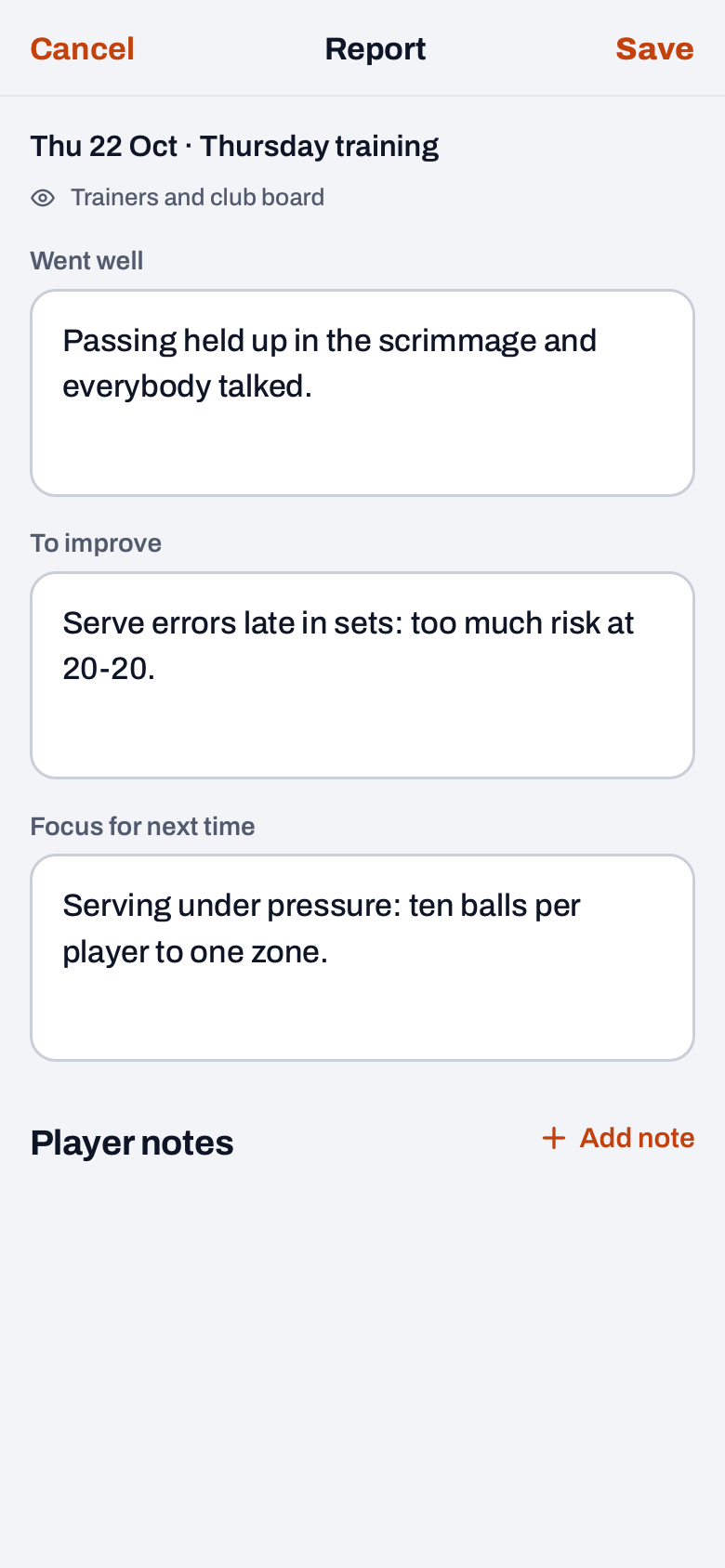
Players and parents do not see player notes; they are for the coaches, and at a club also for the club management through the team log. What Koach costs after the 14 free days is on the pricing page.
14 days free, no credit card. Put your testing session in your plan and record the results per player, so you can find them again in January.
Plan your testing session in KoachFrequently asked questions
Which fitness test suits volleyball best?
A test that measures short, explosive efforts. The wall jump (from standing and with an approach), a 5 and 10 metre sprint and the T-test for agility form the core. A medicine ball throw and the 20 metre shuttle run are an extra. A timed distance run says little about what a volleyball player does in a rally.
How often should you test a volleyball team?
Two or three times a season is enough: after the build-up of the preseason, midseason and at the end. Testing more often mostly produces noise, because form on the day, fatigue and the floor make the difference. Keep the same protocol, the same order and the same moment in the week every time.
What is a good beep test score for volleyball players?
That depends on age, sex and level, so there is no single number. For junior players, Gabbett and Georgieff (2007) give reference values per level and per sex. For most club teams, the same player's previous result is the most useful norm. Also bear in mind that endurance weighs less in volleyball than jump and speed.
Can youth players do a fitness test too?
Yes, the wall, the sprint and the T-test work well, as a game against yourself. Compare a young player with his own previous result, not with teammates: someone who is growing can stall for a while or even drop back. Only let healthy players do the shuttle run, and leave out heavy strength tests with weights.


Record your test results per player
14 days free, no credit card. In January you see what September delivered.
Get started with KoachOr read first what the volleyball coaching app does.