
Volleyball terms A to Z: what are they shouting out there?
You are standing courtside for the first time and people are shouting all sorts of things: "mine!", "short!", "pipe!", "that's out!". Nobody explains it, because everyone standing there already knows. And if you ask afterwards, the answer contains three new words. This is the list that brings you up to speed in a few minutes — in the stands, in the hall or behind the scorer's table.
Why this list isn't alphabetical
A glossary starting at A begins with "ace" and ends at "zone". Handy if you already know the word and only want the meaning. Courtside you have exactly the opposite problem: you hear something, you don't even know how it is spelled, and three seconds later the rally is over. So everything below is in the order of the rally — first the calls that fly around during play, then the terms per moment: serve, reception, set, attack, block, defence and finally the admin at the scorer's table. If you are after one specific word anyway, Ctrl+F (or cmd+F on a Mac) beats any alphabet.
Each term gets one or two sentences, and a link wherever a fuller explanation exists. That is deliberate: this is a starting point, not a textbook. Meant for anyone just beginning — a parent in the stands, a new player in a team that has played together for three years, or the volunteer filling in the scoresheet for the first time.
What they shout during the rally
This is the group nobody writes down and the one you hear most. Almost all the calls are short — one syllable — and they always come before the contact. A call that lands at the same time as the ball is too late and no longer serves any purpose.
- "Mine!" — I'm taking this ball. You call it when two players move to the same ball. Whoever calls first and loudest plays it; the other steps out.
- "Yours!" or "Leave it!" — you're better placed, I'm staying off it. Just as important as "mine", and far rarer.
- "Out!" — let it drop, it's going out. Called by the player with the best view of the ball's flight, usually someone behind or beside its path.
- "In!" — it's landing inside the lines, so play it. The mirror image of "out" and every bit as useful: hesitation costs a point.
- "Short!" — the ball is dropping shorter than you think, move forward. You hear it mostly on the serve and after a block touch.
- "Deep!" or "Back!" — it's going over your head. On the serve this is the call with which the back passer saves the front one.
- "One!" / "Two!" / "No block!" — the number of blockers up. That tells the back-court defence how much court has to be covered.
- "Free!" — the opponent can't attack, an easy ball is coming back. The signal to move forward and build an attack of your own.
- "Tip!" or "Roll!" — the hitter isn't swinging but placing it softly just behind the block. Usually called by the blocker, who is closest to the hitter's hand.
- "Touch!" — the block got a hand on it. That means two things at once: the ball arrives slower, and the team still has three contacts.
- "Net!" or "Off the net!" — the ball has been played into the net and is dropping out of it; somebody has to dig it low.
- "Time!" — a time-out is being requested. The ball is dead immediately.
From the sideline it sounds different. "Base!" means: get back to your starting position before the serve comes. "Sub!" is called to the second referee, not to the players. And the most common sound beside a volleyball court isn't really a word at all — a "yes!", a "come on!", a clap. That one needs no explanation.
Key point: every call during a rally has only two functions — who is playing the ball, and where the ball is going. Hear something you don't know? Sort it into one of those two boxes first. Very little genuine jargon is left after that.
The serve and the reception: from toss to seam
Serve — the ball that starts every rally, struck from behind the end line. Toss — the throw with which the server puts the ball in the air; the calmer that toss, the more stable the serve. More on that in the toss on the serve.
Float — a serve without rotation that wobbles unpredictably, like a knuckleball. See the float serve. Jump serve — the server takes an approach and strikes the ball in the air; harder, but with more risk. Ace — a serve that scores a point outright; how to count one is in serve statistics and aces.
Zones 1 to 6 — the six areas the court is divided into, used to say where someone should serve. "Serve six" therefore means: straight to the back, down the middle. The numbers are explained in the position numbers.
Reception (also serve receive) — taking the serve. Pass — the first contact, usually with two straight arms; the technique is forearm passing. Platform — the flat underside of your forearms that you pass with; "angle your platform" means: turn your arms towards the target.
Seam — the imaginary line between two passers, where the ball drops exactly in between and nobody takes it. A favourite target for servers: serving the seam. Stacking — arranging the passers so the setter runs free and doesn't have to pass. Shank — a pass that flies away completely, often into the stands; not an official term, but one everybody understands.
The set: tempo, shoot and slide
Set — the second contact, which puts the ball up for the hitter. The player who does that is the setter.
First tempo (a quick or a one) — a fast, low ball where the middle is already in the air before the setter touches it. Second and third tempo are the slower, higher versions. The full breakdown is in attack tempo and first tempo.
Shoot — a fast, flat ball driven a long way to the outside of the net. Slide — the middle runs behind the setter and takes off from one foot, like a lay-up in basketball. Back set — the setter plays the ball backwards over her head to the hitter behind her.
Dump or setter dump — the setter puts the second ball over the net herself instead of setting it; see the setter dump. Out of system — the pass was so poor that the setter can't get to it and the team improvises; what to do then is in playing out of system.
The attack: kill, pipe and tool
Spike or attack — hitting the ball down hard out of a jump. Kill — an attack that scores a point outright. How many of your attacks are kills (minus the errors) is your hitting percentage.
Line and cross — the two main directions of an attack: down the sideline or diagonally across the court. Choosing between them is a craft of its own, see hitting line or cross. Pipe — an attack from the back court through the middle; the explanation is in the pipe.
Tool (also block-out or wipe) — deliberately hitting off the blockers' hands so the ball goes out: hitting the block out. Tip and roll shot — soft options where the hitter places instead of swings; see tips and roll shots.
Free ball and down ball — two kinds of easy ball the team gets back. The difference, and why it matters, is in free ball and down ball.
Block and defence: touch, joust and dig
Block — the jump at the net with which you try to stop the attack. Read and commit are the two ways of doing it: look first and then jump, or decide in advance. The difference is in read or commit blocking.
Touch — a block touch. It doesn't count as a contact, so the team may still play three more. Joust — two players pushing against the ball above the net at the same time; what is allowed then is in the joust.
Cover — the players crouching just behind their own hitter to pick up the ball coming back off the block; see covering the hitter. Off-blocker — the hitter on the side the ball isn't going, who peels off the net to defend: the off-blocker.
Dig — keeping an opponent's attack off the floor. Plenty of coaches simply say "defend"; the statistics keep the two apart. Pancake — the flat hand slid onto the floor so the ball bounces off it after all: the pancake. Rally — everything between the serve and the point; a long rally is the reason people come to watch volleyball.
Pepper — warming up in pairs, alternating pass, set and hit. You mostly hear it before the match: pepper.
At the scorer's table: the terms on the sheet
Rally point — every rally produces a point, regardless of who served. Side-out — winning the rally while the opponent served, which gets you the serve back. It is immediately the most important number in the game: the side-out percentage. Rotation — after every side-out the whole team turns one position clockwise; the order is in the rotation order.
Overlap fault (a positional fault) — at the moment of the serve someone isn't standing where they should be: overlap faults. Double contact and four hits — two classic technical faults, explained in double contact and technical faults. Net fault — a player touches the net while playing the ball.
Libero — the player in the different shirt who only plays in the back court and swaps in separately. What is and isn't allowed differs on some points by federation and by age group; the overview is in the libero rules. The number of substitutions permitted per set and the use of yellow and red cards isn't identical everywhere either — check that in your own federation's competition regulations and don't copy anything from a video from another country.
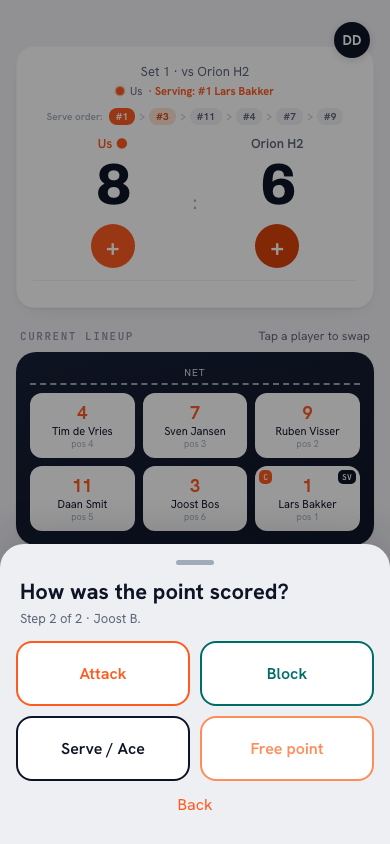
Behind the scorer's table you meet those same words as soon as you track more than just the score: every point is an attack, a block, an ace or an opponent's error — exactly the breakdown above. If you want to know how the sheet works, filling in the scoresheet helps; the rules themselves sit compactly together in the rules overview and the scoring system in keeping score.
Jargon or plain words? In the hall they run side by side
Volleyball is a sport with an American and an Italian history, and you can hear it. Some concepts have a perfectly ordinary word that people genuinely use (block, pass, attack, hit), while for others nobody ever bothered and the specialist term stuck (pipe, slide, joust, pancake). There is no rule; it depends on the club, the coach and the generation. A coach who came through a youth academy uses the jargon far more than a parent who started with a recreational team three years ago.
Four pairs you can hear both halves of in the same hall: set and put it up, dig and defend, kill and attack point, cover and block coverage. They mean the same thing. Names also travel badly across borders: the same player is an outside hitter in one country, a wing spiker in the official documents and something else again in a third language. If you play or coach in an international team, it helps to know that the positions have their own names in German, Spanish and Italian — that is what using Koach in another language is about.
The five terms most often misunderstood
- A side-out isn't an attack. It is the outcome of a rally in which the opponent served. You can win it with a spike, but just as easily with a service error from the other side.
- An ace isn't necessarily untouched. In most counting methods a serve that is touched but still scores outright counts as an ace as well. Agree which definition you use before you start counting.
- A block touch isn't a contact. After a touch the team still has three contacts. This is the rule most often shouted about incorrectly from the stands.
- The libero isn't the weak player. The different shirt doesn't mean "that one isn't allowed to join in", it means "this is the defensive specialist".
- "Out!" is an instruction, not an opinion. Whoever calls it takes responsibility for the decision. Call it hesitantly and the passer plays it anyway — and that is exactly how points get given away.
If you are still stuck on a word after this, just ask the coach afterwards. There isn't a single volleyball term that can't be explained in two sentences — and most coaches far prefer you asking to you nodding along for four months. If you want to understand what the players on court are actually doing, read on in volleyball positions explained; if your interest runs more towards the skills themselves, learning volleyball technique is the logical next step.
Frequently asked questions
What does side-out mean in volleyball?
A side-out is winning a rally in which the opponent served, which hands you the serve. At club level it is immediately the most important number in a match: a team that wins its side-outs consistently keeps the opponent off a scoring run.
Why do they shout out before the ball has landed?
Because the call is an instruction to the player already moving to the ball: leave it, stay off it. That is clearer than a verdict about where the ball lands. The shout aimed at the referee comes afterwards, once the ball is down.
What is the difference between a dig and a pass?
Both are a first contact, but a pass is taking the serve and a dig is keeping an attack off the floor. In everyday coaching language 'defend' often covers both; the statistics keep them apart.
Do I need to know these terms as a parent?
No, but it makes a huge difference to how much you enjoy watching. With the twelve calls from the first list and the terms ace, side-out and rotation you can follow a match almost completely. The rest you pick up on your own.
Are these terms the same everywhere?
The international terms (ace, side-out, pipe, libero) are the same worldwide, but the calls people use and the exact counting method differ by club and by federation. Rules around substitutions, the libero and cards can vary by federation and age group, so always check them in your own competition regulations.