
“Driving twice to the far end of the country is not two turns”
On kilometres instead of turns, a balance that decides the order, and an app that refuses to share anything out while the distances are missing.
Quarter past seven on a Saturday morning. The group chat is asking the question it asks every single week: who is driving? For a junior team with no licences, the away game driving rota is not a detail, it is the condition for turning up at all. And the list going round is almost never fair, because one trip is not the same as another.
Dennis Boekhout coaches a junior side and built Koach. A conversation about kilometres as currency, an app that sometimes refuses to assign anything, and why every automatic step needs a manual way out.
Why does an away match start on Friday night for you?
“Because that is when somebody has to decide who drives. My players are sixteen, seventeen — they are not getting themselves to a hall forty kilometres away. So a message goes round the group chat: who can do Saturday? And then you wait. Two parents answer straight away, the rest read it on Sunday. That is not unwillingness, that is simply how a group chat works.
“The annoying part is that it starts from scratch every weekend. There is no memory in it. Whoever went three times last month knows that perfectly well, but nobody else does.”
What about the tally of turns most teams keep?
“We had one of those too. A little column of marks: three for one, two for another. It looks fair until you check where they actually drove. Somebody who twice drives to the far end of the country has not simply had two turns — they have given up half a Saturday. And the parent who twice popped twelve kilometres down the road has exactly the same number of marks.
“At that point your list is not fair, it only looks fair. That is worse, because there is nothing left to discuss: the marks add up, after all.”
So you count kilometres rather than turns.
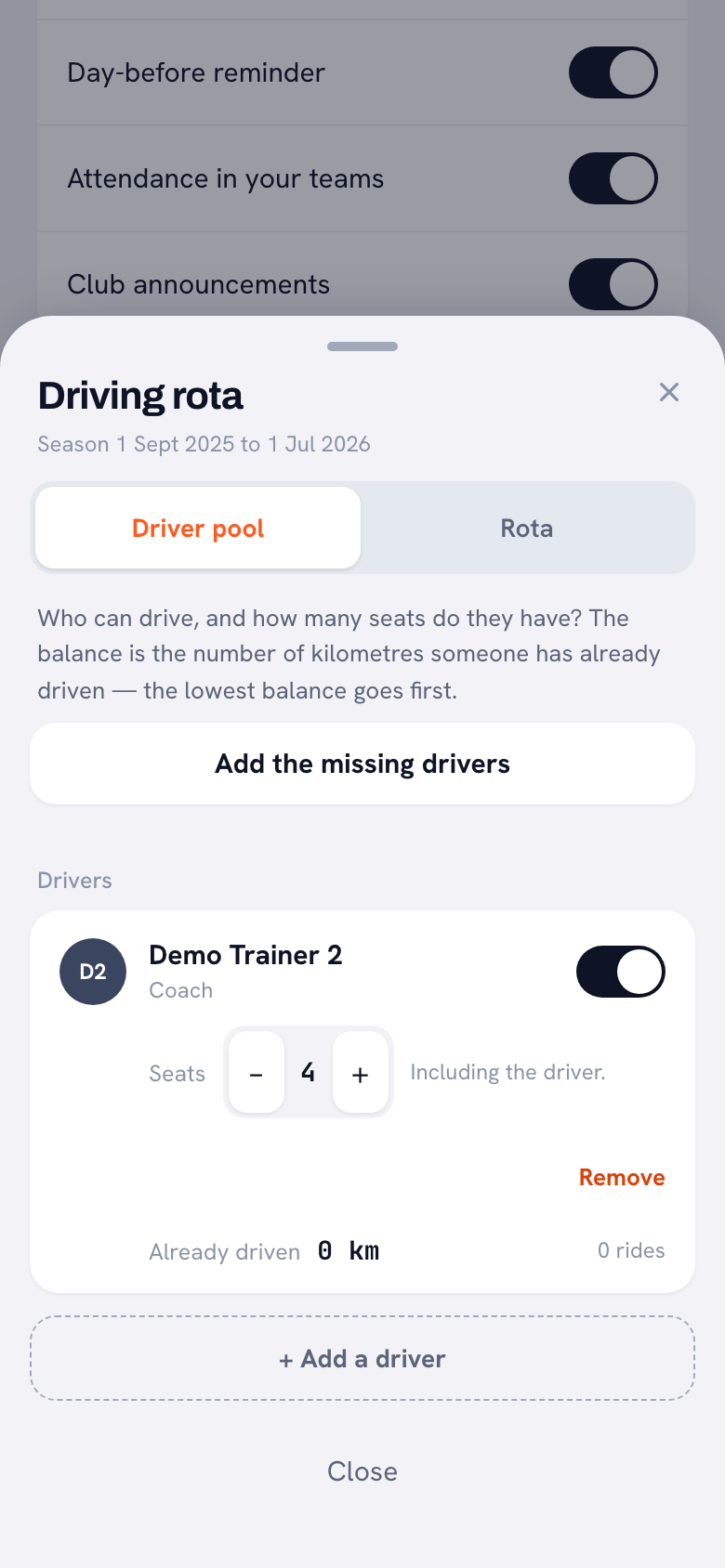
“Exactly. A driver’s balance is the number of kilometres they have already driven, and in the overview the lowest balance sits at the top. That person is next. That is the whole rule — no points, no weighting, no formula you have to explain to anyone.
“The driver pool shows it per person: this many seats in the car, this many kilometres already driven, this many rides. Anyone can work out for themselves why they are top of the list, which ends the argument before it starts.”
Do you enter the distance there and back?
“No, one way. That is what you look up and what stays true: that hall is eighteen kilometres away. The rota doubles it up itself, because you drive home again as well, and each ride says so.
“After that the kilometres are fixed. If an opponent moves to a different hall and you update the distance, nothing changes about rides that have already happened. Otherwise you would be shifting somebody’s balance retroactively, and then it is a sum again instead of an agreement.”
Where does the app get those kilometres from?
“First it wants to know where you set off from. That is the team’s own home venue; a postcode is enough. Without a starting point there is nothing to look up — from nowhere to somewhere is not a distance.
“After that you tap Look up distance per hall, or have it look up all of them in one go. If it finds several places with that name it puts them in front of you and you pick the right one. I wanted that on purpose: better a question than a hall in the wrong county.”
And when the lookup fails?
“Then that same message tells you that you can simply enter it yourself. Literally: entering the kilometres by hand still works. That has become a fixed rule for us — every automatic step has a manual way out, and that way out sits in the same message as the failure.
“Otherwise a coach is stuck on a Friday night because a mapping service is having an off day. He knows perfectly well that it is eighteen kilometres. He just needs somewhere to put it.”
Yet the app sometimes flatly refuses to assign anything. Why?
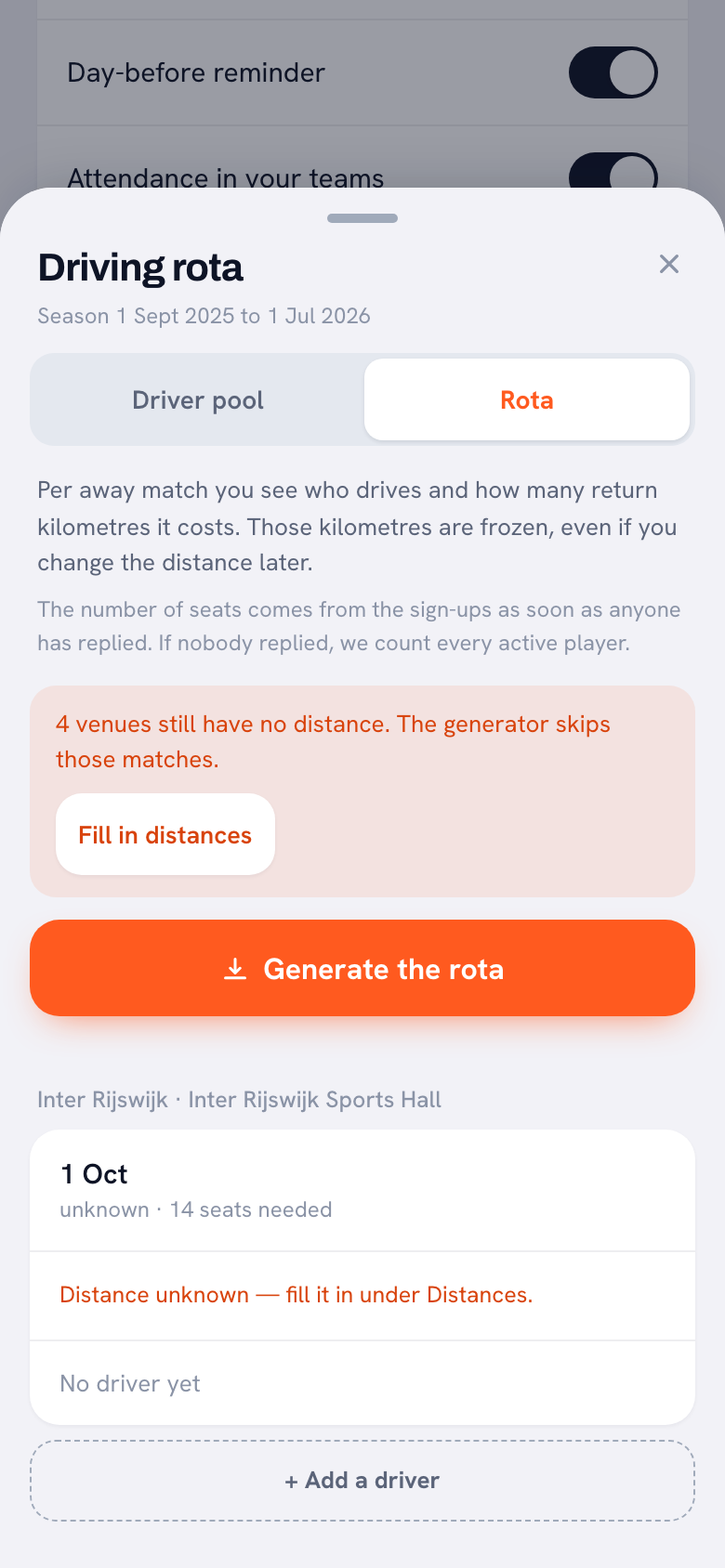
“Because without kilometres there is nothing to share out fairly. If not a single away match has a distance, it assigns nothing and says exactly that: fill in the distances first. With a button next to it that takes you straight there.
“If there are kilometres but not everywhere, it assigns the rest and skips those matches, naming them. Above the rota it says so beforehand as well: this many venues still have no distance, the generator skips those. That is the fairest kind of no I could come up with.”
How many seats do you actually need for a trip?
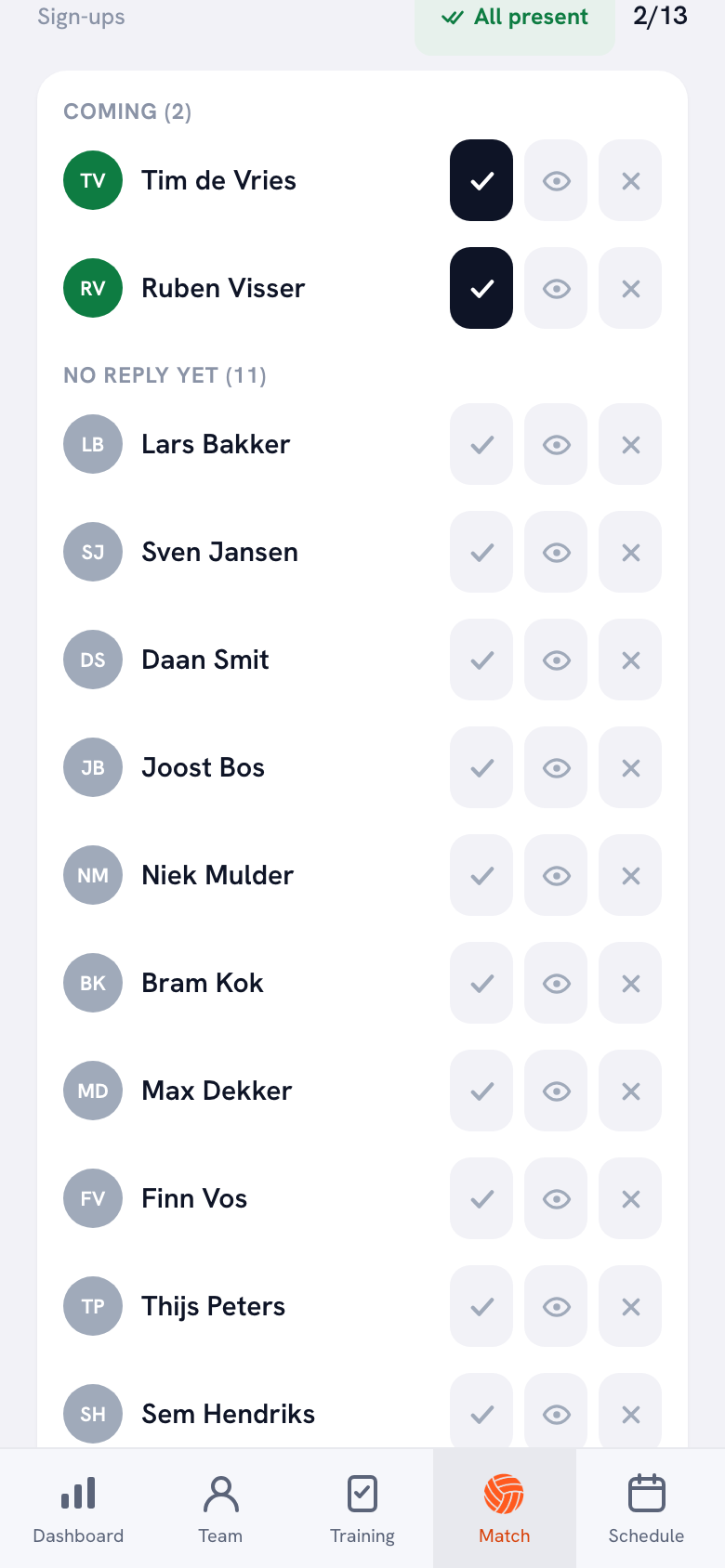
“That comes from the sign-ups. As soon as somebody has replied, the rota counts the players who are going. If nobody has replied yet it assumes every active player — better to hold one seat too many than one too few. And if everyone withdraws it tells you no transport is needed, rather than stubbornly assigning a car.
“The number of seats you enter per car includes the driver. If a parent or a coach drives, their own seat comes off: they carry four players in a car for five. If a player drives, their seat does count, because they need to get to that hall too. And coaches travelling along need a seat as well.”
Who goes into that driver pool?
“You can have it propose one: every player aged eighteen or over with their own account, plus all linked parents. Then you adjust it yourself, because the app has no idea who just sold their car.
“Every driver hangs off a player in the team; for a parent we use their child as the link. If you remove somebody entirely, the app warns you that their rides stay but no longer count towards any balance. If you want to keep that balance, set them to inactive instead.”
And if you disagree with the assignment?
“Then you change it. Every ride has a Change driver button, and in that list the drivers are sorted by balance again, with whoever is up next at the top. So even when you pick by hand, you still see whose turn it really was.
“You can delete a ride too; the kilometres then come off the balance. The rota is a proposal with a memory, not a law. The one limit is that only the coach can change it — players and parents just see their own next ride.”
What does the driving rota not do?
“Tournaments. A tournament day is a single trip for the whole day and has no home or away per match, so it leaves them out — and says how many tournaments there are this season while it does. You arrange that transport separately.
“And it is not a route planner. It does not decide which player gets into which parent’s car and it works out no pick-up route; parents sort that in two messages, faster than I could ever program it. What the app does is answer the question nobody wants to ask: whose turn is it?”
Share the driving out by kilometre
Put your own home venue into Koach, fill in the distances to your opponents’ halls and let the driving rota assign itself. Free to try, with your own team and your own season.
Try Koach for free