
“Two sessions, a match and a team chat that never goes quiet”
Volleyball coach Dennis Boekhout adds up what a week with a youth team actually costs him, what he hands over to others and what he deliberately stopped doing.
Coaching volleyball with a full-time job looks manageable on paper: two evenings in the hall and a match at the weekend. In practice the evening starts half an hour early, ends a quarter of an hour late, and a team chat runs through the whole week with questions about lifts, absences and kick-off times. Almost every amateur coach does this around a job.
Dennis Boekhout coaches a youth team and built Koach. In this interview he adds up his own week: where the hours go, what is finished within two minutes, and why he refuses to promise that an app gives you time back.
Let’s start at the beginning. How much time does this team cost you in an ordinary week?
“On paper, nothing. Two evenings in the hall, half past seven, an hour and a half. Plus a match at the weekend. When someone at a birthday party asks what coaching costs, that is what I say, and everyone nods: that sounds doable.
“Except it is not true. I get there half an hour early because another group is still on court and I want the nets up. Afterwards I always end up standing around, because there is always someone who wants to tell you something. Add the drive, and a session of ninety minutes is an evening of three hours. Twice three, plus a match day that quietly eats half your Saturday.”
And there is more on top of that?
“The preparation. I don’t want to be working out the session in the car at quarter past seven, so somewhere during the week I spend half an hour thinking about what we are actually working on. Before a match I look at the lineup and at who is in form. That is the enjoyable part, but it is still time.
“Add it all up and an ordinary week comes to about ten hours. That is not a complaint, I volunteered and I love doing it. But it is the number nobody mentions when they ask whether you ‘still do something with volleyball’.”
How much of that was pure admin before you started building?
“Of the hours outside the hall, roughly half. And that is the bitter part, because that half never made a single player better. Attendance lived in a spreadsheet, the lifts in a note on my phone, my observations in a notepad, and the rest happened in the team chat.
“The worst bit was reading back. Someone drops out on Tuesday somewhere in a thread of forty messages, and on Saturday I’m scrolling to work out who actually turned up. That is not coaching. That is record-keeping about things that have already happened.”
And then you started building yourself. That costs time too.
“It does, and I’m not going to pretend it was a clever investment of my hours. [laughs] But I did start with an honest list: what do I do every week, and which of those actions makes a player better? Everything that answered ‘no’ to the second question had to get shorter, disappear, or move to someone else.”
What is finished within two minutes now?
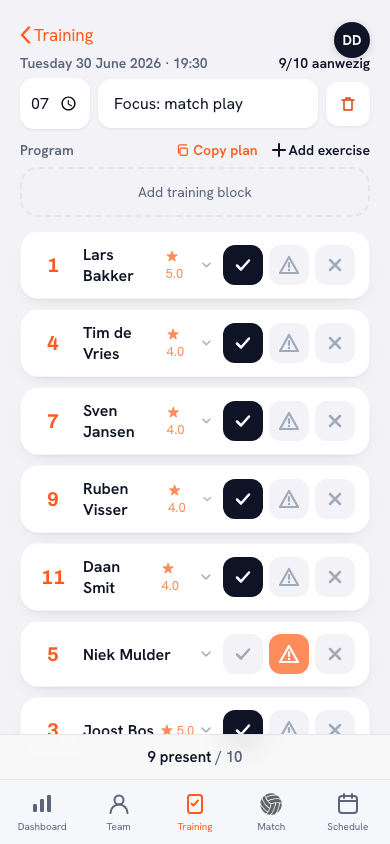
“Attendance. I go down the list before I have left the hall: one tap per player for present, absent with notice, or absent. The count sits at the bottom of the screen, and it feeds straight into their attendance for the season. Two minutes, in the hall, done.
“I used to do that at home on a Sunday, from memory. Then it wasn’t two minutes but twenty, and it was only half right anyway. That is the real difference: not that it is faster, but that it is already finished before I get into the car.”
You open the app during the week as well. Where do you start?
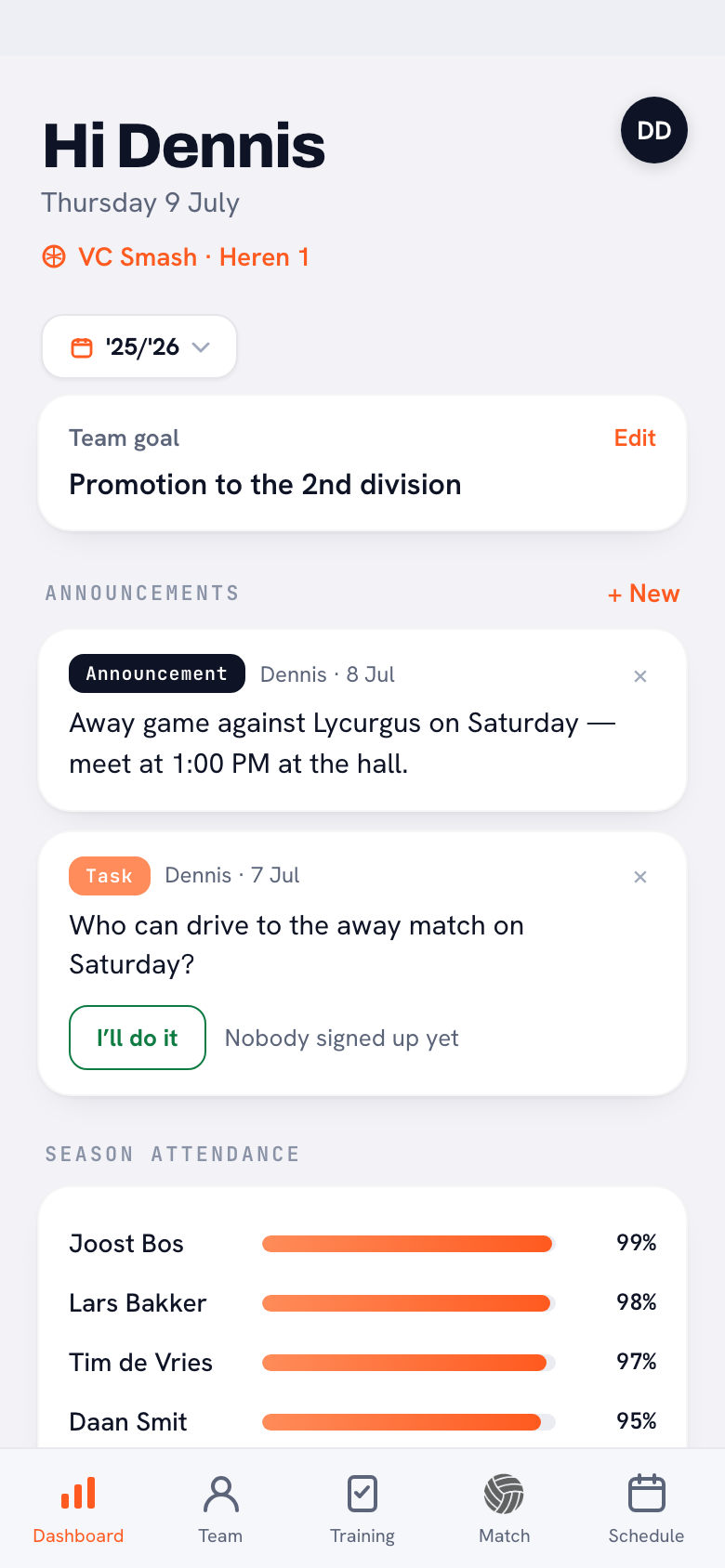
“On the home screen. It shows the team goal, the announcements I sent, the tasks nobody has picked up yet and the season attendance per player. I don’t have to go hunting through four screens to see what is still open.
“And that screen is a mirror, of course. A match with no result and a session with no attendance means I’m behind. Not pleasant, but more honest than an empty screen pretending everything is done.”
You say you hand things over. Such as?
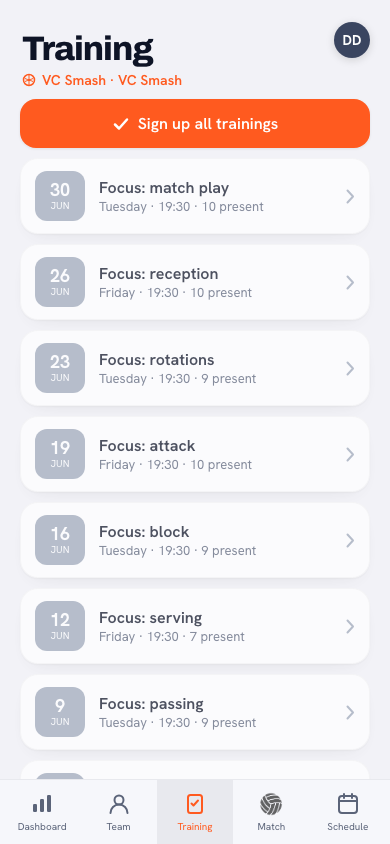
“Sign-ups, to start with. Players sign themselves up for sessions and matches, and anyone who wants to can sign up for every session in one go. I don’t count any more, I just look. Whoever drops out can add a message, and it sits with that session instead of halfway down a group chat.
“It doesn’t save me hours a week, but it saves me the remembering. I no longer have to carry around in my head who pulled out on Tuesday and why.”
What about the scoring and the driving?
“I hand the scoring over whenever someone wants to do it. You authorise a member with a linked account, and they keep the score and the stats on their own phone. That leaves me coaching instead of tapping, and afterwards the match is simply there in the app.
“The driving runs through a driver pool: who can drive and how many seats they have, and the app turns that into a rota. If that doesn’t work out, I post it as a task on the home screen and someone can tap ‘I’ll do it’. Asking three times in the team chat who is driving — I’m done with that.”
And what have you deliberately stopped doing?
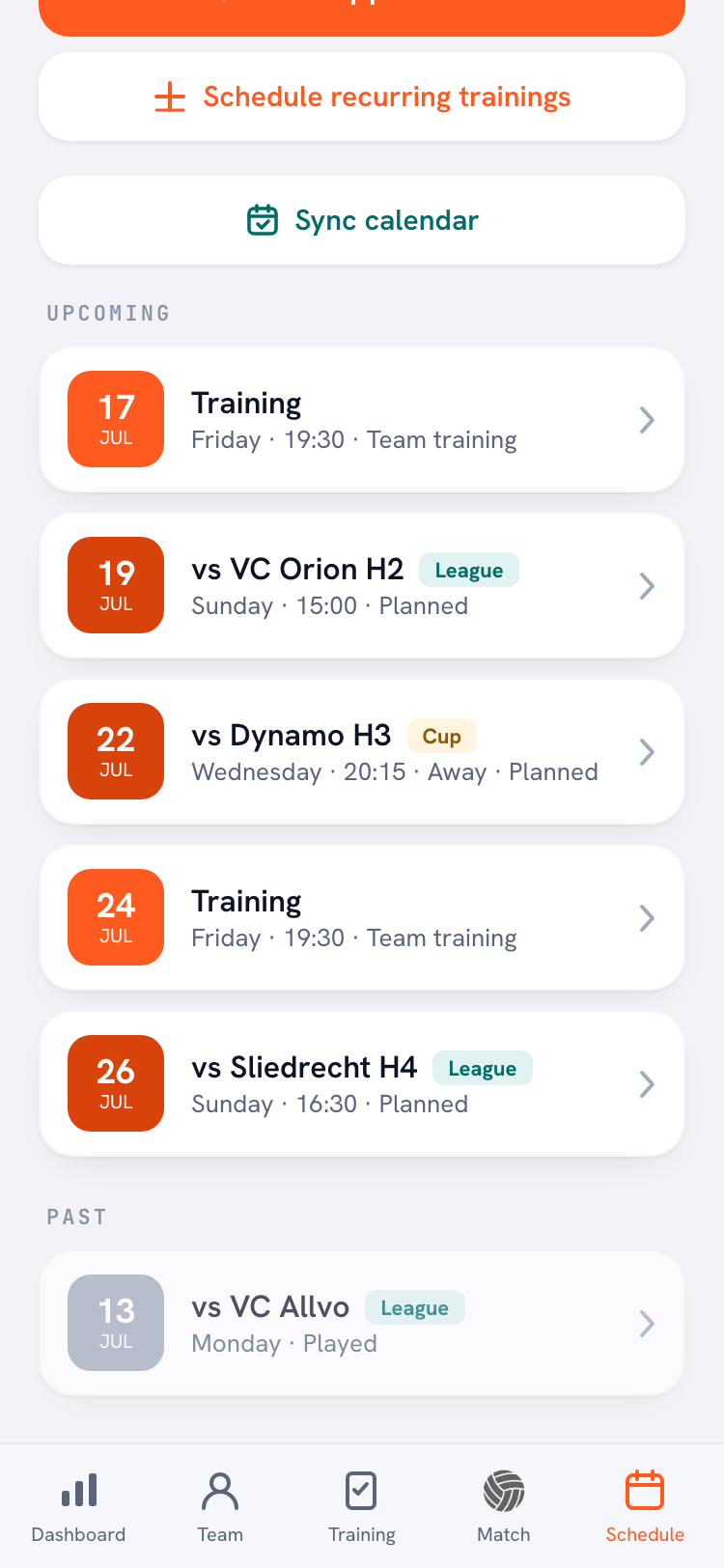
“I no longer write out a full plan for every session. I set one focus for the evening — serving, reception, rotations — with the drills that belong to it. And I schedule the sessions for the whole period in one go, because they land on the same evening every week anyway.
“I also stopped analysing every match to death. The numbers are there, but I pick one thing out of them. If you look at everything you act on nothing, and then it was wasted time after all.”
Honest question: does Koach give you time back?
“No. Not the way that is usually sold. Hall time stays hall time, the drive to an away match is still an hour, and a player who wants to talk still needs my fifteen minutes. There is no button for that, and I wouldn’t want one.
“What has changed is where the hours go. The admin share has shrunk a lot. What still leaks away goes into the things no app touches: travelling, waiting, and the conversation you actually want to have with a player.”
Finally: what would you say to a coach who is barely keeping it up alongside work?
“Hand over one thing this month. Not five, one. Pick the thing that makes you most grumpy — for me that was sorting out the lifts — and either give it to someone else or let the app do it.
“And don’t set up anything you won’t keep doing. A half-filled system costs more energy than no system at all. If you won’t record attendance every week, then don’t record it. This isn’t an exam. You are a volunteer with a team counting on you, and that is quite enough.”
Less record-keeping, more coaching
Curious where your week goes? Put your team in Koach, let players sign themselves up, and tick off attendance in the hall instead of at home on a Sunday evening.
Try Koach free