
“My top scorer doesn’t have the most badges. That’s on purpose”
On twenty-four badges of which only four are about points, a vote the squad runs without the coach, and why there is always a next tier in view.
At the end of a youth match there is always one player who gets the applause and five who deserved it just as much. Dennis Boekhout knows the problem from his own bench: the top scorer is seen automatically, the rest are not. So in Koach the player of the match voting is left to the squad itself, and the app holds twenty-four badges of which only four are about points.
A conversation about the medal case in the app, about the two badges deliberately filtered out of a player’s own view, and about a vote in which the coach has no say at all.
Twenty-four badges. Why not simply a top scorer list?
“Because a top scorer list rewards one kind of player, and that is exactly the player everybody already sees. I counted them while I was building: twenty-four badges across seven categories, and only four of them are about points. Attack points, block points, service points and the most points in a single match. The other twenty reward something else entirely.
“They reward showing up. A run of sessions in a row, the number of years you have been a member, your first match, your birthday. That may sound soft, but it is exactly what holds a team together. The player who turns up every Tuesday for five years is doing something just as hard as scoring fifty attack points.”
Name a few of those twenty.
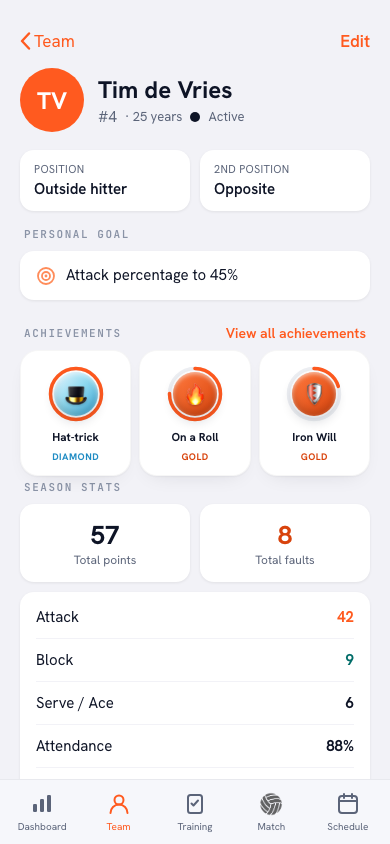
“On a Roll counts how many sessions you have attended back to back. Loyal Player counts the years you have been with the club. Debut arrives when you have played your first match. Birthday shows up on your birthday, and there is nothing more to it than that. Iron Man is the hardest of the lot: every single match and every single session, without missing once.
“The categories are Performance, Attendance, Character, Loyalty, Team, Team performance and Milestones & Fun. Put those seven side by side and you see what I was after straight away: performance is one of seven, not the whole story.”
You said it yourself: your top scorer doesn’t have the most badges.
“My top scorer doesn’t have the most badges. That’s on purpose. He scores, so he picks up Top Attacker and usually MVP, but he skips a session when he is tired, he has only been at the club two years, and he is not the captain. Those are all badges somebody else does have.
“The fullest case in our squad belongs to a middle blocker who never makes it into a match report. The first time I saw that on screen, I knew it was working. If the badge order had come out the same as the points order, I would have designed something wrong.”
Why is there never just a tick saying ‘earned’?
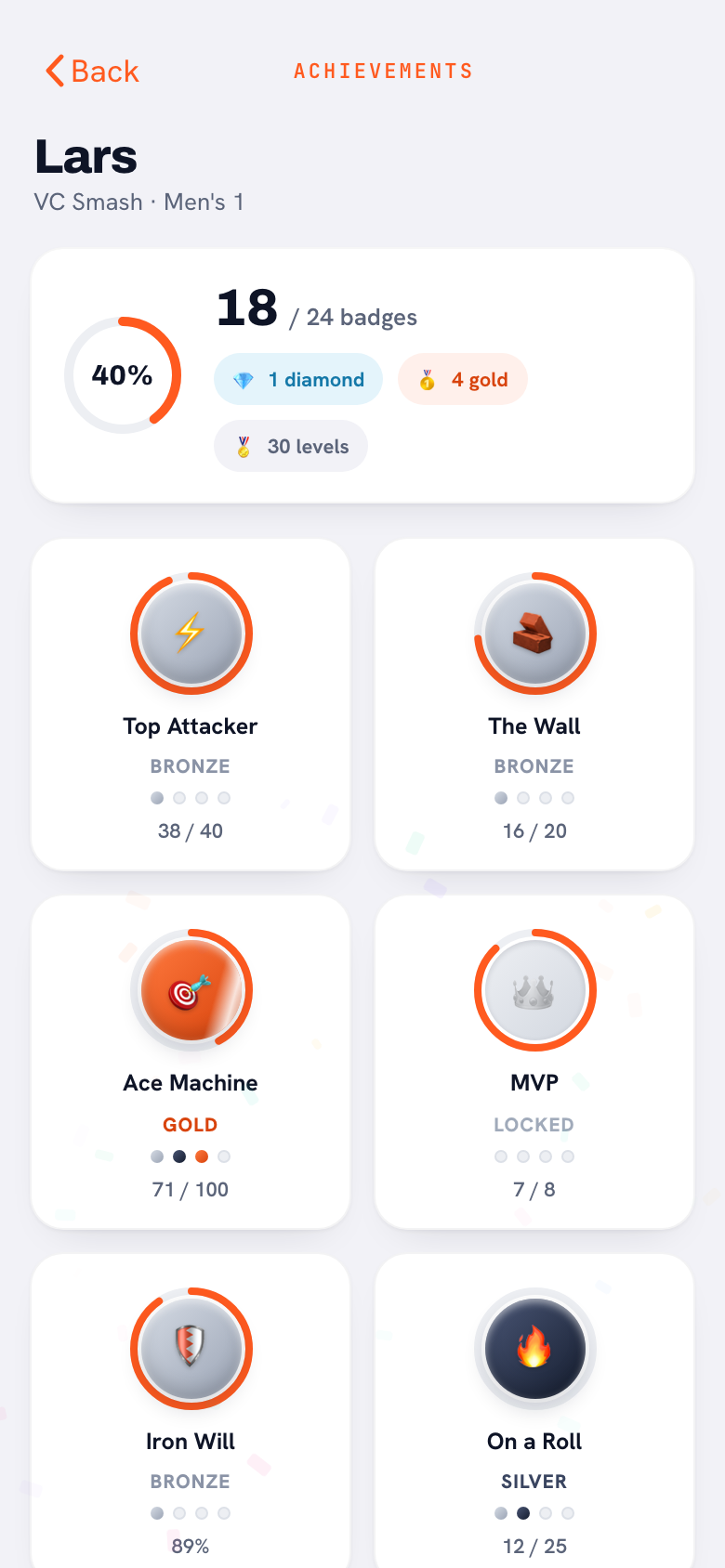
“Because a tick is an ending. Most badges have four tiers: bronze, silver, gold and diamond. An orange ring around the medal shows how far along you are towards the next tier, and the number sits right underneath — 31 out of 40 attack points, 12 out of 25 sessions in a row. So you are never finished, you are always somewhere.
“Tap a badge open and you get all four tiers side by side with their thresholds: earned, in progress, locked. I find that fairer than a surprise. A player is entitled to know what the next step costs before he starts on it.”
There are two badges a player never gets to see. Which ones?
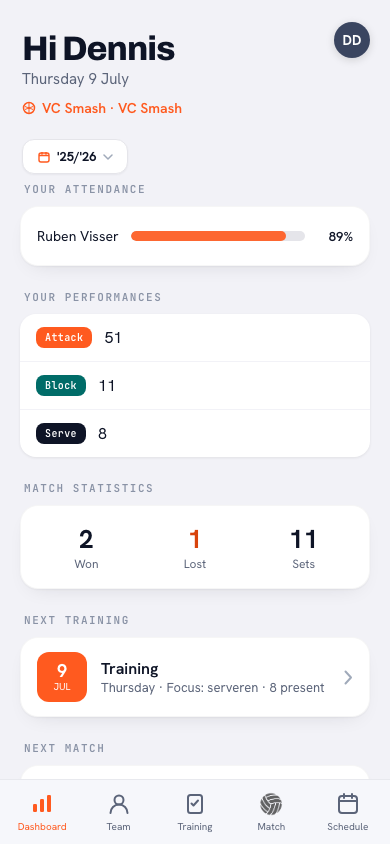
“Hard Worker and Riser. Both of them run on the stars I give someone for effort after a session. Hard Worker shows your average, Riser the difference between the first and the second half of the season. On my screen that reads literally ‘avg. 4.0’ or ‘+0.3’.
“That is my judgement, and it has no business sitting unasked in a player’s case. Not even without the number, because the tier gives it away just as well: gold means 4.6 or higher, full stop. So for the member himself and for a parent those two drop out, and if a category is left with nothing, the category goes too. On the player profile I still see them. That is where they belong — in a conversation, not in a display cabinet.”
How does a player notice something new has landed?
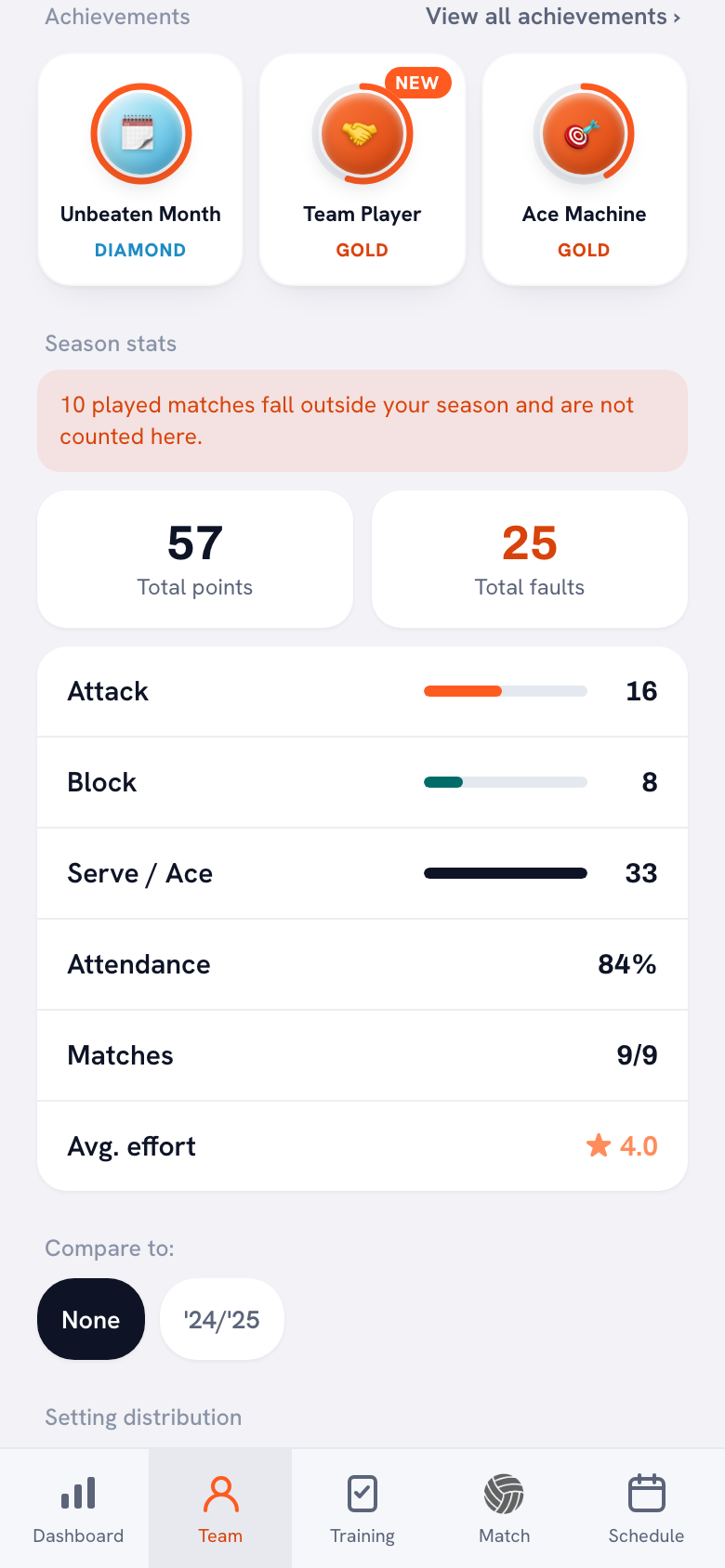
“An orange NEW label appears on the badge and pulses gently, and if you open your case while something in it is still unseen, confetti goes off over the top. Once, not every time. The label only clears a few seconds after the screen is open, because otherwise you tick away something you never actually saw.
“And you only clear your own badges. If I page through a player’s case as his coach, his NEW stays put until he looks himself. There is one more rule: the very first time a team gets its badges, none of them are marked new. Otherwise you open on day one to twenty NEW labels and the word stops meaning anything.”
And if someone drops back? An injury, half a season out.
“Then the badge stays. A badge never drops back. You keep it at the highest tier you ever reached, even when this season’s numbers no longer carry it. That was a deliberate choice. Credit you can lose again isn’t credit, it’s a league table.”
Then the player of the match. Why don’t you vote?
“Because I have been judging all match long. I pick the lineup, I make the substitutions, I hand out the stars after training. If I then also point at who was best, there is no moment left where the team gets to say something about itself. So for Player of the Match only the players vote. Not the coaching staff, which means not me.
“And you can’t vote for yourself. Your own name is in the list, greyed out, with ‘(you)’ after it and no button. The rest is simple: you get everyone who played that match, you tap a name, and one more question comes over the top. Are you sure? Because your vote is final.”
Why can’t a vote be changed?
“Because otherwise it turns into a poll. If you can adjust your vote, you check who is ahead and you drift towards them. That is exactly what I don’t want. One vote, one time, so you actually think about it. [laughs] It is the only place in the app where I force a player to choose.
“Voting stays open through the second day after match day. Then it closes and the crown appears with the name underneath. If it is level, two names simply stand side by side — I am not going to invent a winner. And if nobody voted, the screen says no votes were cast. That is a result too.”
And then it goes into the group chat?
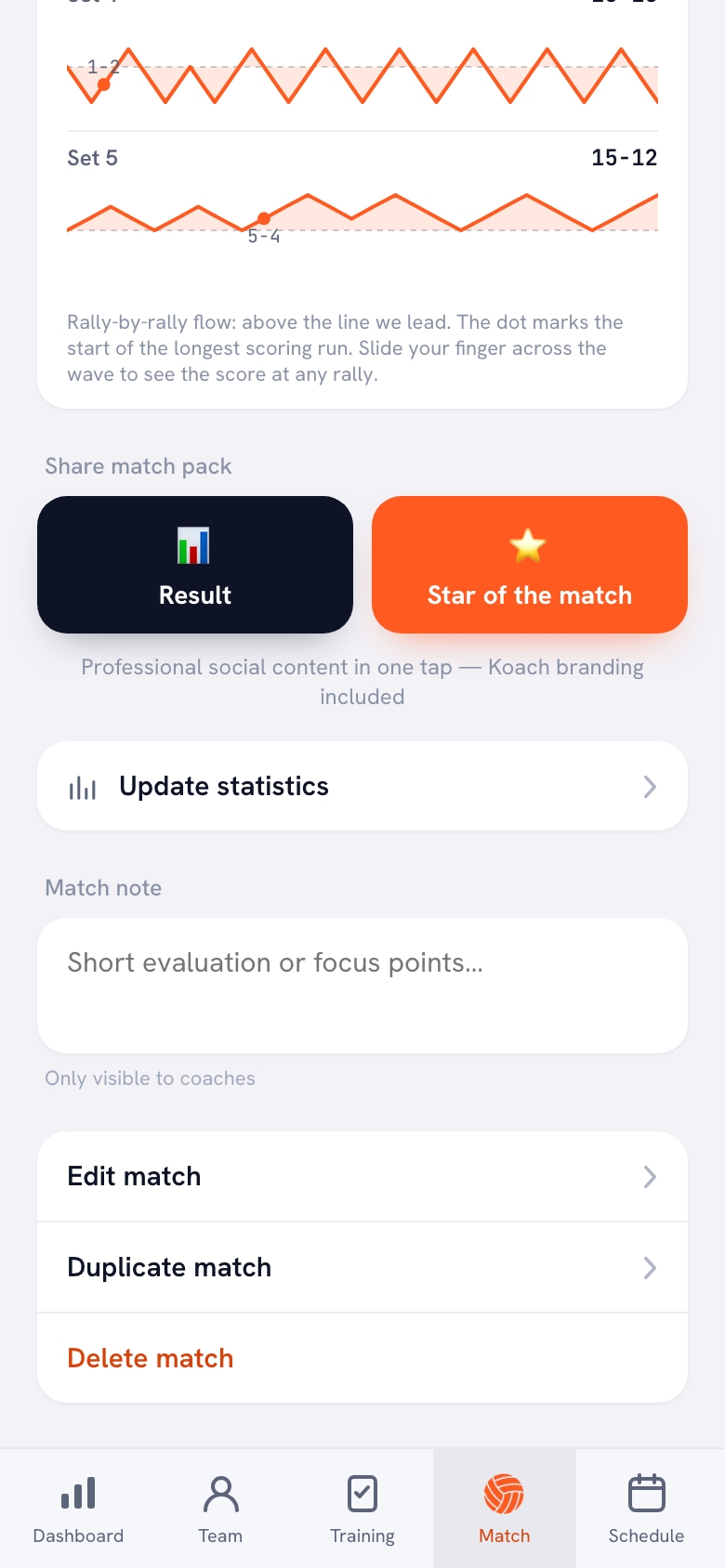
“A played match has two buttons: Result and Star of the match. The result card is the set scores and nothing else — it deliberately singles nobody out, because that is a team outcome. The star card is the exact opposite: one name, large, with a crown on it if the vote produced a winner.
“If nobody voted, that card takes the top scorer of the match and puts a star there instead of a crown. Underneath come three lines: best in attack, best on serve, best at the block, each with their number. A category with no numbers simply drops off. Two honest lines beat three with a zero in them.”
Does a badge make anyone a better volleyball player?
“No. Not one of them. A badge makes nobody a better passer, and anyone expecting that will be disappointed. What it does do is smaller and duller: it gives the player who never posts the biggest numbers a reason to keep turning up. And in youth volleyball, turning up is half the job.
“It gives me something too. I know perfectly well who scores, I see that for myself. That somebody has been at nearly twenty sessions in a row I do not see, unless it is written down somewhere. That is what the case is really for — not for the player who already gets noticed, but for the five who don’t.”
See the players you never see
Set your squad up in ten minutes and let the app keep track of who turns up every week, who plays their first match, and who the team votes player of the match.
Try Koach for free