
“I was handed fourteen names and nothing else, and that turned out to be a gift”
On taking over a team that is already half a season old: what comes with it from your predecessor, and why you leave it alone at first.
Taking over a volleyball team rarely happens at a convenient moment. Someone steps down in November, and two weeks later you are standing in the hall with fourteen players who have known each other for half a season and do not know you. The squad has a history: sessions, matches, agreements, a reputation for every player. You just were not there for any of it.
Dennis Boekhout took over a running team himself, and later built the app that stops a handover from living in one coach’s phone. A conversation about what you inherit, and what you start again.
You took over a team that was already running. How did that go?
“Badly prepared, for a start. [laughs] The coach stepped down after the winter break, for reasons that had nothing to do with volleyball, and somebody had to take it on. I was handed fourteen names and nothing else. No lineup, no idea who was injured, no idea who had not turned up for three weeks.
“At the time I thought: what a nuisance, I am starting at a disadvantage. I see it differently now. For those first three weeks all I did was watch, because I could not do anything else. That happened to be exactly the right thing to do.”
So what were you actually given?
“A group chat I was added to, and a list of names and shirt numbers. Half of that list was wrong. Two players had quit, one had joined, and three were down with numbers they had not worn in months. That is not because the coach was sloppy. It is because a list like that lives in exactly one phone and nowhere else.
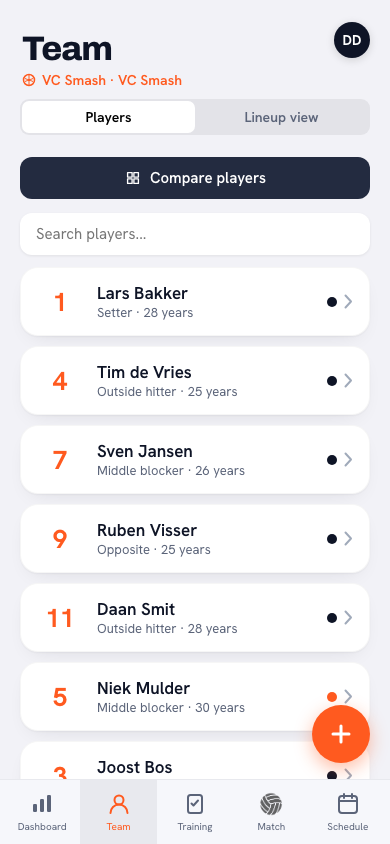
“That is the first thing I wanted to do differently in Koach. The squad belongs to the team, not to the coach. Shirt number, position, age, whether someone is active or injured — it is simply there, and it stays there when the coach changes.”
What exactly comes with a team when it changes coach?
“Everything attached to the team. The players with their position and their status, the sessions that have been and who was there, the matches with the set scores, the stats per player, the notes. There is no export and no file for anyone to forward. It is already there; you are simply given access to it.
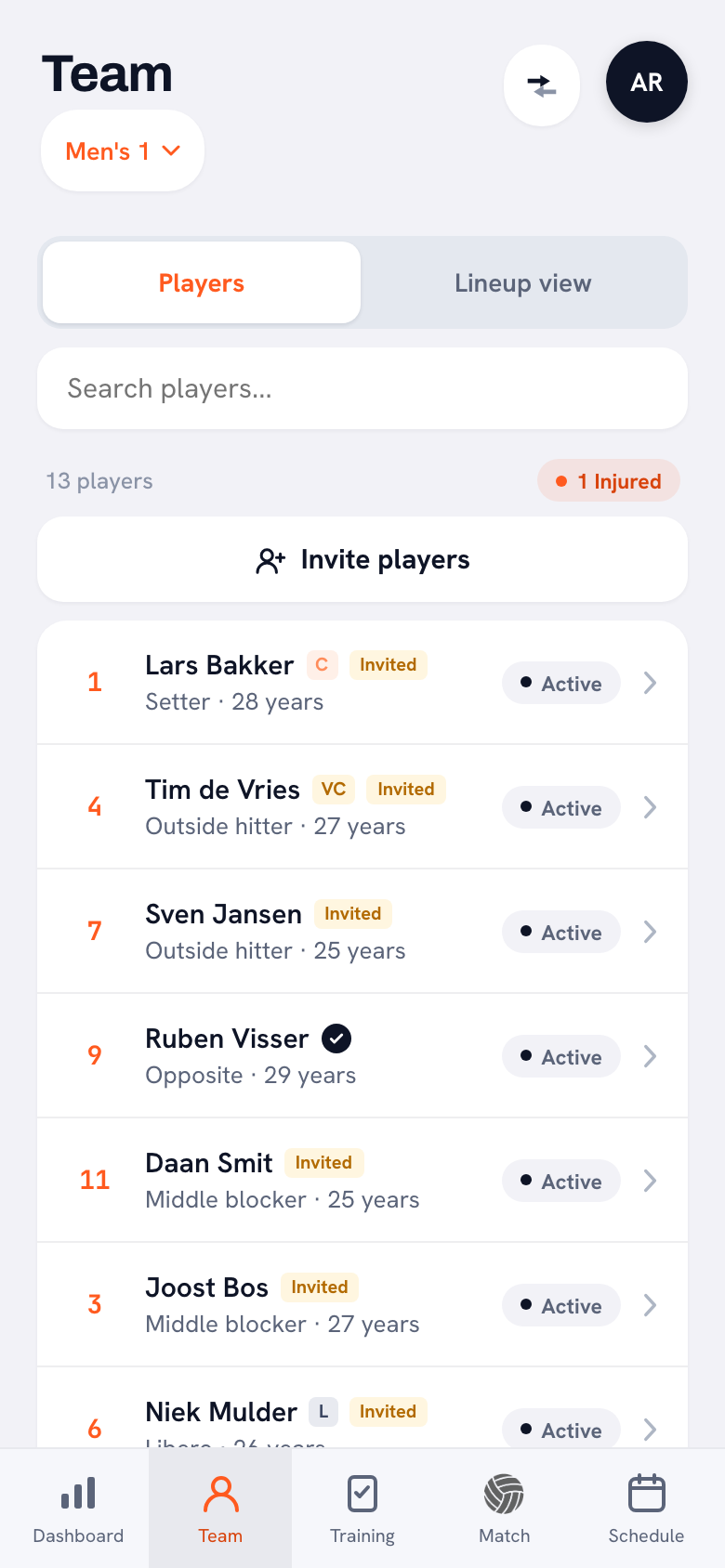
“You also see straight away which players have a linked account and which ones are only a name on the list. Worth knowing before you send a message and assume everyone has read it.”
And practically: how do you get in without your predecessor retyping everything?
“He invites you. You get a link to pass on, and whoever opens it becomes a coach of that team — even if they do not have a Koach account yet. That mattered to me, because the new coach usually has nothing at all.
“After that you are both in there, and it can stay that way for a while: the Coach plan lets two coaches share a team, and on Club there is no limit. That overlap is the best time to ask questions. When he is done, he leaves the team and everything stays where it is.”
You say: keep the old coach around. But you do not read his notes straight away?
“No. And that is the only genuinely unreasonable rule I have. [laughs] I would say: do not read them in your first week. Look for yourself first.”
Why not? It is right there.
“Because your predecessor’s file is an opinion, not a fact. It says ‘goes for the safe ball from 20 points on’ or ‘slow to get going’. That is what somebody saw under his regime, in his lineup, with his drills. Change the regime and that observation can be nonsense by tomorrow.
“And the dangerous part is that you believe it before you have looked. Read on Monday that somebody is uncoachable, and on Tuesday you will see a player who is uncoachable. That is simply how your head works. So I do read it — just later.”
What about the numbers? Those are objective.
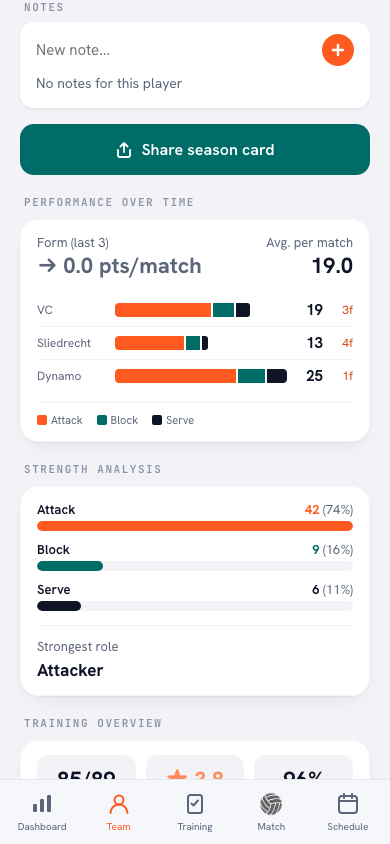
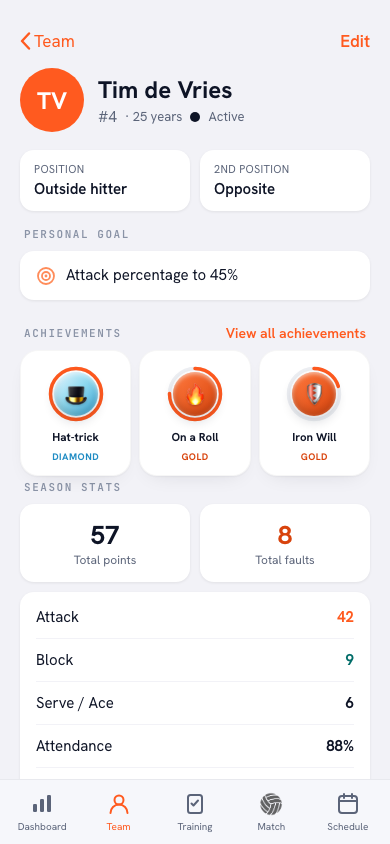
“Numbers are facts about the past, yes. It says someone was at 88 per cent of the sessions, and that is simply true. It says how many points they scored and how many errors they made, and that is true as well.
“But a profile also summarises. Out comes a strongest role, and a personal goal that someone agreed with a different coach six months ago. That summary covers a period you were not part of. I read the hard numbers straight away and the conclusions once I have an opinion of my own.”
So what do you do in those first weeks?
“Watch, and write it down. In those first three sessions I write one note per player, no more. One sentence about what struck me. Not ‘needs to pass better’, but ‘always turns away from the net on the second ball’. Something you can check later.
“And I change as little as possible. I leave the lineup exactly as it was, even when I think it is wrong. Not out of politeness, but because otherwise I will never find out what was not working. Change five things at once in week one and you still know nothing in week four.”
And then you do read the file after all?
“Yes, after about three weeks. And then it is suddenly useful, because now you have something to hold it up against. Where the two of you agree, you know it is stable: that is the player, whoever is standing in front of the group.
“Where you disagree it gets interesting. Either you are wrong because you have seen three sessions, or he was wrong, or — and this is the most common one — the player has changed. That is exactly the conversation you want to have with them.”
Do you have to start anything over in the app when you come in mid-season?
“No, and you really should not. The season carries on. The sessions and matches from before you arrived stay where they are and the stats keep counting. Starting a new season resets everything to zero and stores the old one separately — that is something for the summer, not for November.
“I understand the temptation, a clean slate feels good. But you would be throwing away the only thing you know about that first half, and that is precisely what you need it for.”
And if your predecessor kept nothing at all?
“That happens more often than you would think, and it is less bad than it sounds. Then you start with an empty list and fourteen names, just like I did. You put the squad in, you tick off the first session, and after four weeks you have more on paper than the coach before you had in half a season.
“The one thing I would still do: ask him for half an hour, once. Not for the file, but for the things that fit in no app. Who gives whom a lift, who is always late on Saturdays, and which parent you are better off phoning yourself. That is in no system anywhere and it saves you a month.”
Take over a team without retyping
Put your squad in, invite your predecessor or get invited, and keep your own record from your very first session. Koach is free to try.
Try Koach for free