
“By May everyone knows. I want to know it in November”
Dennis Boekhout on the question every coach asks halfway through a season: is this player genuinely getting better, or does it just feel that way?
Somewhere in November every coach asks the same question: is that player actually getting better, or does it only look that way because he put three balls down on Saturday? Learning how to track player development in volleyball sounds simple, but in practice the last match colours your verdict on the previous ten. Dennis Boekhout built the screens he uses to test that verdict.
A conversation about the form indicator on a player’s page, about the trap of a line that rises because the opponents were weaker, and about the three things he lays beside it before saying anything.
The headline on this piece is: by May everyone knows. What do you mean by that?
“At the end of a season it is easy. You look back and you can see exactly who grew, because everything is there. Only by then you cannot do anything with it. The season is over, the players scatter, and you are left holding a conclusion with nowhere to go. I want to know in November, when there are still twenty sessions ahead of us.
“And yes, usually you can feel it too. But a feeling is not a measurement. My sense of a player is always coloured by the last match I watched. Someone puts three balls away on Saturday and suddenly he is flying, even though he had four thin evenings before that. I wanted something that does not move with my mood.”
So what do you look at first?
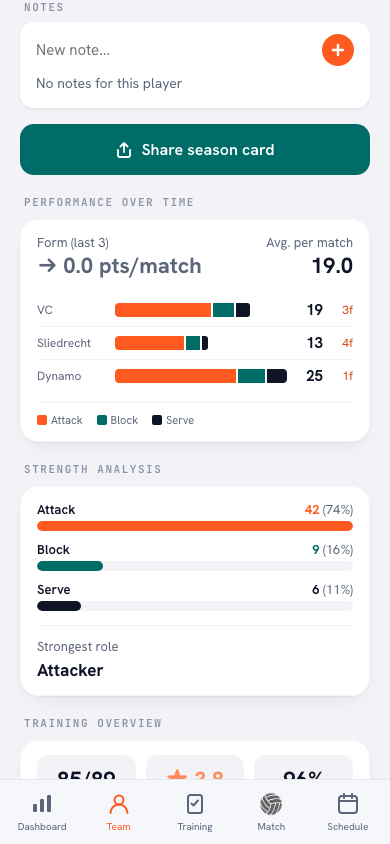
“The player’s own page. There is a block on it with performance over time: one bar for every match played, made up of attack, block and serve, with the number of faults from that match next to it. One glance tells you whether it is bouncing around at random or actually heading somewhere.
“Above that there are two numbers: the average per match across the whole season, and the form over the last three. That second number is the most important thing on the screen for me.”
Why that one in particular?
“Because it compares him with himself. The form over the last three matches is the difference between those three and his own season average. An arrow up with 2.4 next to it means he is scoring 2.4 points per match more over the last three than he has averaged this season. An arrow sideways means he is exactly at his own level.
“That is deliberately not a ranking. I never wanted a table with the players listed from best to worst. A player who goes from three to six points a match has grown enormously, even if he is still at the bottom. In a ranking that growth would be invisible.”
And if the arrow points up, you know?
“No. That is exactly where it goes wrong. A line going up can also mean the opponents were weaker. We had a stretch with three matches in a row against the bottom of the pool. Every line in my team went up. That was not growth, that was the fixture list.
“If I tell a player at that moment that he is doing well and then it sags again, I have misled him twice. So I say nothing about it until I have laid something next to it.”
What do you lay next to it?
“Three things, always in the same order: the match itself, the training, and what I wrote down. Only when all three tell the same story do I believe the line.”
Starting with the match itself.
“Points say very little without the circumstances. Every played match has a playing-time block: a bar per player with the number of rallies and the number of sets he was on court for. Someone who goes from two sets to five sets will score more points by definition. That is more playing time, not growth.
“And the faults belong in the same glance. Next to a match’s points sits the number of faults that came with them, and on the profile there is the fault breakdown: serving fault, bad pass, net fault. Someone scoring more points while also missing more serves has not got better. He is taking more risk. That can be a perfectly good choice, but it is a different thing.”
Then the training.
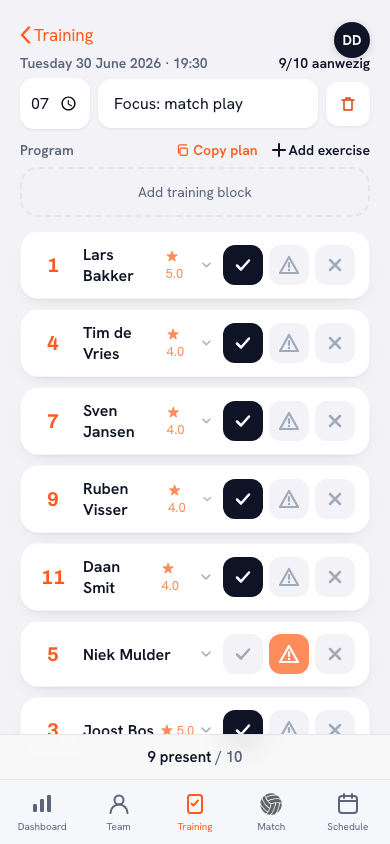
“After every session I mark attendance, and I tap a player’s name to rate their effort, one to five stars. It costs me two minutes in the car. On the profile that becomes a second line: the training rating next to the points per match.
“Those two lines together are far more honest than either on its own. Points rising while effort has been sliding for six weeks is usually someone coasting on talent. That stops at some point. It happens the other way round too: the effort has been climbing for two months and the points have not followed yet. That is exactly when I do say something, because that is where growth starts.”
And the third one: what you wrote down.
“The notes on the player. Every note gets a date and where it came from: training, match or conversation. Three sentences, typed in the car. His jump serve is getting steadier, next step is alternating zone 1 and zone 5. That kind of line.
“Without those lines a graph is just a shape. With them I still know in February what we agreed in November, and I can see whether the line rises at exactly the point we worked on. That is the difference between ‘you are improving’ and ‘since January you have been serving to zone 5 by default, and that is where this comes from’.”
Do you also compare players with each other?
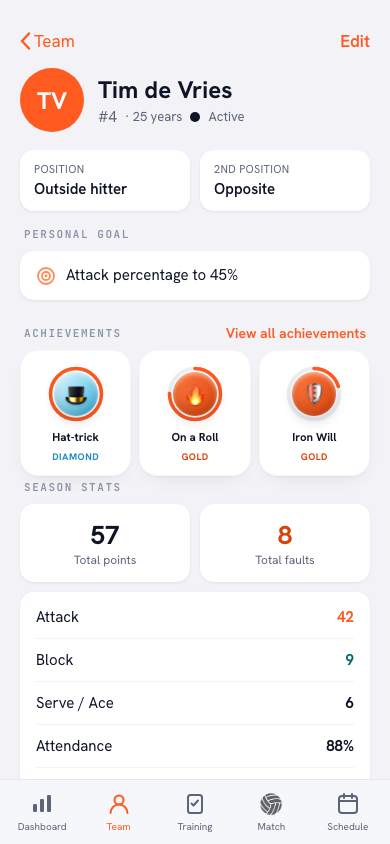
“You can. In the player list you tick two or more and they appear side by side on one screen, each in their own colour, with the shirt number next to it so colour is never the only difference. You get the total points, the split across attack, block and serve, the average per match and training attendance.
“But I almost never use it to decide who is better. I use it to see whether a dip belongs to one player or to the whole team. If two lines drop at the same time, it is not that one outside hitter, it is our passing. Then I was about to have the wrong conversation.”
What do you end up saying to that player?
“I show him the screen. Not as evidence, just so we are both looking at the same thing. This is your average, these are your last three, and this is what I wrote down in November. That conversation takes five minutes and is ten times more concrete than ‘I have a feeling you are improving’.
“A lot of my players also have a personal goal on their profile, something like attack percentage to 45 per cent. Then the conversation is not about whether he is doing well, it is about that one thing.”
And if, after all that puzzling, the line simply does not go up?
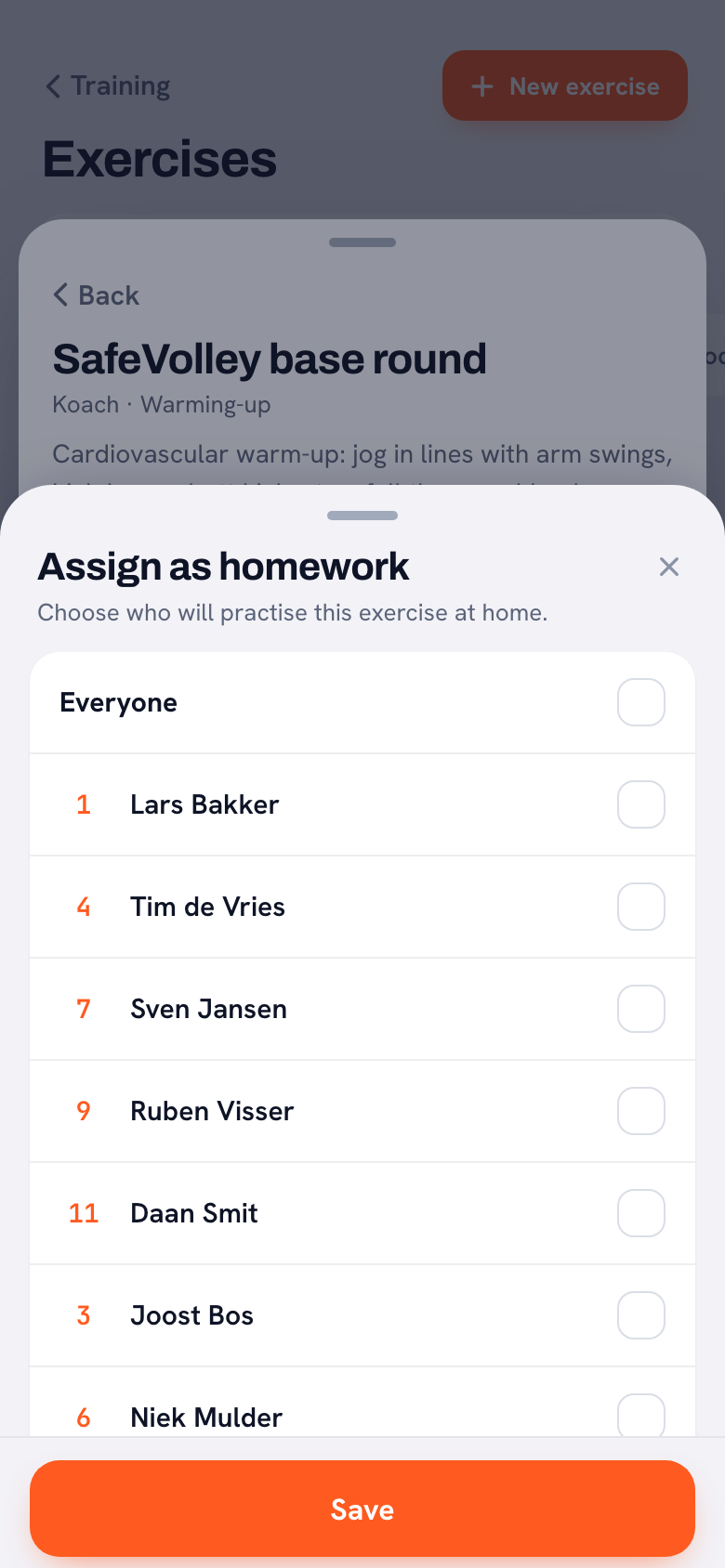
“Then I am glad it is November. I can still do something about it: rebuild the session, clear a block for exactly that thing, or hand out an exercise as homework. You pick the exercise and tick who is going to practise it at home — everyone, or just that one player.
“That is the whole point. Not that the app tells you who is growing; it does not, that is still your job. But that you see it early enough to do something with it. In May all you have left is a nice graph.”
See growth while there is still time
Koach puts form, faults, training effort and your own notes on one player page. Free to try: set up your squad, and the first line appears after three matches.
Try Koach free