
“For three rounds I gave myself a seven, and the picture never got better”
Why Dennis Boekhout stopped judging the two hundred drills in Koach on a still image and started judging them on the running animation instead.
Koach ships with two hundred volleyball drills with animation, spread over nine categories: warm-up, passing, defence, attack, blocking, serving, game forms, teamwork and a small catch-all. They looked fine. Then Dennis Boekhout measured them, and 194 of the 200 turned out to carry at least one real error. The biggest category was also the simplest: the ball was lying on top of a player.
A conversation about three review rounds that stalled on a grade, the five yes-or-no questions that replaced it, and the lesson underneath: a still image hides exactly the error you are looking for.
Those two hundred drills were already in the app. Why go back and check them?
“Because they were just slightly off. That is the worst kind of mistake, because you cannot put your finger on it. I would look at a drill and think: this is good enough. But a coach is standing in the hall at quarter past eight with a phone in one hand and ten players waiting. He has three seconds to understand what is supposed to happen. Good enough is not good enough then.”
What came out of the measurement?
“It shook me a bit, honestly. 194 of the 200 drills had at least one real error. And the biggest group was the simplest one imaginable: the ball was sitting on top of a player. Over a thousand ball positions, spread across 173 drills.
“That sounds cosmetic, but it is the opposite. The ball is the only thing you follow in an animation like that. If it disappears under a figure, you lose the exact moment the drill is built around.”
How does an error like that happen a thousand times without anyone noticing?
“Because the little figure does not scale with the court. It is a fixed size on your screen. On a phone 375 pixels wide, one figure is over two metres tall in court terms. A distance that is perfectly correct on paper can be a single blob on screen.
“That was one of the things I had to unlearn. I was calculating in metres while the coach is looking at pixels. Since then I measure both.”
You say three rounds of work led nowhere. What went wrong?
“For three rounds I gave myself a seven. [laughs] Not literally a mark on paper, but that is how it felt: I looked, I wrote down what was still off, I fixed it, I looked again — and it stayed a seven. One drill actually got worse.
“Two things were wrong. I was judging still images while the product is an animation. And if you ask yourself to list everything that is not right yet, you will always get a list. A grade can never go up, because there is always something.”
What replaced it?
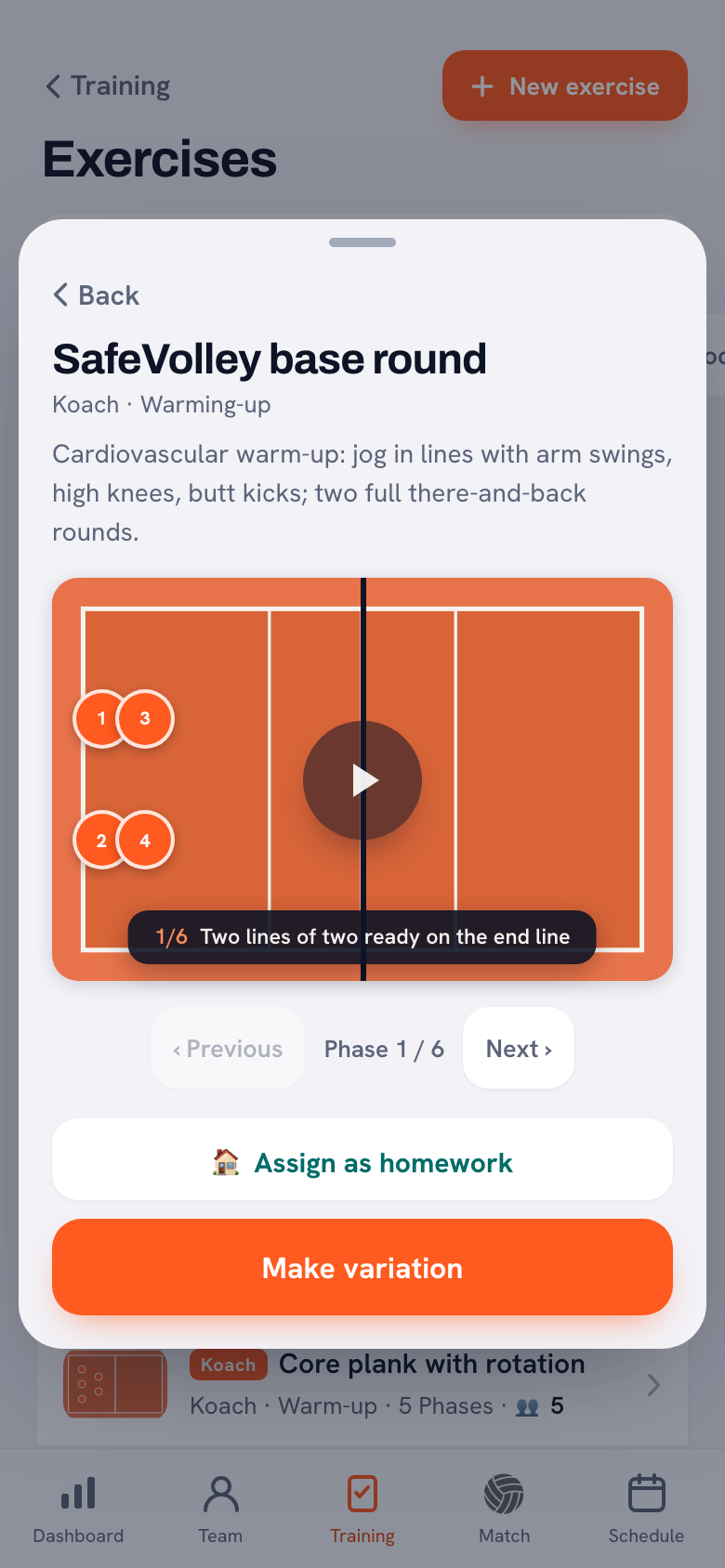
“The animation itself, played back with exactly the timing rules the app uses. And on top of that, five questions that can only be answered yes or no. Is every phase one single event? Does the phase caption match what you see? Can you follow the ball at all times, never under a figure and never appearing out of nowhere? Does anything jump when the drill loops? And does every movement take time in proportion to the distance covered?
“Five yeses and you are done. One no and that drill goes back. No more grades. It sounds dull, but it was the difference between going round in circles and actually finishing.”
So why is a still image so treacherous?
“Because most errors sit between two phases. The app draws the movement in between itself, in a straight line. Two players standing neatly apart in phase three and equally apart in phase four can walk straight through each other halfway. Neither picture shows you that.
“That is why I now look at twelve frames pulled from the running animation, including the moments right in the middle of a transition. That one test alone found thirty drills that were fine on paper.”
Can you describe a repair?
“The simplest one: a ball lying too close to a player moves out to about a metre, in the direction it is travelling. That way you read the intention immediately. If someone is standing there too, it keeps rotating until it lies free.
“The hardest one is the loop. A drill that ends in a different setup from the one it starts in snaps back the moment it restarts. That looks like a glitch in the app, but it is the drill itself. Those got a closing phase, so that every starting spot is occupied again by someone of the same kind. On average a drill went from six phases to seven or eight. Slightly longer, but you can follow it.”
Did you catch yourself cheating as well?
“Yes, and that was the most instructive part. The moment you have a check that draws a line, you unconsciously start steering towards that line. At one point a ball was placed exactly on the edge of the measuring range: the warning disappeared, the picture was not one bit better. Now anything sitting exactly on such a line gets flagged separately.
“The same thing happened with the text check. I searched for 'set' and got 'setter', I searched for a verb and got a completely different word that happened to start the same way. Then you end up rewriting coaching language to please a checker. Now I match whole words only.”
How many drills did you end up changing?
“85 out of 200. The other 115 stayed exactly as they were. That is the number I care about most in the whole project, because 'five times yes, changed nothing' had to be an acceptable answer. Otherwise everybody starts inventing something to look useful. It is precisely because 115 were left alone that I believe those 85 repairs.
“The measurement now reads two hundred drills, zero errors. That is not a grade any more, that is a count.”
Is there anything you deliberately left as it was?
“Definitely. Three game forms say six against six in the text and show six against three on the court. That is not an error, that is a diagram simplifying — you are not going to cram twelve figures onto a phone screen just to show how a drill runs.
“And in a couple of drills the ball cart sits invisibly underneath the coach. Seen from above, that is simply correct. I would rather say it plainly: it is not that everything is perfect, it is that I now know where it is not.”
What does a coach in the hall actually notice from all this?
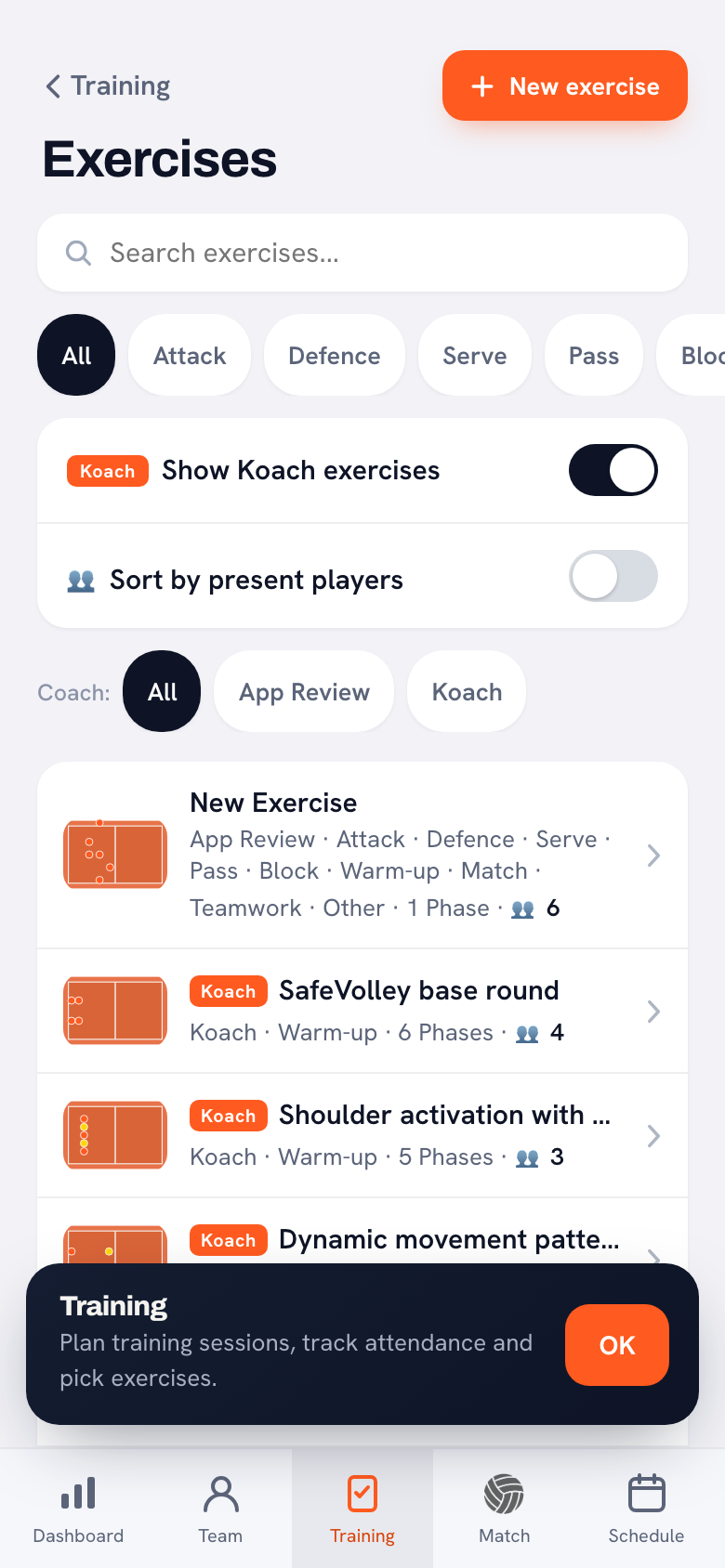
“That he opens a drill, taps play and within half a minute knows whether it fits what he wants to train tonight. He can filter by category, switch the Koach drills off if he only wants to see his own work, and sort by the number of players who are actually coming.
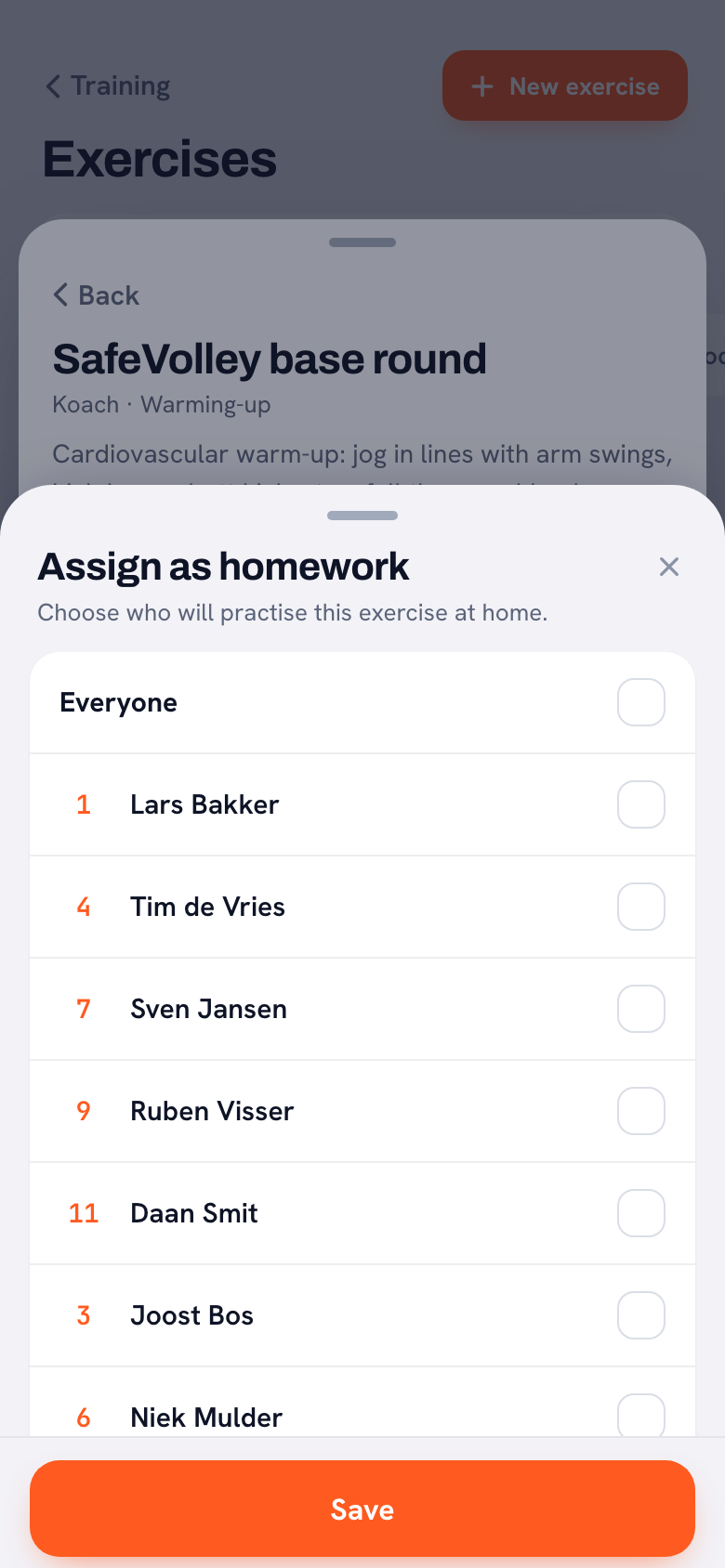
“And if a player needs to keep repeating something, you assign that same drill as homework. He gets it at home on his own phone, with the same animation. That is exactly why the picture had to be right: there is no coach standing next to him to explain it.”
And if a coach draws his own drill, what do you advise?
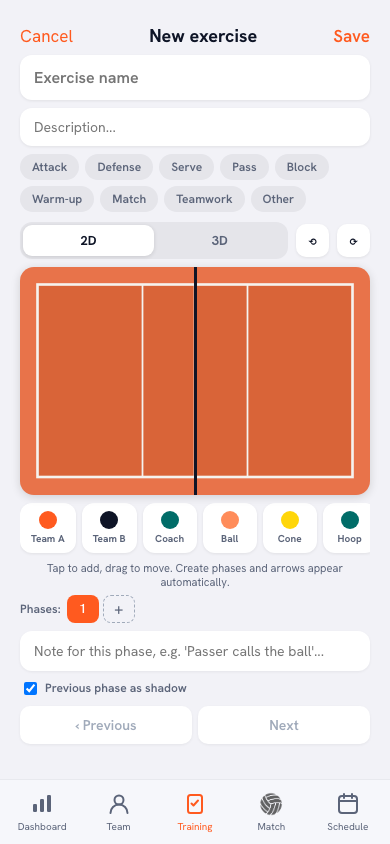
“One event per phase. That is the entire trick. The temptation is to cram everything into a single picture: the pass, the set, the attack and the cover. Then eight things move at once and nobody knows where to look. Split it into three phases and it reads itself.
“And make the ball do what the text promises. If it says the ball gets passed, that ball has to actually move. Those two rules together catch more mistakes than any automated check.”
Two hundred drills, zero errors
The whole library is in Koach, in nine categories and in six languages. Open one, play the animation and assign it to your players as homework.
Browse the drills