
“The same player was on 33 per cent and 50 per cent. In my own app”
On three buttons per player, a percentage that contradicted itself, and the question of which evenings actually belong below the line.
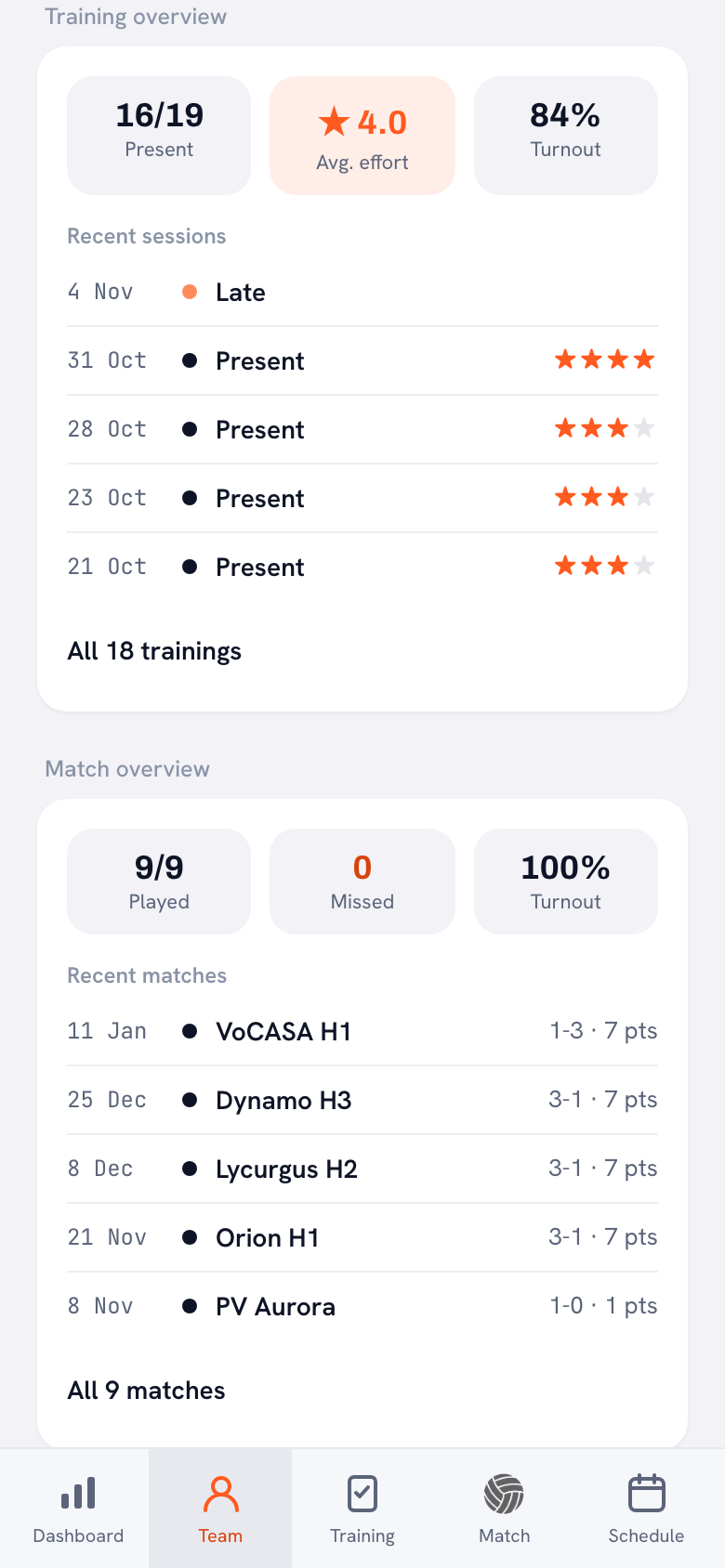
Volleyball practice attendance tracking in Koach comes down to three buttons per player: present, late, absent. The sheet is filled in within ten seconds. And yet the same player sat at 33 per cent on the dashboard and at 50 per cent on his own profile, while both screens promise they are showing the same thing. The difference was not above the line, but below it.
A conversation about what actually goes into a turnout percentage: why late counts as present, why a cancelled evening does not count, and what happens to a session a player never answered at all.
Attendance looks like the simplest part of a coaching app. So why are we talking about it?
“Because it looks simple, and it is, right up until you turn it into a percentage. Ticking a player off takes half a second. I walk down the side of the court before training with my phone, tap the names, done. That part never gave me a headache.
“The headache started when that same tapping turned into a number in three other places in the app. A bar on the dashboard, a tile on the player profile, a column in the export. Suddenly you have to be able to say, without wriggling, exactly what is and isn’t inside that number.”
Why three buttons per player, and not just two?
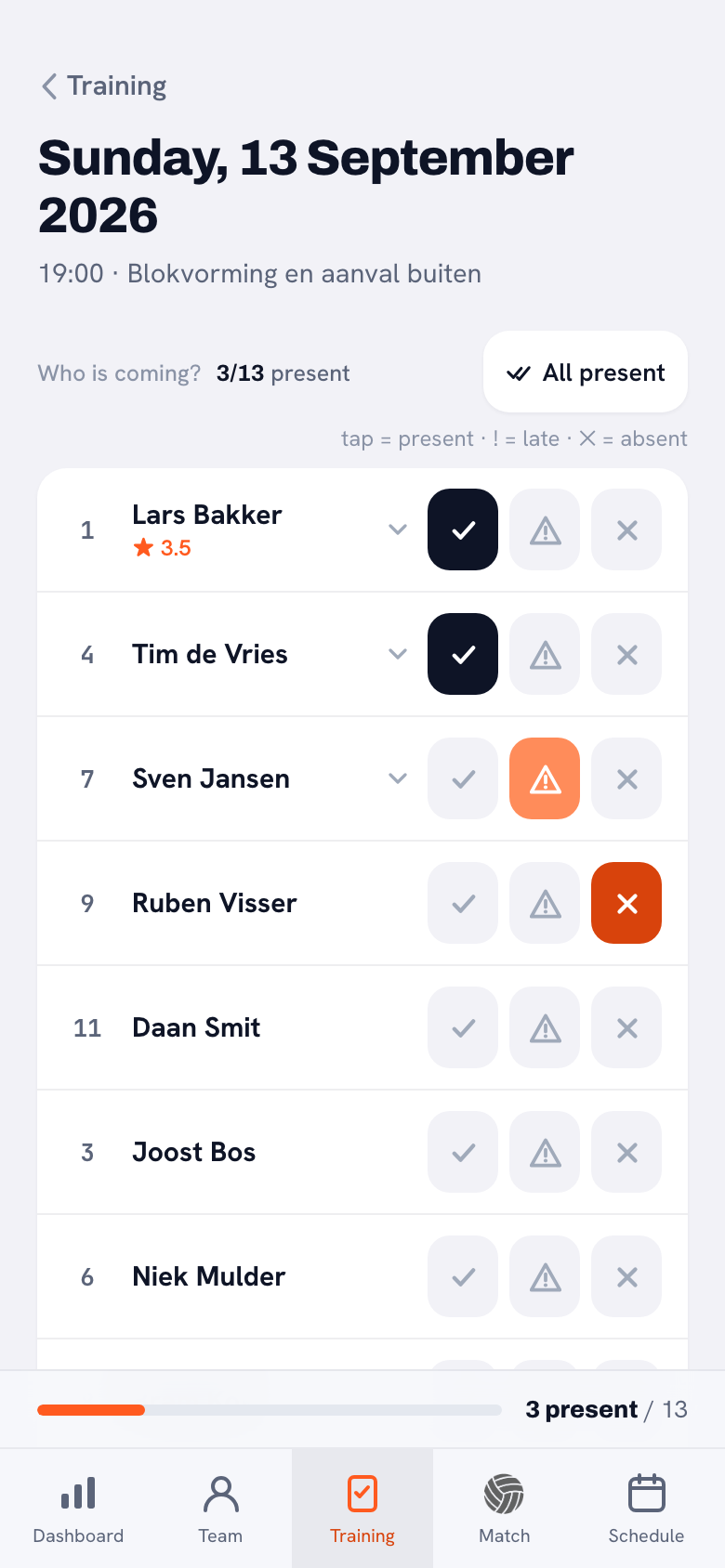
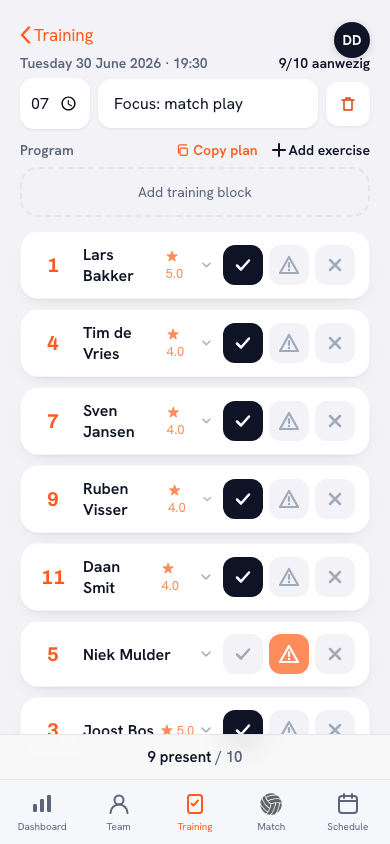
“Because ‘wasn’t there’ and ‘turned up late’ are two different conversations. A tick is present, an exclamation mark is late, a cross is absent. I deliberately didn’t add more states, because everything you invent has to be explainable later on.
“Since this spring there is a line under the heading spelling out what the buttons mean: tap is present, exclamation mark is late, cross is absent. That line isn’t decoration. On my own design sheet I had the exclamation mark down as ‘injury’, while in the app it means ‘late’. If I mix it up myself, another coach is just guessing.”
So late counts as present?
“Everywhere, yes. The question a turnout percentage answers is: did he train that evening? Someone walking in at a quarter to eight has trained. If I filed him as absent, I could no longer explain his percentage to him, let alone to his parents.
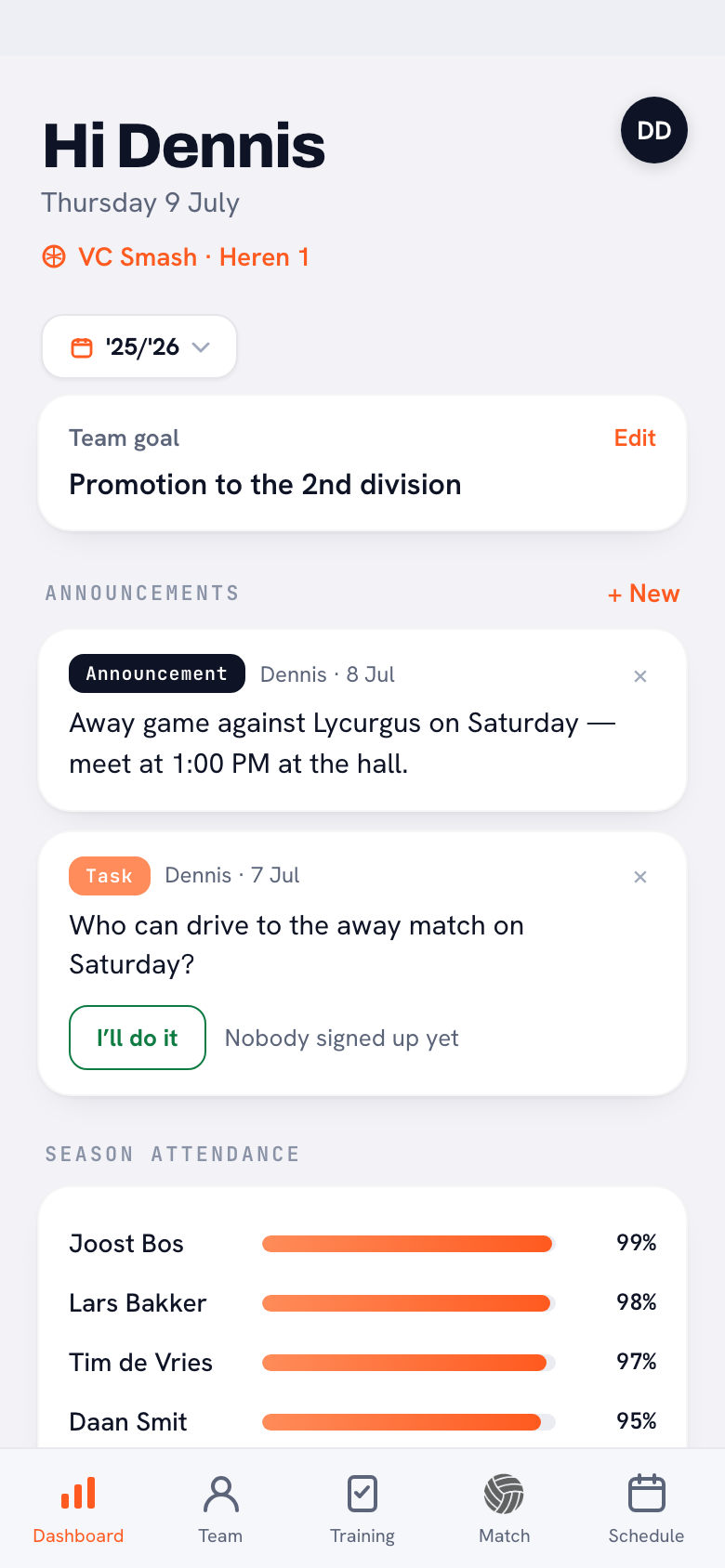
“That information isn’t lost, it just lives somewhere else. The dashboard has a separate ‘Often late’ block, and that counts exactly this state: how often out of how many sessions, with the percentage behind it. So turnout stays about being there and the other block is about being on time. Two questions, two numbers.”
So where was the hard part?
“Below the line. Above the line is easy: that is the number of times you were there. But what do you divide by? Which evenings belong in that denominator? I got that wrong three times, and all three were nicely hidden, because each screen on its own looked perfectly fine.”
What was the first one?
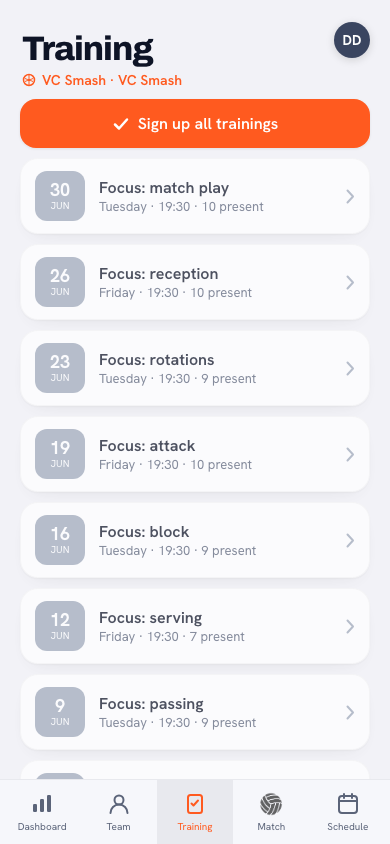
“The future counted. A player can sign up for every session still to come in a single tap — handy, because then he doesn’t have to answer week by week. But those sign-ups sat there as ‘present’, and on his profile they were quietly counted.
“So the counter read 18 out of 20 while only eight sessions had actually happened. And the odd thing was: on that same profile, attendance said 60 per cent next to turnout at 95 per cent, because one block stopped at today and the other didn’t. Two numbers on one screen, and neither of them true.”
And the second?
“Cancelled sessions. If the hall is shut or there is no coach, I mark the evening as cancelled. That must never push anyone’s turnout down, because there was nothing to miss. The dashboard filtered those evenings out neatly. The player profile didn’t.
“So the same player, at the same moment, stood at 67 per cent on the dashboard and 50 per cent on his own page. If a father brings that up with me, I have no story. I can hardly say: go and look at the other screen instead.”
And the third?
“An evening where a player filled in nothing at all. On his profile that session dropped out of the denominator, because the app only looked at sessions with something recorded against him. On the dashboard that very evening did count, as not-present, because that block runs over every session that was held.
“That is where 33 against 50 came from. Same player, same week, same app. One screen punished him for his silence, the other rewarded him for it.”
Which of the two was right?
“The dashboard. A session that went ahead with nothing recorded against your name is not attendance. Either you weren’t there, or nobody knows whether you were — for the percentage that amounts to the same thing. So that evening belongs in the denominator, not in the numerator.
“That became my test: can I explain this to a parent without an excuse? Not ‘the app is being weird’, but simply: this is the rule, here are the evenings, count them yourself. The moment you need a caveat, the number isn’t sound.”
Isn’t that harsh on a player who just forgets to tap?
“It feels harsh, but the alternative is worse. If an evening without an answer quietly drops out of the denominator, the player who never fills anything in ends up with the highest percentage in the squad. That is the exact opposite of what you want.
“And it can be fixed on the night. The sign-up is the player’s answer beforehand; the attendance list is what the coach taps in the hall. I run down that list during the warm-up and then it’s right. After that, nobody talks about percentages any more.”
Is there anything else that doesn’t count?
“One-off guests. If someone from another team trains along for an evening because we are down to eight, I add them, but they count towards nothing: not turnout, not statistics. They only show up in the overview of that one evening, so I know who was on the floor. Anyone who trains with us regularly you simply add to the squad, and they do count everywhere.
“And players who have stopped no longer sit in the team’s denominator. A squad with three lapsed names on the list was seeing its turnout structurally too low, while nobody expected those three anywhere any more. You only find that sort of thing once your nose is right up against it.”
In the end, what does it give you as a coach?
“That I can have a conversation without bluffing. Next to the percentage sits the average effort score, and only together do those two say something. Always being there but coasting is a different conversation from turning up half the time and going flat out when you do.
“And beyond that, mostly peace of mind. I never have to put two screens side by side again to work out which number I am supposed to believe.”
Attendance that still adds up in March
Tap your players off on the list and Koach works out the rest: turnout per player, average effort, and a block for whoever keeps arriving late. Free to try.
Try Koach free