
“I am on the sofa at half past eight and Tuesday needs a session”
On the evening before practice: how to put together a session that actually fits in twenty minutes, and why reusing it is not laziness.
The hall is booked, the players know what time to turn up, the match is in the calendar. The only thing missing is what actually happens on Tuesday. For most coaches, a volleyball practice plan does not get written at a desk but on the sofa, late, squeezed in between everything else. And the question is the same every week: how do I make something decent out of this in twenty minutes?
Dennis Boekhout coaches a youth team and built Koach. He talks through how he builds a session out of blocks, reuses what worked, and where the app simply cannot help him.
Be honest: how long does preparing one session take you?
“The first one of the season, an hour, maybe an hour and a half. After that, twenty minutes, and that is not a trick — it is because I no longer start from nothing. I am on the sofa at half past eight, the day is done, and Tuesday needs a session. That is how most coaches build their practice. Not at a desk with an empty notebook and all the time in the world.
“And when I say twenty minutes, I mean finished. Not a list on the back of an envelope that I am still reshuffling in the car.”
So where do you start, with the first drill?
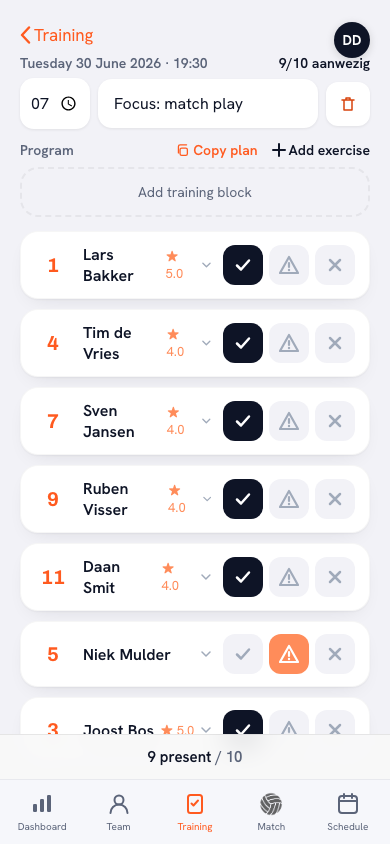
“No, with the clock. I have ninety minutes in the hall, so I put down blocks with a duration on each one: warm-up ten, pass-attack twenty, serving pressure twenty, block timing fifteen, game play twenty-five. That is exactly ninety. Only once that skeleton stands do I hang content on it.
“Do it the other way around and you pick five lovely drills, then discover you need two and a half hours for them. That is the classic mistake. You run over, and the first thing to get cut is the game play — the exact part they have been waiting for all evening.”
And does it hold up in the hall, that ninety minutes?
“Almost never exactly. [laughs] A twenty-minute block runs to twenty-five because it is finally clicking, and then I cut into the warm-up. But I know what it costs me, because the minutes are written next to every block. That is the difference with a list in your head: in there, everything takes ten minutes.”
You also give the session a focus. Why?
“Because a session without a focus is a pile of drills. When I schedule it I fill in one line — serving pressure and passing, say — and that line sits above the programme. For me it is a filter: does this block belong to tonight, yes or no? The players see it too, so they know what the evening is about before they walk in.
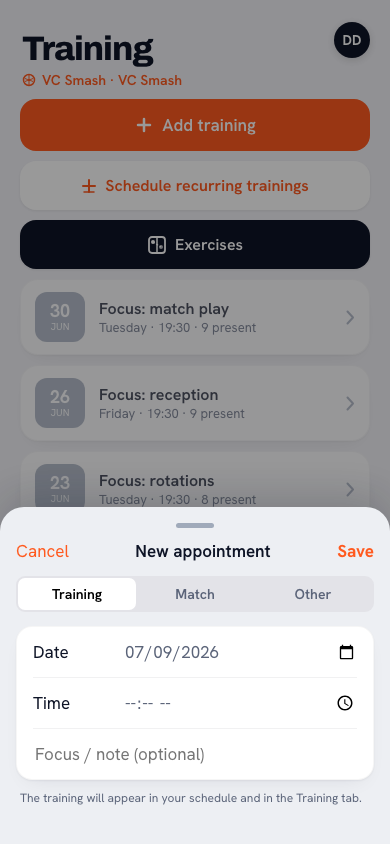
“And I schedule them as a recurring series straight away, every Thursday, same time, same hall. Then I never have to type it again and the whole season sits in the calendar.”
And then the drills themselves?
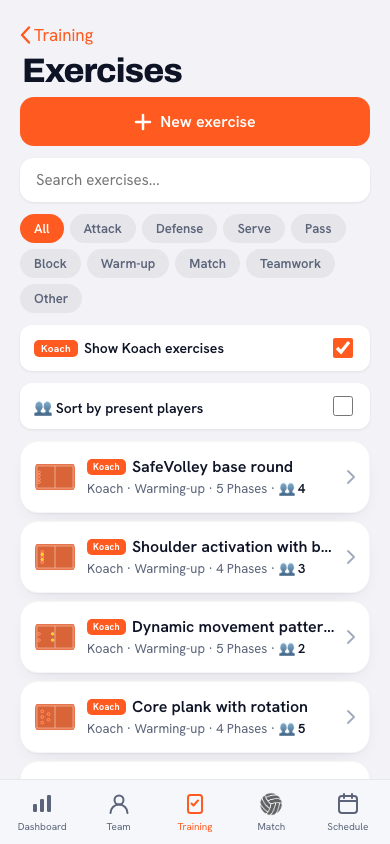
“Those come out of the library. I filter on the category of the block I am working on — serve, pass, block, warm-up — or I search for a word. Every drill says how many phases it has and how many players it needs, and it comes with an animation. That last part matters more than it sounds.
“A drill in writing you read and think: I have got this. Until you are standing in the hall and cannot explain it. Once I have played the animation through, I know exactly what I am going to say and where the lines go. And I can hand the same drill to a player as homework, so they watch it again at home.”
What happens to that session once it is over?
“I save it as a template. One button under the programme, you give it a name — mine are called Serving pressure, Pass-set-hit and Small court — and that is it. In the list it then shows how many blocks it holds and how many minutes that adds up to.
“Three weeks later I create a new session, tap Copy plan, pick that template, and the blocks are in. That takes me twenty seconds. What is left of those twenty minutes goes to the question that actually matters: what needs to be different this week?”
Is that not just running the same session again?
“I hear that a lot, and I think it is nonsense. A coach who starts from nothing every week will not last a season. By November you are so tired that at eight in the evening you think: I will come up with something in the car. That is where bad sessions come from. Not from reuse, from exhaustion.
“And repetition is the whole point anyway. A passing drill you do once is a nice evening. The same drill five times, with a bit more pressure each time, is a skill. Every coach I look up to runs the same core, season after season.”
So what do you change?
“Usually two blocks. The skeleton stays — warm-up, technical block, add pressure, game play — and inside it I swap the content. Last week our reception fell apart, so the technical block becomes passing and I aim the serving pressure at the zones where we let it slip.
“I can also pull back an earlier session instead of a template; the recent ones are listed with their blocks and minutes. Sometimes you just want that Thursday in mid-October back, because that one worked.”
And when you really do not have those twenty minutes?
“Then I copy last week and change one thing. One. That is still infinitely better than improvising with twelve players standing there watching you. And if you want to do it properly: when you schedule a recurring series you can attach a template right away, so every Thursday already has the programme in it.
“A seven out of ten that actually exists beats a nine you never made.”
Where does the app stop?
“At the door of the hall. It does not know that six players are ill, that half the court is taken by another group, or that your setter rolled her ankle yesterday. I only find that out when I walk in, and then my beautiful ninety-minute programme is upside down anyway.
“I can see the sign-ups, sure, but nobody calls in sick three days ahead. What I do then is flip a switch in the exercise list and enter how many players I actually have. It then sorts them into exactly enough, for fewer players, and need more players. But I type that number in myself. The app does not count heads in the gym.”
Finally: what do you say to the coach who starts from scratch every week?
“Make one good session this week, and save it. That is all. Next week costs you twenty minutes instead of an hour, and the week after that, ten. You build your own little library of evenings that worked, and that is what carries you through the season. Still enjoying the walk into the hall in March matters more than every session being unique.”
Build your session in blocks
Put your next session together as blocks with a time on each one, pull drills in from the library and save the whole thing as a template. Next week you will not be starting from nothing.
Try Koach free