
“My gut said he’d had a terrible night. The numbers told me I was wrong”
Volleyball coach Dennis Boekhout on the line between what you see and what you measure, and which of the two wins when they disagree.
Every coach walks out of the hall carrying an impression: that player had a bad night, that rotation never got going, we were nowhere in the second set. The next morning the app shows something that does not quite agree. Volleyball stats vs gut feeling is not a choice you make once, then; it is a question that comes back every week, usually on a Monday.
Dennis Boekhout coaches a youth team and built Koach. Here he talks about the times he had to revise his own verdict, the times the numbers were right but useless, and the rule of thumb he now sticks to.
You leave the gym after a match with an impression. How often is it right?
“More often than not, I think. But not often enough to trust it blindly. The trouble is that my head does not count, it remembers. And what it remembers is the last quarter of an hour and everything that went loudly wrong. A service error at 22-22 stays with me for two days. Twenty rallies that simply went well just evaporate.”
The headline on this interview is about one of those nights. What happened?
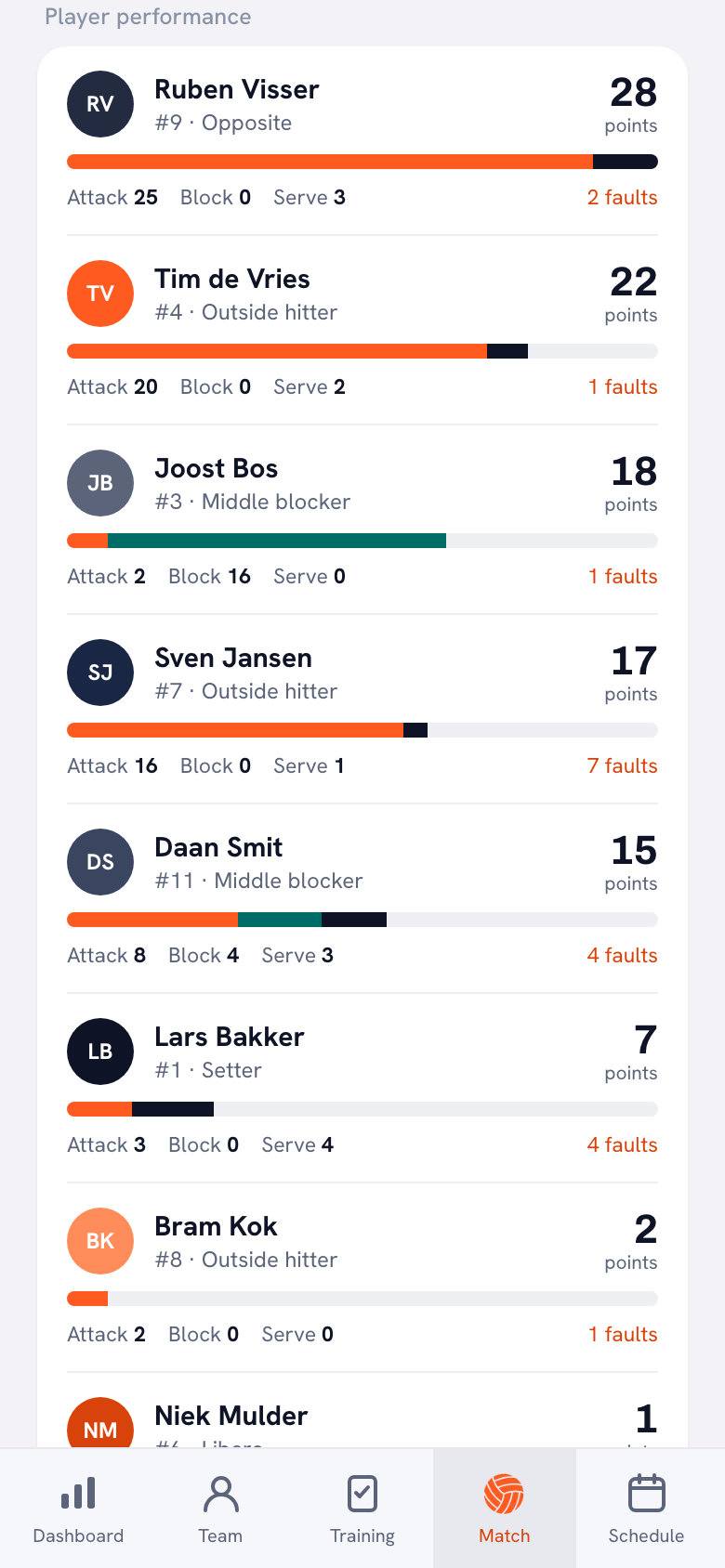
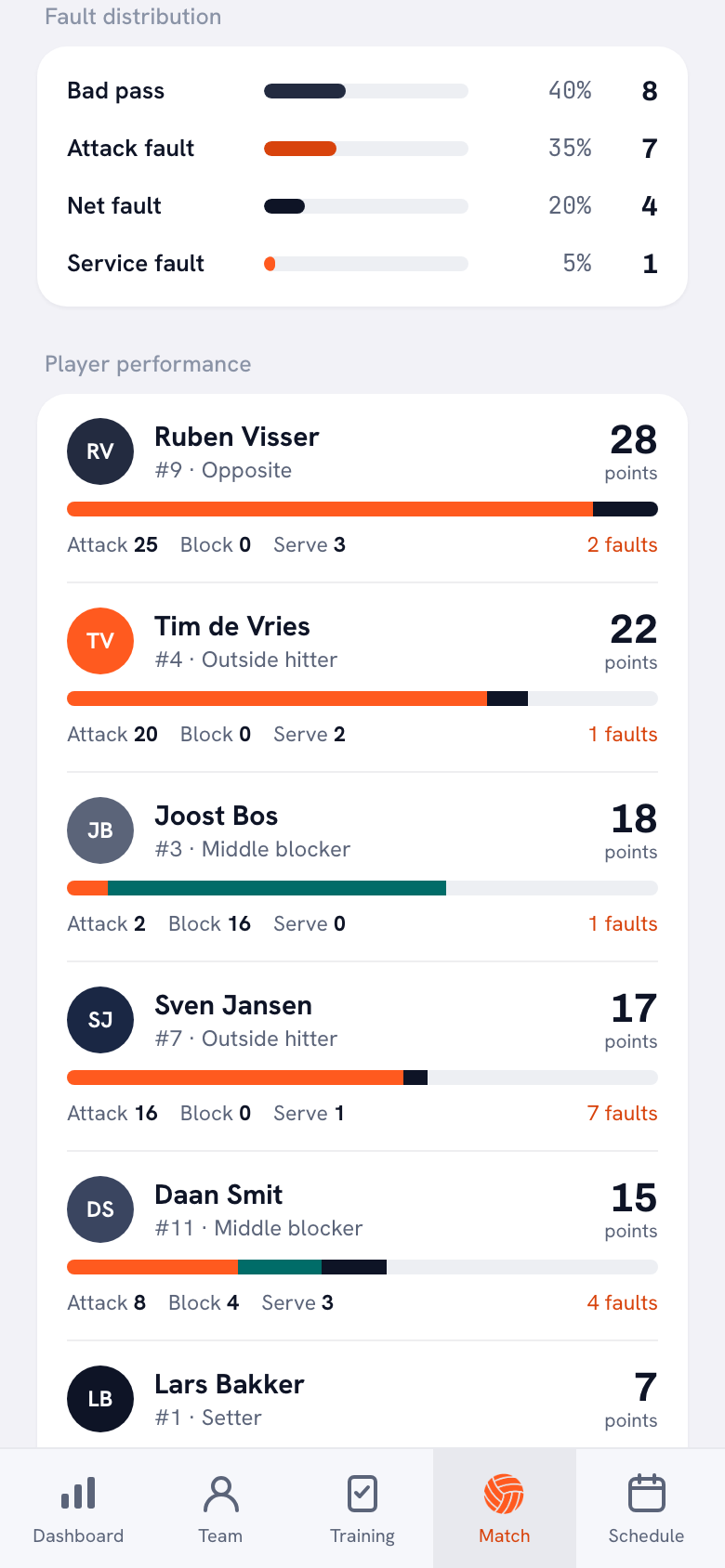
“One of my outside hitters had, as far as I was concerned, a shocking night. He put two balls into the net right in front of me, he was late getting under the ball, and in my head I had already subbed him off. The next day I opened the player performance block in the app, and there he was with seventeen points. Sixteen of them from attack. Fourth on the list.
“What I had right was the seven errors. More than anyone else in the team. But he also made seventeen points, and I had simply lost those. I had kept the two balls that hurt and thrown away the sixteen that went in.”
So the numbers were right.
“About the counting, yes. About the meaning, no. The app says seven errors. It does not add that four of them came after we had swapped our setter and the balls started arriving differently. I know that, because I was standing there. A number like that is a question, not an answer.
“That is the heart of it for me. Numbers are brilliant at counting and useless at interpreting. A coach is exactly the other way round: I can see why something happens and I am hopeless at adding things up. You need both, and above all you should not let either do the other one’s job.”
Was there ever a time the numbers were right but no use to you?
“Plenty. The best example is side-out per rotation. It tells me we win thirty-nine per cent of the rallies on the opponent’s serve in rotation 1, and fifty in rotation 2. Perfectly true. And now what? I cannot remove a rotation. There are six of them and every one comes around.
“A number like that only becomes worth something once I can say what is going wrong in there. For us it was the pass on one position. You do not see that in the bar, you see it in the gym. The bar only told me where to look. Still useful, but less than people think.”
During a match there is no time to dig into anything. What do you do then?
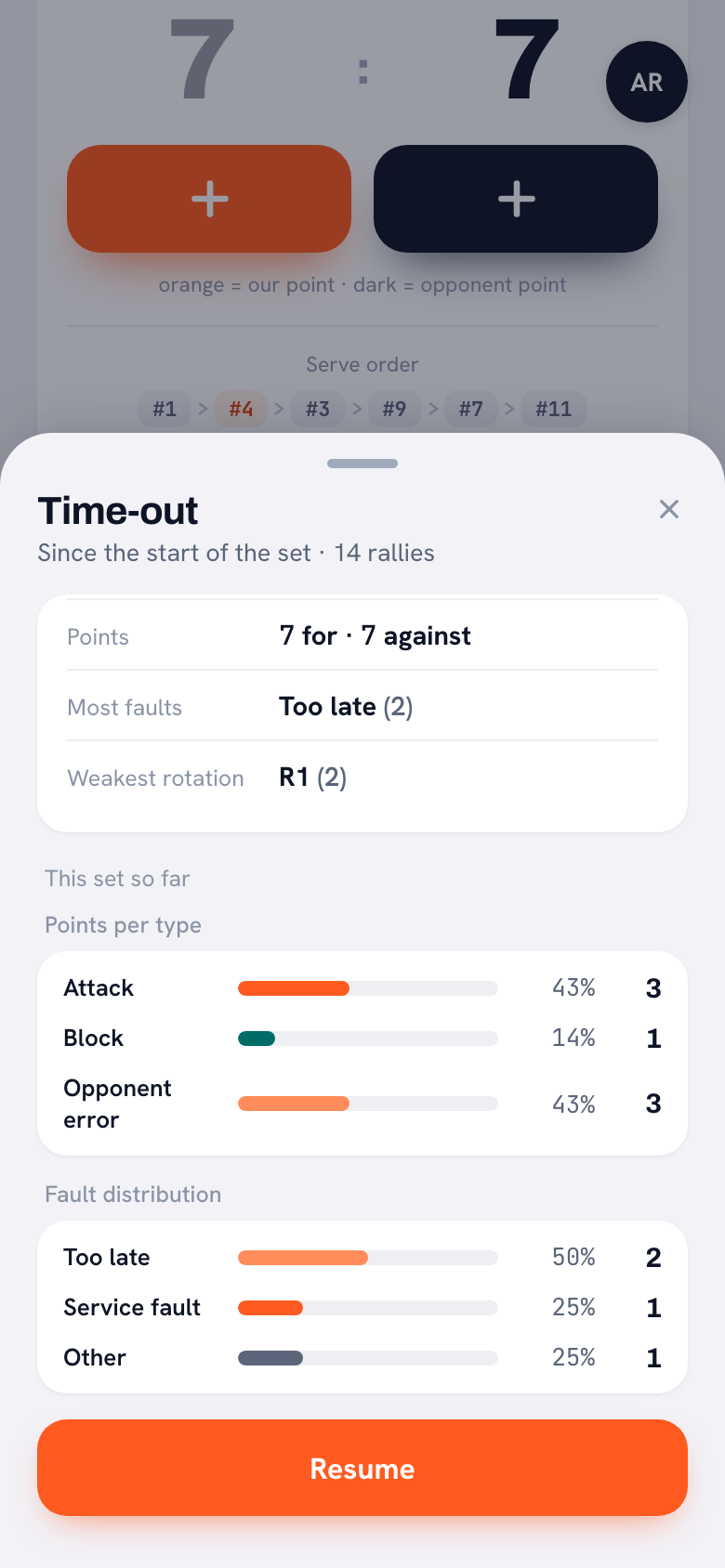
“During a match my eyes beat the numbers, if only because you have thirty seconds. You call a time-out and you want to know one thing, not five. That is why the time-out card in Koach is deliberately short: how many rallies have been played since the start of the set, points for and against, which error came up most, and which rotation is running worst.
“That is not a report, that is one sentence you can actually use. If it says ‘late’ was the error twice, I know it is not a technique problem but a footwork problem, and that is exactly how I say it. Anything longer than that you are not going to read on the bench anyway.”
And when your gut and the numbers contradict each other, which one wins?
“I have one rule of thumb for that, and it is simple. Over one match my eyes win, over five matches the numbers win. A single evening is too little to mean anything. A player can get unlucky three times, he can be served off the court, he can be coming down with something.
“But if I see the same pattern five matches in a row and my gut still says otherwise, then my gut is wrong. By then I have built a story about that player in my head and I have started collecting evidence that fits it. That happens to everyone. Which is why it is rather nice to have something watching that is not fond of anybody.”
How does a run like that show up in the app?
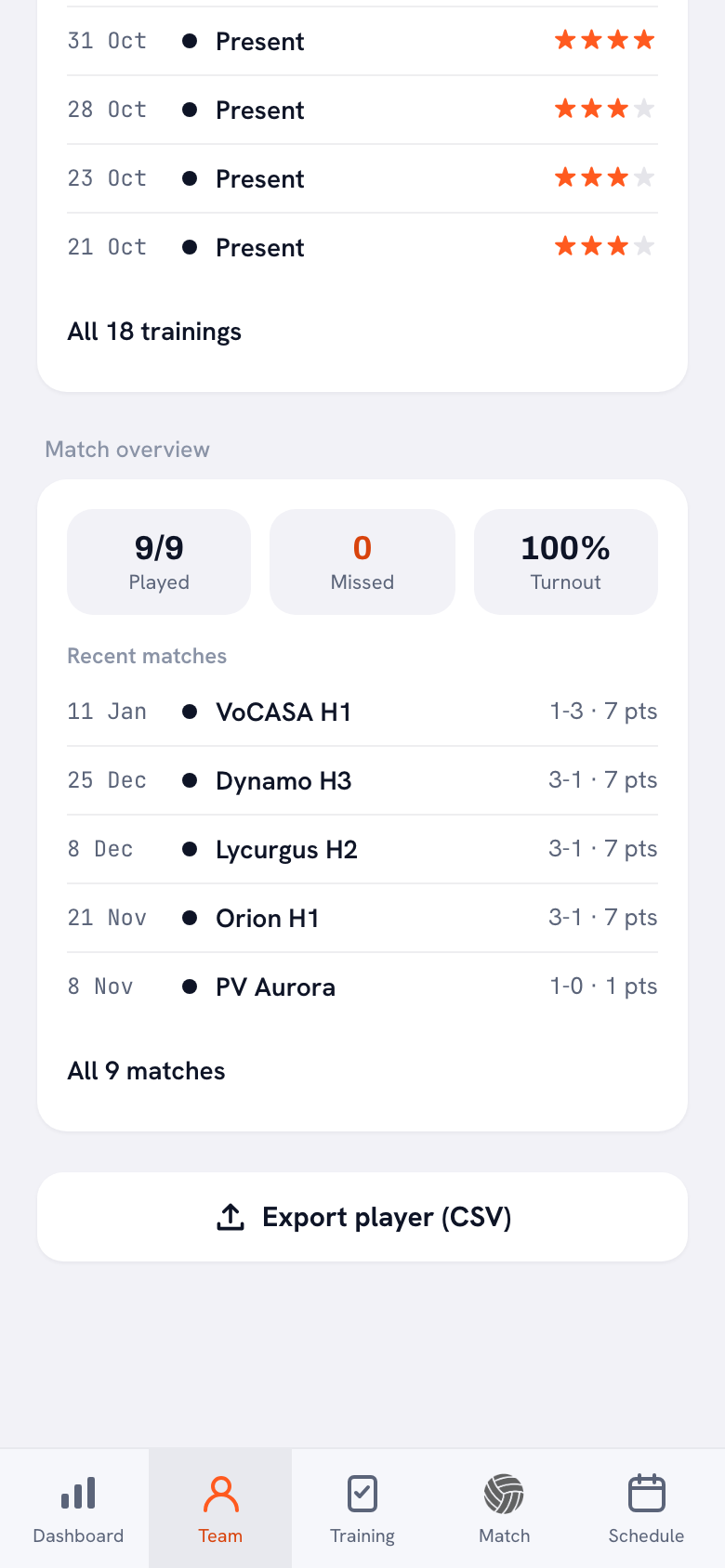
“The player profile has a match overview: the recent matches listed underneath each other, with the set score and what he scored that night. In five seconds you can see whether an impression is an incident or a line. Above it sits the same thing for training sessions, with the rating for each one.
“I mostly use it before a conversation with a player. Not to wave numbers at him, because that backfires, but so that I know myself whether what I am about to say holds up.”
What can the app emphatically not see?
“Almost everything I care about. [laughs] Whether someone is coachable. Whether he lifts his team-mates after an error. Whether he dragged us through that fifth set while scoring nothing himself. There is no number for effort, and I am not going to build one, because then I would be pretending I can measure it.
“And there is something underneath that too: a human being taps those points in. When the point goes to the opponent you choose whether it was a good ball from them, who made the error, or that you did not see it — and that last option is allowed. I would far rather have an honest ‘unknown’ than an error landing on the wrong player, because you make decisions on that later.”
And yet you also store your own judgement in the app.
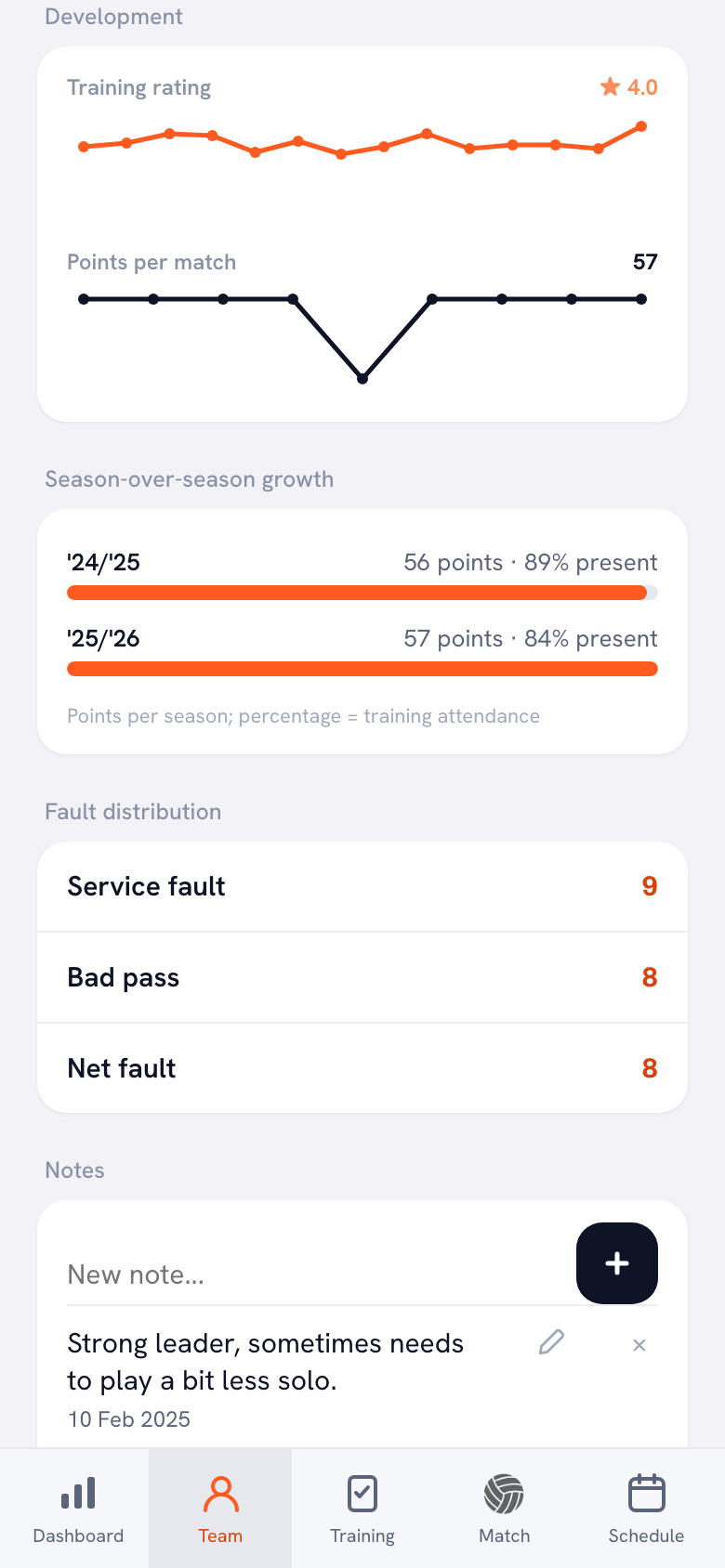
“Yes, in the notes on the player profile, and that is on purpose. A line like ‘strong leader, sometimes plays a bit too solo’ is not a statistic, but it sits right next to the graph. In three months I will not remember what I thought in September, and then a sentence like that is worth more than a percentage.
“On the same screen you get the points per match as a line and that player’s fault distribution across the season. Putting those two side by side is the whole idea: the number counts, the note interprets.”
Have you ever made a decision purely on numbers?
“Once, and it went wrong. I took someone out of the starting six because his error list was the longest. On paper that was correct. What I had not weighed up is that he also got far more balls than anyone else. The chance of an error simply rides along with the number of times you touch the ball. The player I put in made fewer errors and far fewer points.
“That is the trap: numbers feel objective, so you question them less than you question yourself. Ever since, whenever I look at an error I look at what is standing next to it. Two errors on five balls is worse than seven errors on fifty.”
What would you say to a coach who does not trust his gut? Or his numbers?
“The same thing to both: use one to check the other, not to replace it. If you do not trust your gut, look back at one match and count. If you do not trust the numbers, there is only one way to find out: record a few matches and see whether they say what you saw. Usually they almost do, and the difference sits exactly where there is something to learn.”
Put your gut next to the numbers
Koach records who scored and what went wrong while the match is running, and keeps your own notes right beside it. Try it for free and check your impression against the numbers after your next match.
Try Koach for free