12 Fun Volleyball Games for 8-Year-Olds Kids Ask For
A good game does two things at once: kids ask for it, and while they play they rehearse exactly what you wanted to train. These twelve work with groups of eight to eleven year olds, with what each one trains and how to pitch it at the right level.
Why a game delivers more than a drill
In a classic drill in pairs a child does what you say; in a game they make decisions. That difference is big: kids who choose for themselves where to put the ball remember the movement better and hold attention longer. The arithmetic is simple too — a game with four kids on a small court gives each child two to three times as many ball contacts as a drill in which you wait your turn. The condition is that there is a technical goal in it, otherwise it is just a fun hour.
Four games to warm up
- 1. Ball tag. Two taggers holding a soft ball tag the rest; whoever is tagged becomes a tagger. Trains: movement, looking, reacting.
- 2. Over the bench. Two groups either side of an upturned bench throw and catch; drop it and you lose a point. Trains: throwing in an arc, choosing a receiving position.
- 3. Relay with the ball overhead. In a line, pass the ball back with arms extended overhead, then sprint from the back to the front. Trains: the arm extension of setting, plus tempo.
- 4. Rescue dodgeball. Classic dodgeball with soft balls, but anyone hit can come back if a teammate throws them a ball and they catch it. Trains: catching under pressure, and nobody stands still for more than ten seconds.
Four games for technique
- 5. King of the court. Two against two on small courts; the winning pair moves up a court. Trains: everything at once, and every kid touches the ball every few seconds.
- 6. Catch-and-set. Every ball may be caught first, then tossed and set. Trains: overhead contact without time pressure. Once it runs, take the catch away from one of the two teams.
- 7. Hit the mat. Two groups try to land a pass on a mat or hoop on the other side. Trains: giving the pass a direction instead of just getting it up.
- 8. Ten in the air. A group of three keeps the ball up as long as possible, counting out loud, trying to beat their own record. Trains: cooperating, calling, choosing a spot. Works better than any concentration exercise you can think of.
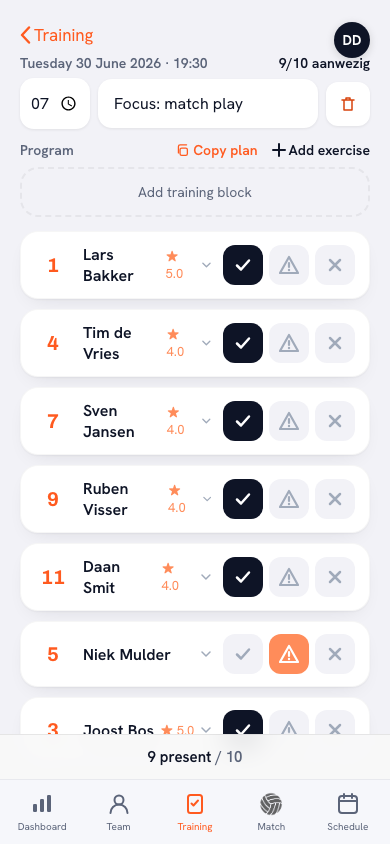
Recording it costs little: the Koach library holds more than two hundred worked-out drills with animations, and the games that landed well with your group you save as your own template for next season. See also the drill library for how to build that collection up.
Four game formats
- 9. Double points. An ordinary small-sided game, but a point counts double if the ball was played three times before it went over. Trains: playing three contacts, without you having to hammer on about it.
- 10. Moving house. Whoever scores a point moves to the other court. Teams change constantly. Trains: playing with everyone, and nobody gets stuck in a losing team.
- 11. Serve and run. After serving, the server runs around a cone and joins the court again. Trains: serving under mild time pressure plus movement — and it is surprisingly tense.
- 12. Joker court. Three against three with an extra player who always belongs to the attacking team. Trains: recognising an overload and finding the free player; weaker players also end up in the play far more often.
The four dials that set the level of any game
Every game above can be made easier or harder with the same four dials, without having to invent a new one:
- Court size. A smaller court means more rallies; a bigger court means more defending and running.
- The ball. Lighter or softer makes everything easier; changing the ball is the fastest adjustment there is.
- Number of contacts. Allow a catch, allow an extra contact, or make three contacts compulsory.
- The scoring rule. What you award points for decides what kids will try. Double points for a good pass work better than shouting about passing ten times.
Aim for roughly a seventy percent success rate. If almost everything works, the group gets bored; if less than half works, the energy is gone within two minutes.
The rules of the games hour
- Explain in ninety seconds, maximum. Anything that takes longer to explain, they will only grasp by playing it.
- Everyone plays. No games where you are knocked out and sit on the side — pick variants where you can come back in.
- Restart within thirty seconds after an interruption. Every stoppage costs attention you do not get back.
- Stop while it is still fun. The game you cut off at its peak is the game they ask for next week.
How to fit these formats into a complete session is in building a youth practice.
Frequently asked questions
How much of a youth practice can consist of games?
With eight to eleven year olds, half to two thirds is fine. Skills stick fastest when kids have to use them in a game straight away; isolated drilling without application quickly loses its effect at this age.
What do I do about big ability gaps within one game?
Change the demands, not the game. Give stronger kids an extra task (setting only, or a compulsory pass first) and weaker kids a bigger margin, such as being allowed to catch. That way everyone plays the same format.
How many games do I prepare per session?
Count on three or four plus a spare. A game that is running well can happily run longer; more important than the number is that you know the progression and can adjust the game while it runs.