
Volleyball for 6-year-olds: how to coach kids aged 5 to 7
The short answer
Volleyball for 6-year-olds is mostly throwing, catching and moving with a light ball. As a rule of thumb you coach 5 to 7 year olds in sessions of 45 to 60 minutes, with a ball per child, short games without lines, and as the first game form one against one over a rope, catching and throwing the ball.
Volleyball for 6-year-olds looks nothing like practice for adults, and that is how it should be. This article is for the coach or parent who takes on a group of 5 to 7 year olds: what they can already do, how to build a session, six games that work and when a child is ready for the next step.
What can a child of 5 to 7 do with a volleyball?
A child this age doesn't play volleyball the way you see it on TV yet. Playing a ball back over the net without holding it means quickly judging the path of a flying ball, and children only learn that in the years after this. What they can do: throw, catch a bouncing ball or a slow high one, run and stop, jump and turn, and take turns with another child. How that shifts with age is covered in what age a child can start playing volleyball.
So your practice revolves around four things: moving, ball feel, playing together and the first volleyball forms. Those last ones are catching above the head and throwing a ball over a rope to another child. Real skills such as forearm passing are not something you drill yet; they come later, once reading the ball works. What changes for each age group after that is in coaching youth volleyball by age.
How to build a session for 5 to 7 year olds
As a rule of thumb a session of 45 to 60 minutes is enough; there is no fixed standard for this age. Better 45 minutes in which everyone moves than an hour whose last quarter falls apart. A fixed order helps young children: they know what's coming and you have less to explain.
| Part | What you do | Minutes |
|---|---|---|
| Circle | Names, and in one sentence what we're doing today | 3 |
| Moving | A tag or running game, with or without a ball | 7 |
| A ball each | Ball feel: rolling, bouncing, tossing up, catching | 10 |
| Together | Throwing and catching in pairs | 10 |
| Game over the rope | One against one or two against two | 12 |
| Circle | What went well, tidying up together | 3 |
Change the activity after a few minutes (five to eight is a useful rule of thumb), even when it's going well: stop while it's still fun. Agree on one fixed stop signal, for example "ball between your feet", and use it every session. And no lines: a six-year-old standing in a line is busy with something else within half a minute.
Six games that work with kids aged 5 to 7
1. Traffic light with a ball
Everyone walks around the gym with their own ball. On green you walk with the ball in your hands, on yellow you roll or bounce it, on red you stand still with the ball above your head, in the "window" of your hands. Easier: only green and red. Harder: add a fourth color, for example blue: toss the ball up and catch it. It trains listening, moving with the ball and the hand shape above the head.
2. The catching ladder
Every child has a ball and picks their own step: toss and catch, toss with a clap and catch, toss and catch after one bounce, toss, touch the floor and catch. Whoever gets five in a row moves up a step. Nobody waits, and every child works at their own level; in a group this age those levels are far apart.
3. Balloon keep-up
Pairs with a balloon. Tap the balloon with two hands above your head to your partner and count together how many times you manage before it touches the floor. A balloon floats long enough to get under it, so here something works that doesn't work with a ball yet. Harder: touch the floor once after every tap.
4. Rainbow throw into the hoop
Pairs three meters apart, with a hoop on the floor between them. Throw the ball in an arc so it bounces once in the hoop; your partner catches it above the head. Five good ones and you take a step further apart. It trains aiming, and the catcher learns where a ball goes after a bounce.
5. Clean up your yard
Two groups on either side of a rope or low net, with as many soft balls as possible. Throw the balls with two hands above your head over the rope into the other yard. At the whistle everyone freezes and you count the balls on each side together; the yard with the fewest balls wins. Everyone touches a ball again and again, and nobody is out.
6. One against one over the rope
Small courts of about three by three meters per child, with a rope at head height. Throw the ball over the rope; your partner catches it, at first after one bounce, and throws it back from the spot where they caught it. First count together how many times the ball goes over, and only later play for points. Harder: catch without a bounce, or two against two where you first throw to your teammate. This is the first form of real volleyball: over the net, reading where the ball will land and getting there.
Equipment: light balls, a low net and plenty of space
- Balls. Soft, light balls, ideally one per child, and a few balloons for the first catching games. An official match ball is too heavy and hurts; which ball suits which age is in what size volleyball for each age.
- Net. A rope, an elastic band or a low badminton net at the children's head height, or an upside-down bench.
- Courts. Cones or lines for small courts, and a few hoops. Set everything up before the children come in.
- Help. A rule of thumb from practice: with eight to ten children you can keep an overview as the only coach. If you have more, ask a parent to look after a small group.
Show it, say one sentence, let them start. A six-year-old remembers little of a one-minute explanation. Show the game with one child, say what the most important rule is and start. Explain the rest while they play, to the child who needs it.
How to talk to young children in the gym
- Use pictures. "Make a window above your head" works better than "hands above your forehead, thumbs toward each other".
- Praise what they do. "You were already under the ball before it dropped" tells a child more than "good job".
- Let them choose. Their own step on the catching ladder or their own distance gives every child success.
- No elimination games. Whoever is out stops moving, and those are exactly the children who need to move most.
- A soft start for fear. A child who ducks away from the ball starts with rolling and a balloon. More on that in helping a kid who is afraid of the ball.
When is a child ready for the next step?
Look at the game, not the birthday. A child is ready for more volleyball once they catch a high ball above the head while standing still, move to the spot before the ball drops, throw on target to another child and keep the ball going back and forth a few times in a game of one against one. Then it is time for the games of the next age group, such as volleyball games for kids aged 8 to 11, and for the progression from catching to playing the ball directly in mini volleyball drills by level.
Keeping track of a group of young children in Koach
With a group of six-year-olds, most of the work isn't the practice but everything around it: who's coming, how many balls you need and which game worked last week. In Koach you set up the session as a plan, with each game as a section with a name, the duration and the rules in the description. If the session worked, you bring it back the next week with Copy plan.
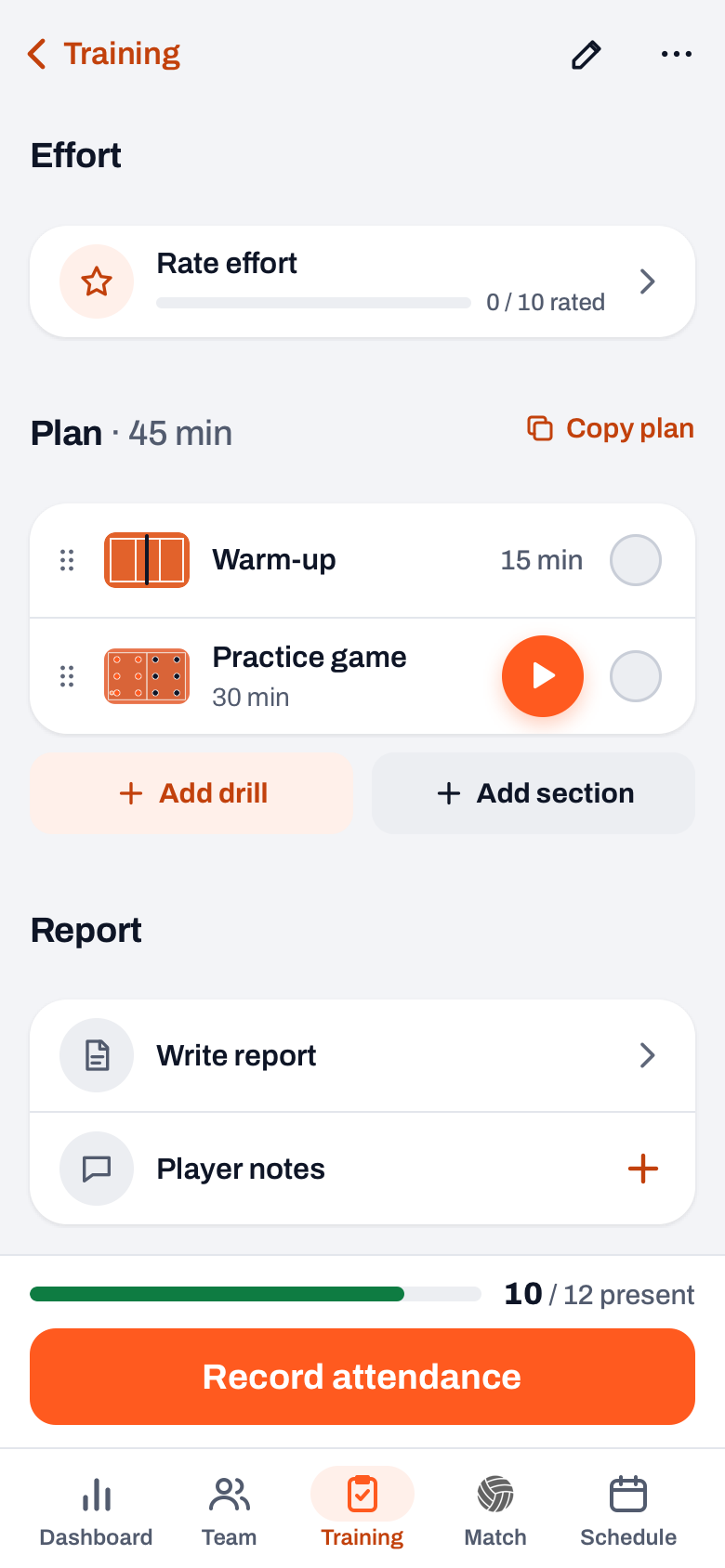
Parents mark their child as coming or not coming on their own dashboard or in the schedule, so you know before the session how many children will turn up. In the gym you tick off attendance and record it. What Koach costs after the 14 free days is on the pricing page.
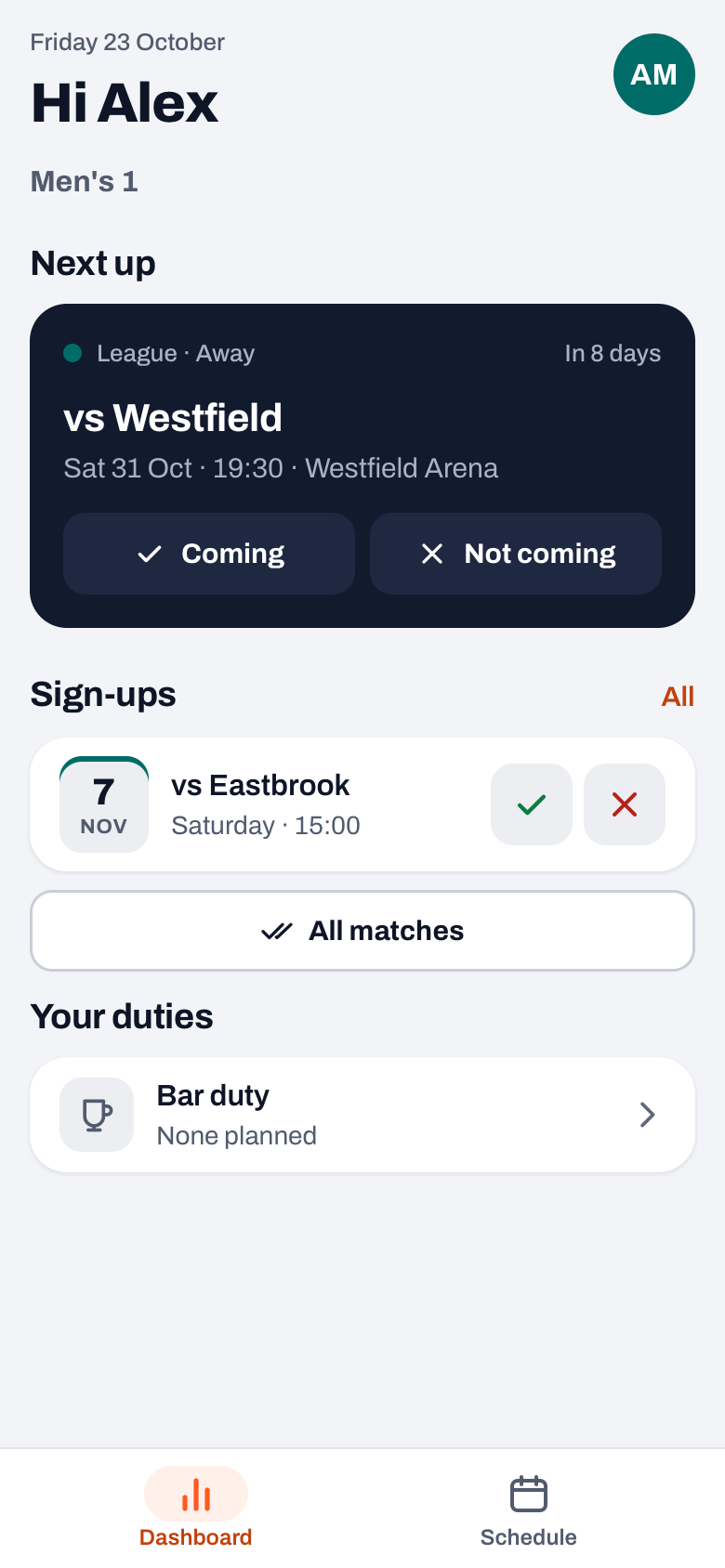
14 days free, no credit card. Set up Saturday's session and let the parents sign their child up themselves.
Try Koach with your groupFrequently asked questions
How long should volleyball practice for 6-year-olds be?
As a rule of thumb 45 to 60 minutes; there is no fixed standard. Longer makes little sense: attention drops, and a shorter session in which everyone moves the whole time achieves more. Split the session into short blocks of five to eight minutes, with a fixed start and a fixed finish in the circle.
What ball should you use for kids aged 5 to 7?
A soft, light ball, ideally one per child. A balloon is good for the first catching games because it falls slowly. An official match ball is too heavy for this age: it hurts the hands and arms, and a child who expects pain ducks away instead of moving toward the ball.
Should a 6-year-old already learn to set or pass?
Not as a skill drill. The hand shape for setting comes back naturally in catching above the head and keeping a balloon up. You only really train forearm passing and setting once a child reads the path of the ball well, usually a few years later.
What do you do with a child who doesn't want to join in?
Don't force them and don't ignore them. Give the child a role in the game, such as handing out balls or counting, and invite them again for the next game. If a child always needs a few minutes before starting, let them start next to a friend. If it stays difficult, talk it over calmly with the parents.


Set up Saturday's session
14 days free, no credit card. Next week you copy it with one tap.
Get started with KoachOr read first what the volleyball coaching app does.