
3v3 volleyball: rules, formation and court size
The short answer
3v3 volleyball has no general rulebook. One official format is FIVB snow volleyball: three players plus one substitute, a 16 by 8 metre court and sets to 15. At practice it is often played on half a court lengthwise, and in a good rally everyone touches the ball: pass, set, attack.
3v3 volleyball is not a stripped-down version of six against six, but a game in which every player is involved in every rally. You come across it on snow, in youth volleyball, at recreational tournaments and above all at practice. These are the rules, the court, the formation and how to use it as a practice game.
Where do you play 3v3 volleyball?
There is no general FIVB rulebook for three against three indoors. Which rules apply depends on where you play:
- Snow volleyball. An official format with its own FIVB rules. The main rules are below.
- Youth. In a number of countries three against three is a competition format within mini volleyball, with a smaller court and a lower net. The sizes and rules are set by the federation in your own country; how such formats are built up is in the mini volleyball rules.
- Recreational tournaments. On grass, in the park or in the gym. The organiser decides the court, net and scoring, as with grass volleyball.
- Practice. Here you choose yourself, and that is mainly what this article is about.
Official 3v3: the snow volleyball rules
The FIVB snow volleyball rules (2021-2024 edition) look like a mix of indoor and beach:
- Team: three players on court and optionally one substitute, with at most two substitutions per set.
- Court and net: 16 by 8 metres, the same size as a beach court. The net hangs at 2.43 metres for men and 2.24 metres for women, lower for youth.
- Scoring: sets to 15 with a two-point lead, whoever wins two sets wins the match. Court switch after every 5 points, one 30-second timeout per set.
- Positions: there are none. Players may stand wherever they like; only the serving order is fixed for the whole set.
- Ball contact: three hits, a block does not count as one. As on sand, you may not attack with an open-hand tip using your fingertips, and an overhand set over the net must go straight forward or straight back in line with your shoulders.
- Coaching: players get no instructions from outside during the match.
The full text is in the Official Snow Volleyball Rules 2021-2024 on the FIVB site; in November 2026 the FIVB did not yet offer a newer edition. If you play a recreational tournament, ask for the rules: the indoor rules often apply there, with their own court size and scoring.
The court: how big do you play 3v3?
The number that counts is the floor per player. On a regular half court of 9 by 9 metres, each player covers 13.5 square metres in six against six. In three against three on that same half, it is double.
| Court per side | Floor per player in 3v3 |
|---|---|
| 9 by 9 metres (regular half) | 27 m² |
| 8 by 8 metres (snow court) | Just over 21 m² |
| 9 deep, 6 wide (sidelines brought in) | 18 m² |
| 9 deep, 4.5 wide (half court lengthwise) | 13.5 m² |
The half court lengthwise gives every player exactly as much floor as six against six on a full court, and you play two games at once under one net. That is why it is the default choice for practice. The downside: at 4.5 metres wide the cross-court shot barely exists, so hitters mainly hit straight ahead. If you want players to learn to read and move, as on sand, choose the full width.
Formation: two basic shapes with three players
With three players you have no positions as in a line-up for six, but you do need a fixed shape. Two shapes work, and teams that do not choose one end up playing both halfway.
- The triangle. One player in front, slightly right of centre and close to the net; two players at the back, each covering a half, about six to seven metres from the net. The front player sets the second ball, the two at the back pass and attack. Strong: the second ball is always clear. Weak: a short ball in the middle front drops between the three.
- Three across. All three about six metres from the net, each covering a third of the width. Everyone passes, and the player who did not play the first ball and is closest to the net sets. Strong against a hard serve; weak if nobody agrees who takes the second ball.
Who takes the second ball, you agree beforehand, just as in the formation for 4v4. With three players the rule is even simpler: whoever did not play the first ball and is closest to the net calls "mine" before the first contact and sets. The third player and the passer are then both hitters, so the setter can choose.
The serving order runs over three players, so everyone serves much more often than in six against six. Have each player remember who serves before him; that is one name instead of an order.
Blocking with three: only when it pays off
Every blocker takes a defender off the court. On a 9 by 9 metre half, the remaining two then share 81 square metres, over 40 each. So only block against a hard attack off a good set close to the net. On a high ball far from the net, a tip or a free ball, all three stay back and you defend with three. On a narrow 4.5 metre court it is different: there one blocker closes off a big part of the net, and blocking pays off more often.
Agree on three things before the first serve. Which basic shape you play, who takes the second ball and who serves after whom. Without those three, 3v3 is not a game but three people running to the same ball.
3v3 as a practice game for your indoor team
Three against three gives every player lots of ball contacts. Take a rally that goes back and forth three times: each side then touches the ball nine times. In six against six that is one and a half contacts per player, in three against three it is three. The same principle is behind the formats in more ball contacts per practice.
- With six players: one game, sets to 15, a different split after each set.
- With nine players: three teams of three. The winning three stay on, the losing three go off and the waiting three come on. Play to 7 or on time, so nobody stands still for long.
- With twelve players: two games side by side on a half court lengthwise, with lines or cones as the centre line.
Three constraints keep the format useful for matches: three contacts compulsory, calling before the first contact, and beginner groups start with a tossed free ball instead of a serve. Watch the load: every player jumps and defends much more often than in six against six, so keep the games short and rotate the teams of three.
There is a downside too. In three against three a slow high set and an attack through the middle get rewarded, while in six against six they end in a double block. So in the last part of the game, only count sets that land close to the net, and briefly name what is different in a match afterwards.
Tracking 3v3 in Koach
In Koach you track a game at practice as a practice game. With + Add drill you add the Practice game to the practice plan and start it from there. For each player you choose Team A or Team B, and that can be three per team. With Rotation on, each team gets a serving order of three, just like in a real game. In Simple you tap per rally who scores and who makes the error.
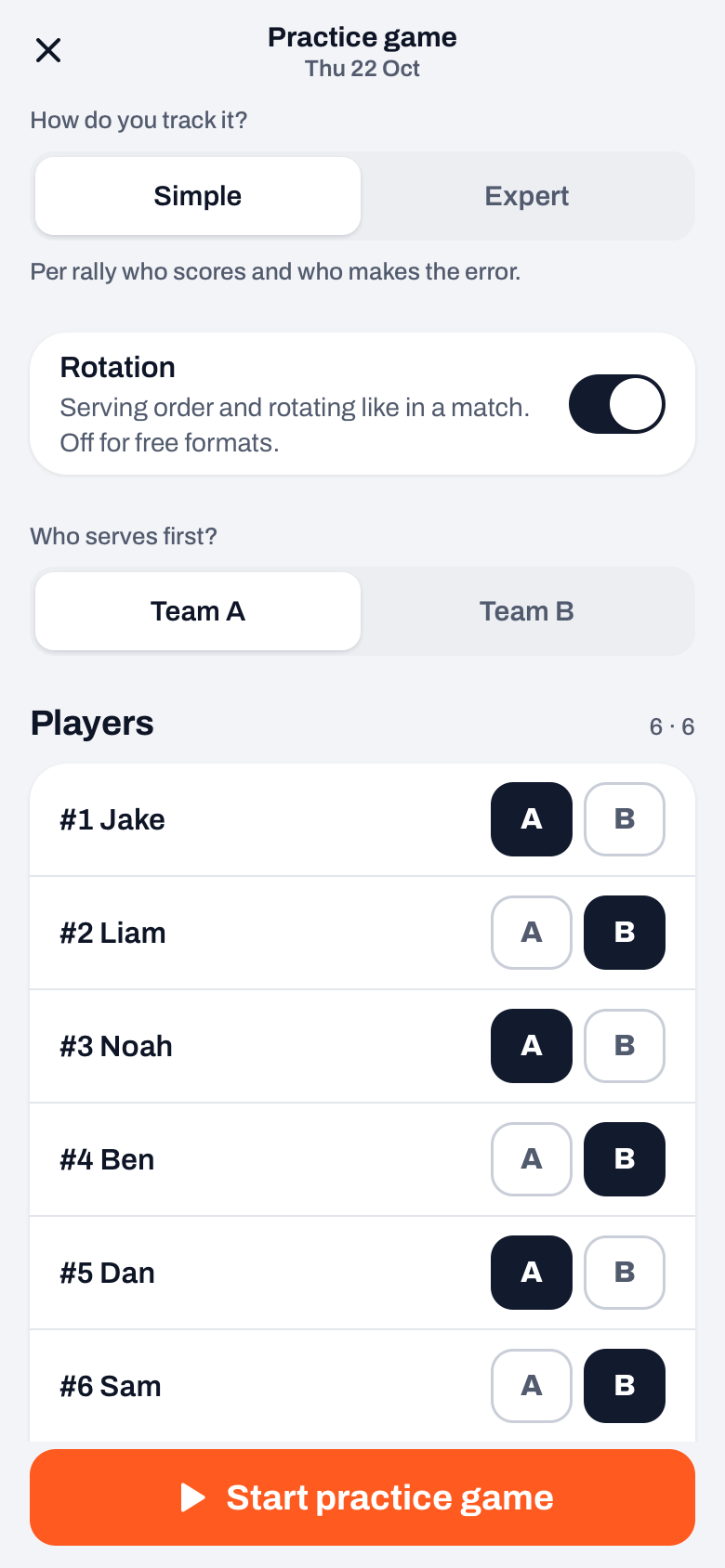
After a set you start a New round: the score is kept and it starts again at 0-0. If you tap a player during the game, you move him to the other team or swap him with a teammate. After Finish and save you see the points and errors per player, separate from your match stats. What Koach costs after the 14 free days is on the pricing page.
14 days free, no credit card. Put your next 3v3 in your plan as a practice game and see who scores in the game.
Try Koach at your practiceFrequently asked questions
How big is the court in 3v3 volleyball?
That is not fixed. Snow volleyball, the official format, is played on 16 by 8 metres. At practice a half court lengthwise is common: 9 metres deep and 4.5 metres wide per side, so you play two games side by side. At a recreational tournament the organiser decides the size, so ask for the rules.
Can you tip with your fingertips in 3v3?
That depends on the rules. In snow volleyball you cannot: an attack with an open hand and loose fingertips is a fault there, just as on sand. At recreational indoor tournaments the regular indoor rules often apply, and then it is allowed. Check before the first match, because it changes how you defend.
Do you need a fixed setter in 3v3?
No, but you do need a fixed agreement. With a fixed setter in the triangle, the second ball is always his. If you play three across, the player who did not play the first ball and is closest to the net sets, and he calls it before the first contact. Without an agreement, two players go for the same ball.
How many players do you need to practise 3v3?
With six players you have one game. Nine is ideal: three teams of three, where the winning three stay on and the waiting three come on. With twelve players you play two games side by side on a half court lengthwise. Keep the sets short, because every player jumps and defends much more often than in six against six.


Track your practice games
14 days free, no credit card. After a week you see who scores in 3v3.
Get started with KoachOr read first what the volleyball coaching app does.