
An angry parent at your club: getting the conversation right
He has been watching for a whole set and after the last ball he walks straight at you. What you say in the fifteen seconds that follow decides whether this becomes one conversation or three weeks of grief in the group chat. The temptation right then is to do exactly the wrong thing: argue the substance, on the sideline, with twenty people listening. The conversation you want to have isn't the one you have there and then.
The moment on the sideline: three sentences, then you stop
You never win an argument next to a court. People are listening in, you both still have adrenaline running, and the parent has been rehearsing his line for five minutes. Anything you say about the substance there can be quoted back at you later in a version you don't recognise. So your aim isn't to explain or to be proved right, but to move the conversation to a moment where it can actually happen.
Three sentences do that, in this order:
- Acknowledge. “I can hear you've got something to say about it, and I do want to hear it.”
- Set a boundary, with a reason that isn't about him. “Just not here — I'm standing among the children and my head isn't in it right now.”
- An arrangement with a time in it. “I'll ring you tomorrow evening at eight and take twenty minutes for it. Does that work?”
Then turn around and go back to your team. If the parent keeps going, repeat sentence three word for word, without new words: every new argument is a new handle. Make sure you aren't standing there alone either — a third person present usually takes the edge off — and walk a few metres away from the bench, so the child it is about doesn't have to listen to it.
Six sentences that always make it worse
- “Calm down.” Nobody in history has ever calmed down because of it.
- “That's my decision.” True, but you turn it into a question of authority, and from then on the conversation is about who is in charge.
- “The other parents are fine with it.” You set parents against each other, and within a week he'll hear from others that they weren't fine with it.
- “If you know better, you do it.” Sometimes someone says yes.
- Anything about another player. “Sanne just fits there better” is the start of a second angry parent.
- “I'm a volunteer, you know.” Also true, but it turns your work into a favour and his criticism into ingratitude.
This article is about the confrontation once it is there; the arrangements that head most confrontations off are in parents on the sideline.
The 24-hour rule, with an upper limit
The 24-hour rule is well known in youth sport: you don't talk about a match until a day later. It applies to this conversation too, but with an upper limit attached. At least 24 hours, otherwise you are talking to two people who are both still in the match. At most 72 hours, because a complaint left lying for four days often isn't one parent's any more: by then he has talked it over with others, and you are no longer talking to a father but to a story. Three rules go with that:
- You ring him, not the other way round. Even if you think it has blown over. Not ringing is a common mistake, and an expensive one: the parent concludes you don't take him seriously and goes to somebody else.
- Ring, don't message or email. A written sentence has no tone, so the reader picks one — usually the nastiest available.
- One exception. If it is about safety, health or behaviour towards a child, you don't wait 24 hours, and you don't do it alone — see the last section.
The twenty-minute conversation, with the clock running
Say at the start how much time you have: “I've got twenty minutes, is that enough?” A limit set in advance makes the conversation both shorter and calmer. Here is how you spend those twenty minutes:
- 0–2 minutes: the opening question. Don't start with your side, start with this sentence: “Before we talk about the match — has [name] said anything about this himself, and does he know we're talking now?”
- 2–8 minutes: he talks, you write. Literally: pick up a pen. Don't interrupt, don't correct, not even when something isn't factually right. Three follow-up questions are enough: “When did you first notice that?”, “What exactly did you see?” and “What do you think should change?”
- 8–10 minutes: sum it up in his words. “Let me summarise, tell me if I've got it wrong.” Don't move on until he says yes. A parent who knows he has been summarised correctly doesn't need to explain it all over again — and that is exactly what a second conversation is.
- 10–15 minutes: your side, with facts. Two reasons, concrete, without dragging the other players into it.
- 15–18 minutes: one commitment. Not three. One thing you are going to do, with a date on it.
- 18–20 minutes: the two closing sentences that are written out further down.
That opening question is the most important sentence in the whole conversation, because it separates the child's complaint from the parent's. There are three answers and they lead to three different conversations. “Yes, he's gutted about it” — then there is a problem with the child; schedule a short conversation with the player himself straight after. “No, he knows nothing about this” — then the complaint is the parent's. Legitimate too, but it is then about what he sees rather than what the child feels, and you are allowed to name that difference out loud. “He says it's not that bad” — usually the child doesn't want to be caught in the middle. Promise then that you won't raise it with him as if he had complained.
The moment you stop defending
There is one recognisable signal: you hear yourself explaining the same decision for the second time, in different words. From that point you aren't convincing anybody; you are only confirming that you are defending yourself, and defending reads as guilt. Stop there and switch from this case to the policy.
The sentence you do it with: “I'm not going to explain to you why Sanne did start on Saturday. I'll show you how I divide playing time, and then we can look together at whether I've stuck to it this month.” That changes the subject from your judgement into an arrangement you can both look at — and one you can be found wrong on. That isn't weakness, that is what ends the conversation.
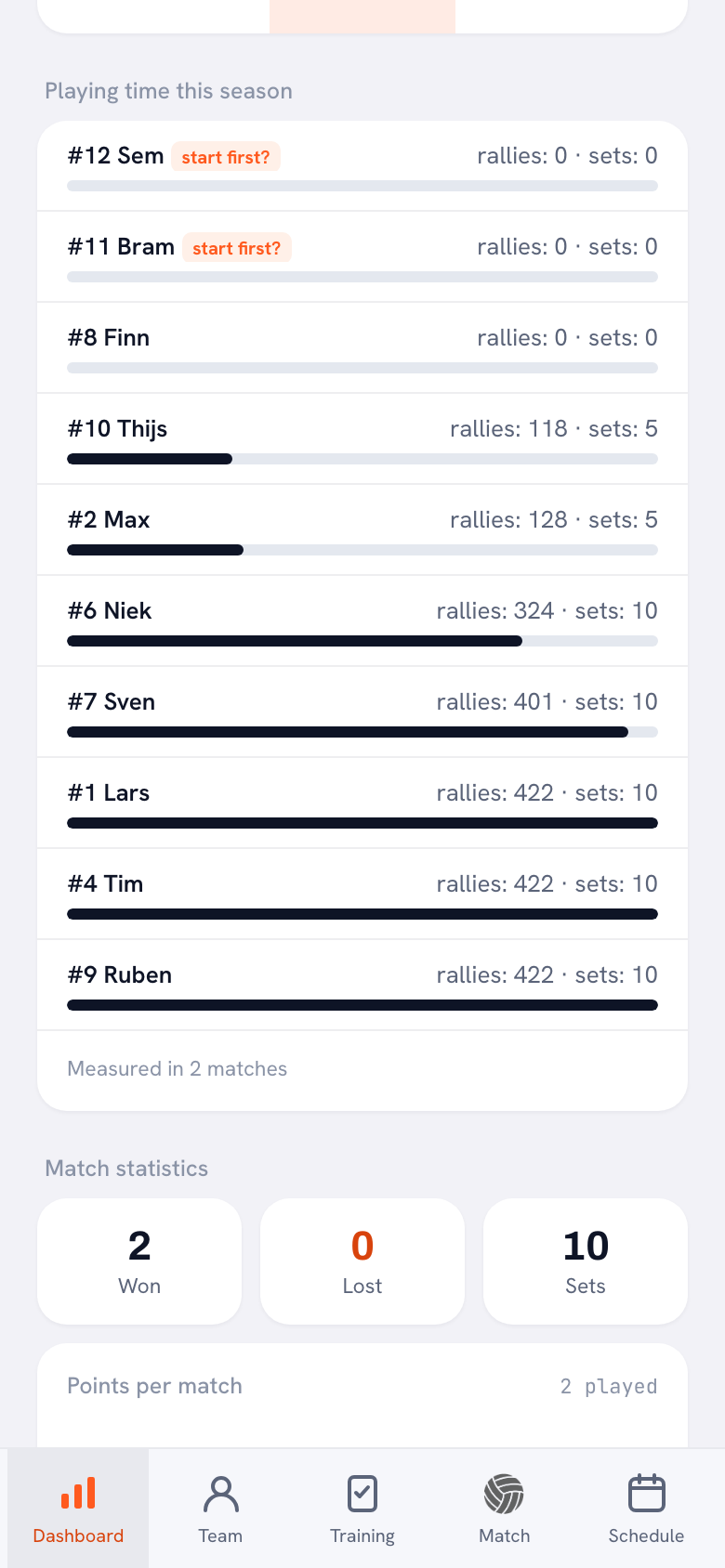
Just make sure you have something to show. Work it out once with your own figures. Say you have played eleven matches lasting 36 sets in total: 36 sets times six positions on court is 216 slots. Divided by ten players that is 21.6 sets per player on a perfectly even split. If this child is on 17, you are talking about not quite five sets across eleven matches — a little under half a set per match. You can argue for an hour about “he hardly ever plays”; you can't about half a set a match.
How to make such a split explainable in advance is in dividing playing time fairly; the tracking itself in tracking playing time. If you record your substitutions during the match in Koach, you already have that overview per player. And if it turns out the parent is right, say so immediately: “You're right. This doesn't match what I agreed and I'm going to put it right.” Those two sentences prevent more grief than any defence.
Three kinds of angry parent, three different conversations
Work out in the first few minutes what the anger is about, because the three kinds ask something different of you.
1. Playing time, lineup or position. This is the policy conversation above: figures, agreements, and one development point for the child that he can influence himself. One rule is absolute — you never talk about another player, not even in the soft version (“Sanne does train more often”). The moment you compare two children, you risk a second angry parent. What you can do: explain what role the team needed. If it turns into frustration about the bench role itself, give that role real content — see keeping substitutes involved.
2. A referee's decision or the opposition. The shortest conversation: five minutes. Here you are an ally, and you can say so. But the subject isn't the decision, it is what the parent did. “I agreed with you about that ball. And I want you to know what happens when you shout that: that referee is a youth member himself and might not be officiating next week.” Never promise a protest or a complaint to the federation; what is possible there and what it costs differs per federation, so check it first. If it was about what was called, the signal itself is often the quickest answer.
3. The way you coach. The hardest one, because it is about you. Here you ask about observation rather than judgement: “What did you hear me say?”, “At which moment was that?”, “What did [name] do afterwards?” Three answers to those get you further than half an hour of arguing about whether or not you are too fierce. Take one point away from it, even if you disagree with the rest — “I'm going to watch how I react after a service error” is stronger than any justification. If it becomes about who you are rather than what you did, the conversation stops and continues with a third person present. If you coach your own child, expect this category more often: the arrangements that calls for are in coaching your own child.
The two sentences you close with
A second conversation often comes about because something was missing: no end date, or no route. The two closing sentences cover exactly those two gaps.
Sentence one — the commitment in his words, with a date. “As I understand it, you're worried that Tim has played less since Christmas. We've agreed that he starts at least one set in the next three matches, and that I'll let you know on 1 March what I'm seeing.”
Sentence two — the route, not the door. “If you still disagree on 1 March, we'll go to the youth coordinator together. That's not a row, that's simply how it works here.”
Watch what you promise. Promise your own behaviour — “he starts”, “I'll watch for it”, “I'll let you know” — and never an outcome such as “he'll be in the starting six”. An outcome depends on too much, and a broken promise is the most reliable way to have the same conversation in six weeks' time with less credit. Ideally hang the follow-up moment on the ordinary development conversation with the player, so no separate complaints track appears.
What you record, and where not
Within 24 hours of the conversation you write down five lines — more isn't needed, less is too little:
- Date, time and form (phone, in the hall, at home).
- Who was there.
- What prompted it, in one sentence, without judgement.
- The commitment, word for word as you said it.
- The date you come back to it.
Write factually: “the conversation got heated” is fine, “dad is a pain” isn't. The exact rights of access differ per country, but the rule of thumb is the same everywhere — write nothing down you wouldn't read out with him in the room. A short note on the player in Koach is enough, or a folder on your own computer.
Then send one two-sentence email with the commitment and the date in it. That is your confirmation and your file at once, and it prevents the version where the two of you turn out to have agreed two different things.
When you are no longer the coach here
There is a point at which carrying on isn't brave but unwise. Hand it over then — not refer, hand over — as soon as one of these five things is in play:
- It gets personal or threatening. Abuse, blocking your way, messages at night. Name it once, and after that don't handle it yourself.
- It is the third conversation about the same thing. Two is a difference of opinion; three is a pattern, and you don't solve a pattern in the corridor outside the changing room.
- It is no longer about your team. Team allocation, moving up, which division or the membership fee are not coaching decisions. Those belong with the technical leadership, and which role that is exactly is in who decides what at your club.
- Other people are being pulled in. The moment the complaint appears in a group chat or does the rounds among other parents, it is a club matter: you can't be both a party to it and the mediator.
- It is about safety or abuse. Then you stop investigating it yourself immediately and report it to the designated person within your club or federation. What that role is called and how the report runs differs per country and per federation — look it up before you need it, not on the night itself.
Hand it over openly: send your five lines to the youth coordinator (or to whoever has that role at your club) and copy the parent in, with one sentence attached — “I've asked the youth coordinator to take this conversation over.” No surprises, no file behind anyone's back. And say to yourself what coaches rarely say out loud: this isn't your failure. It is the club doing its job, and you getting to be a coach again instead of a party to a dispute.
Key point: on the sideline you solve nothing — there you only move the conversation. Everything that finishes it in one go afterwards sits in three things: you ask first what the child makes of it, you stop defending the moment you repeat yourself, and you end with a date plus a route. Miss one of those three and there will be a second conversation.
Frequently asked questions
How do I respond to an angry parent during the match itself?
Acknowledge that you have heard him, say you aren't discussing it now because you are standing among the children, and name a moment straight away when you will ring. If he keeps going, repeat that last sentence word for word without new arguments. Ask a team manager or another coach to come and stand with you; a third person present usually takes the edge off.
What if the parent is still angry after 24 hours?
That is normal and usually not a problem. Have the conversation anyway, but start with what he sees rather than with your explanation. If you notice he isn't looking for a solution but wants to be heard, summarising in his own words works better than any argument.
Can I explain why another player does get to play?
No. The moment you compare two children, you are talking about a player who can't defend herself and you often create a second angry parent. Do explain which role or position the team needed at that moment — that makes your choice followable without it being about somebody else.
Should I record a conversation with an angry parent?
Yes, in five lines: date and form, who was there, what prompted it, the commitment and the follow-up date. Write factually and without passing judgement on the parent, and assume he can ask to see it. Then send him a two-sentence email with the commitment in it.
When do I bring the club in on a conflict with a parent?
With threatening or personal behaviour, at the third conversation about the same subject, as soon as other parents or the group chat get involved, and always when it is about team allocation, moving up or the membership fee. Where safety or abuse is concerned you report it immediately to the designated person within your club or federation — what that route is called differs per country.
What do I do if the parent turns out to be right?
Say so at once and without hedging: this doesn't match what was agreed and you are going to put it right. Attach one concrete action with a date to it. A coach who names their own mistake rarely loses authority over it; it is precisely what makes a second conversation unnecessary.



Try it yourself in Koach
Less admin, more coaching.
Get started with KoachOr read first what the volleyball coaching app does.