
Earned vs unearned points in volleyball: how many do you make?
The short answer
Earned points are the ones you make yourself: with an attack, a block or an ace. Unearned points come from opponent errors, such as a serve error or an attack into the net. Divide your earned points by all your points and you know which share of your score came from your own play. In Koach that is under Points per type.
Earned points in volleyball are the points your team wins on its own; the rest the opponent hands you as unearned points. So winning a set with 25 points says little on its own. Did you make eighteen of them yourself, or were half of them gifts? Here is how to work it out, how to read it and how to see it in Koach.
What are earned and unearned points?
Every rally produces a point, for you or for the opponent. Your own points come in two kinds:
- Earned: your team wins the point itself. An attack that scores directly (including one that goes out off the block), a block that wins the point directly, or an ace.
- Unearned: the opponent gives the point away. A serve error, an attack out or into the net, a net fault, a double contact or a rotation fault.
On the other side of the net it works the same way. The opponent's points are their earned points plus your team's errors. An ace against you is an earned point for them, even if it feels like a bad pass on your side.
Why the distinction matters: earned points say something about your own level, unearned points mostly about that day's opponent. How to record points by type is in recording point types, and why you record opponent errors separately in tracking opponent errors separately. How this number fits among your other match stats is in understanding volleyball statistics.
Worked example: a set won 25-21
Say you win a set 25-21. You count along:
| Type of point | Your team | Opponent |
|---|---|---|
| Attack | 13 | Not counted |
| Block | 3 | Not counted |
| Ace | 2 | Not counted |
| Earned in total | 18 | 12 |
| From the other side's errors | 7 | 9 |
| Total | 25 | 21 |
Your 25 points: 13 + 3 + 2 = 18 earned, and 7 from opponent errors (for example four serve errors, two attack errors and one net fault). For the opponent you usually do not count every point, but you do count your own errors: say four serve errors, three attack errors and two net faults, 9 in total. Then they earned 21 − 9 = 12 points themselves.
Written out according to the formula earned divided by total: your team 18 / 25 = 72% earned and 7 / 25 = 28% unearned; the opponent 12 / 21 = 57% earned. So you won this set on your own strength: 18 against 12 earned points. That you gave away more than you were given (9 against 7) is the lesson for practice.
Now a second set, won 25-23. Your team earns 12 and is given 13; the opponent earns 17 and gets 6 from you. A win on the scoreboard, but the opponent made five more points themselves. Against a team that makes fewer errors, you lose that set.
What does a high share of unearned points tell you?
There is no fixed standard for how many of your points you should make yourself. It depends on your level and your opponents: the lower the level, the more rallies end in an error. So do not look at one number, but at three comparisons:
- You against the opponent in the same match. Whoever earns more points themselves usually plays the better volleyball, even if the result says otherwise. See the second set above.
- Matches won against matches lost. If you mainly win when the opponent makes lots of errors, your result depends on them. Then it pays to train finishing: your top scorers by type show where your points come from now.
- Your own trend over the season. If the share of earned points goes up, you are scoring more and more on your own strength.
One caveat: not every opponent error is luck. A tough serve that disrupts their pass provokes attack errors; you count those as unearned, but you did force them. How to put pressure on with the serve without giving away too much yourself is in serving strategy. And which of your own errors cost you the most points is in types of errors in volleyball.
14 days free, no credit card. Score your next match and see afterwards how many of your points your team made itself.
Try Koach with your teamHow to count earned points in Koach
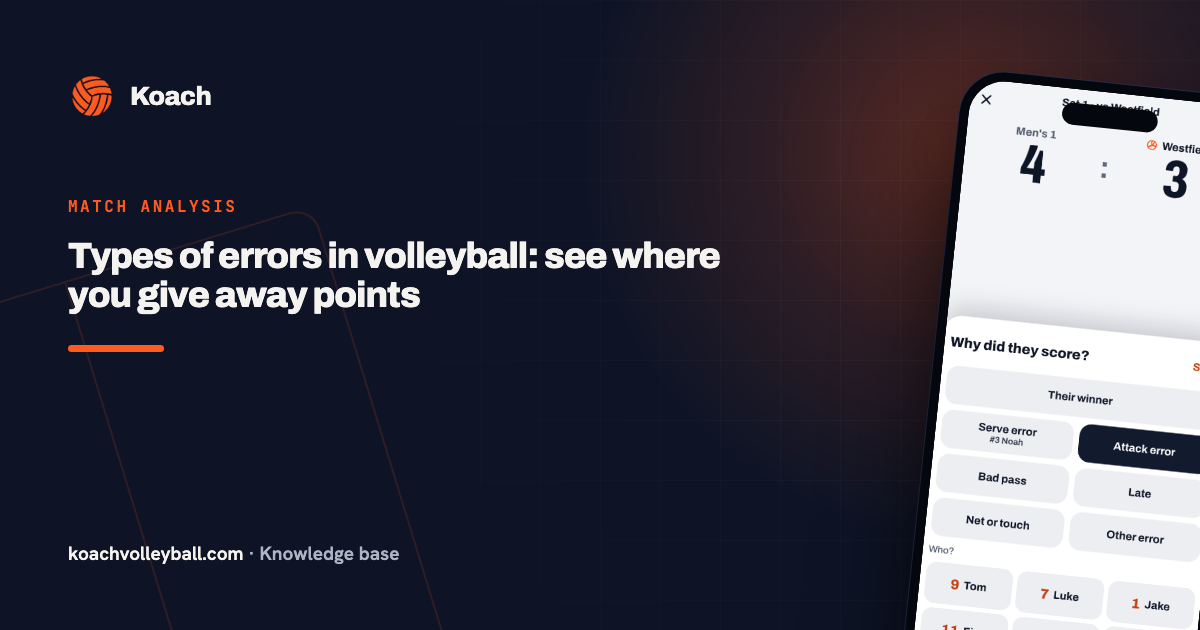
In Simple mode a point counts on the first tap on your team's button. Then the drawer asks How did we score?: Attack or Block with the player, Ace for the server, or Their error. That way you record the type of every point straight away. If you tap Skip in that drawer, the point does count in the score, but not in the points by type. So do that as little as possible, or the share is no longer right. When the opponent scores, the drawer asks Why did they score?: an error by your team, or Their winner if they earned the point. Watch out with an ace against you: in Koach you record it as Bad pass on the player who received, and then it sits among your own errors. If you work out the opponent's earned points yourself, add the bad passes on their serve to their earned points.
In Expert mode you give every ball contact a rating. A 5 for Serve, Attack or Block is an earned point; the Their error button records an unearned point at every step.
Where do you see earned and unearned points?
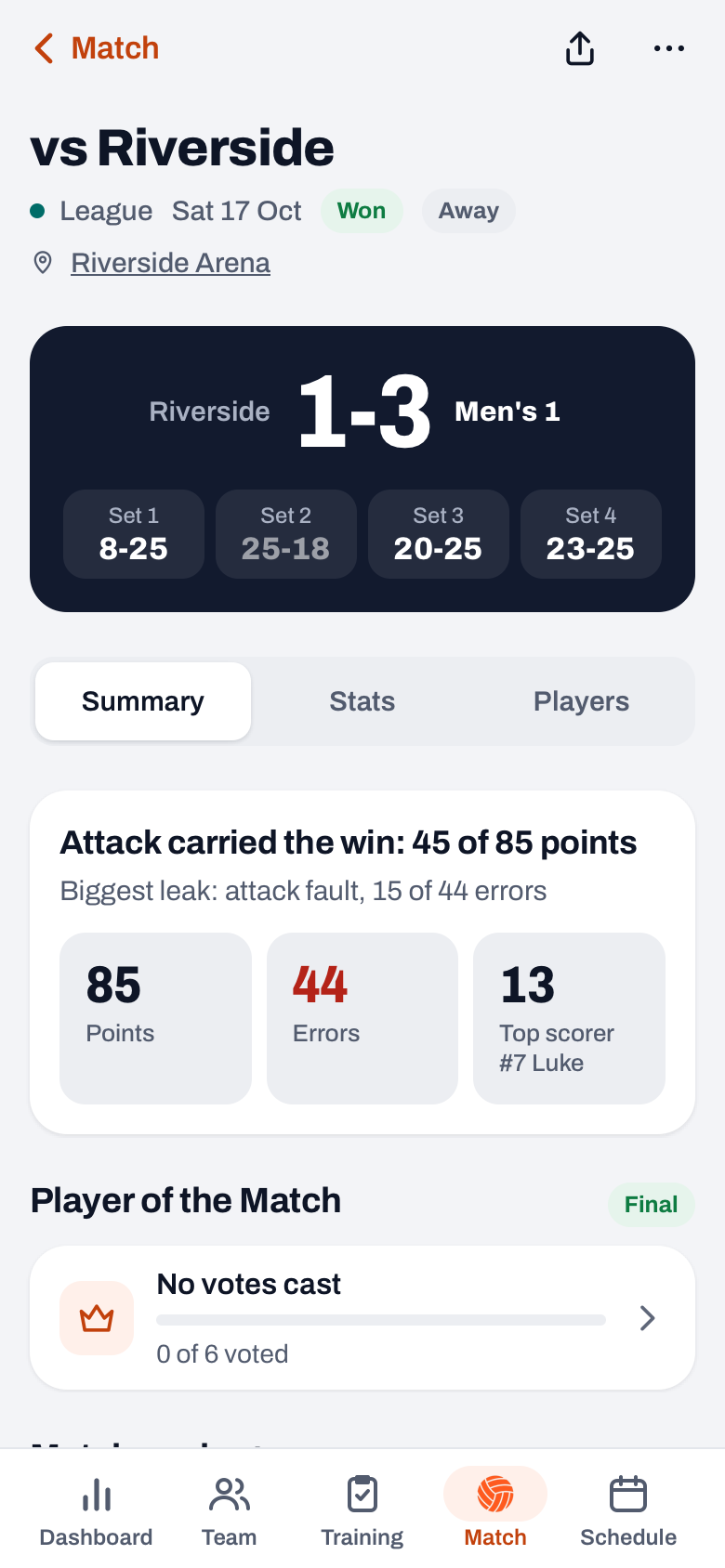
- Summary. At the top is the biggest source of your points in one line, such as Attack carried the win with how many of your points that was, and below that your biggest leak, the error type that cost the most points. If opponent errors were your biggest source, it says Their error.
- Stats > Points per type. One bar per type: Attack, Block, Ace and Their error, each with its share. With the set chips you look at it per set.
- Stats > Errors. Your own errors by type, with the type that cost the most points. In an Expert match it also shows how many points against went to their winners, points nobody could have saved.
- During the match. In the timeout and in the set break Koach sums up the set in one line, such as 9 of 21 points from their errors if their errors were your biggest source, or Serve error gave away 5 points if one of your own errors weighed more.
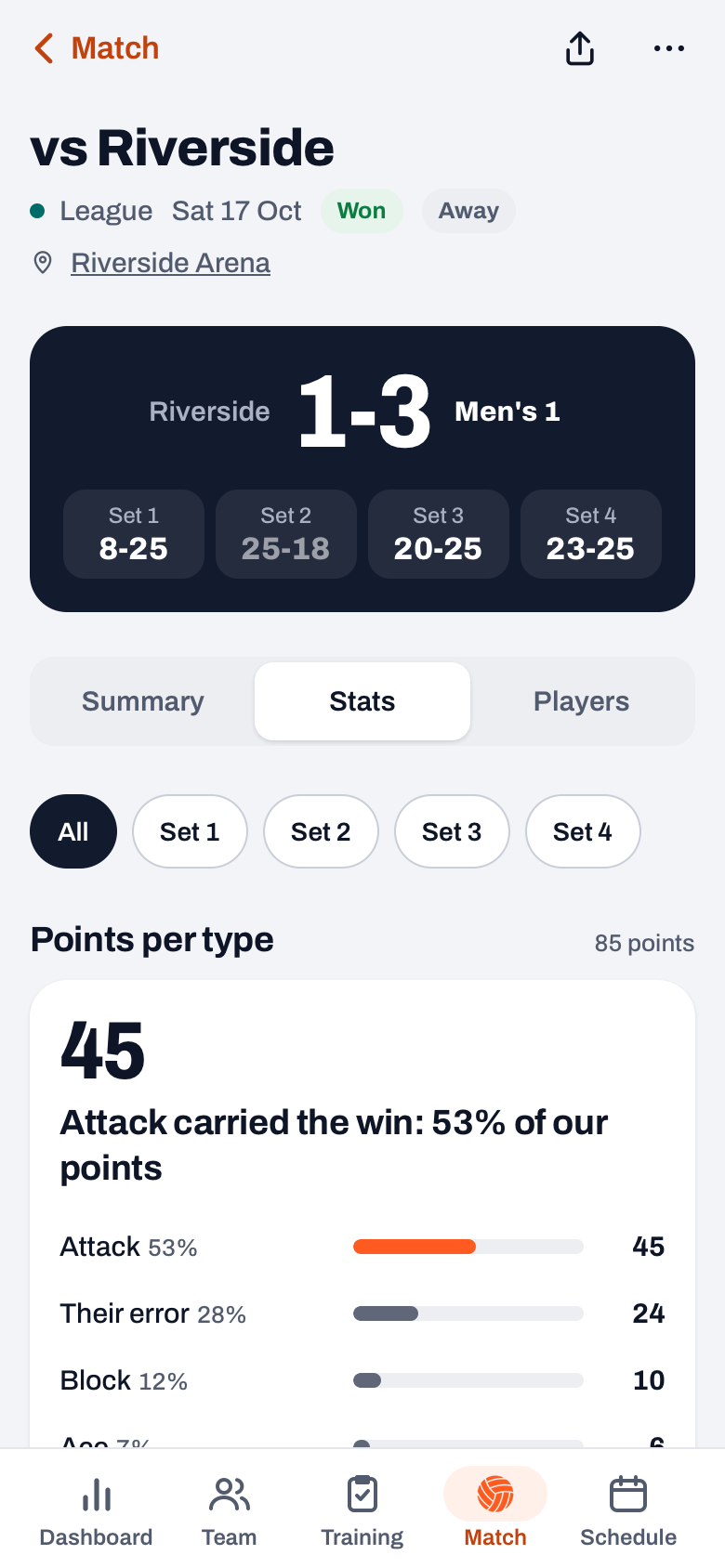
You work out the share of earned points from those bars yourself: add up attack, block and ace and divide by the total above the block. An example of our own: 40 points from attack, 8 from block and 5 aces makes 53 earned points. Add 22 points from opponent errors and you have 75 points, so your team made 53 of the 75 itself, just over seven in ten. Points you recorded with Skip are not in that total. And for matches from before opponent errors were counted separately, a line underneath says those points were not stored separately.
A related measure is the earned side-out: your side-out without the opponent's serve errors. It is under Momentum, or for a match with Expert ratings in Expert figures, as Earned side-out; more on that in side-out after a good or a bad pass. You can count earned and unearned points in Simple too, on both plans; the amounts are on the pricing page.
Put two numbers side by side in your debrief. Not the result, but: how many points did we make ourselves, and how many did they make themselves? Whoever wins that comparison played the better volleyball. That conversation works just as well after a win as after a loss.
Frequently asked questions
Does an ace count as an earned point?
Yes. An ace is a point the server makes themselves, so it is an earned point. The other way round, an ace against you is an earned point for the opponent. In Koach you record your own ace with the Ace button, or in Expert mode with a 5 on the serve. An ace against you is recorded as Bad pass, or in Expert as a 0 on reception; it then sits among your own errors, so add it to the opponent's earned points yourself.
Is an attack that goes out off the block an earned point?
Yes. If your attack goes out off the blockers' hands, your attacker made the point: it is a kill and so an earned point. It is only an opponent error if they did something wrong without your attack forcing it, such as a net fault or an attack they hit out themselves. Agree on borderline cases beforehand, so your counts stay comparable.
How many of your points should you make yourself?
There is no fixed standard; it depends on your level and your opponent. A more useful comparison is within one match: did your team make more points itself than the opponent did? Also follow your own share of earned points over the season. If it goes up, you are scoring more on your own strength and your result depends less on someone else's errors.
Can I track earned points without Expert mode?
Yes. In Simple mode you choose Attack, Block, Ace or Their error after each point, and that is enough to split your points into earned and unearned. Koach puts that under Points per type after the match. You can try the app free for 14 days, no credit card; what it costs after that is on the pricing page.
See how many points your team makes itself
14 days free, no credit card. After one match you know what you earned and what you were given.
Get started with KoachOr read first what the volleyball coaching app does.