
How many sets does a volleyball match have (and to how many points)?
"How high are we actually playing to?" — anyone new to volleyball is guaranteed to ask that at some point. The answer: it depends on which set it is and which competition you play in. This article explains the full set format, including the Dutch quirk of the fixed four sets.
The official format: best-of-five
A volleyball match is officially played to three sets won: whoever wins three sets first wins the match. A match therefore lasts a minimum of three and a maximum of five sets, and can never end in a tie. Sets one through four are played to 25 points, the decisive fifth set is played to 15 points. In all cases: winning is only possible with a margin of at least two points.
Two-point margin — with no cap
If it is 24-24, the set continues until a team has a two-point lead: 26-24, 27-25, and in theory endlessly on. There is no maximum. Set scores of 30-28 occur at every level, and in international matches sets have ended well above 35 points. For the tension that rule is worth its weight in gold; for hall scheduling a little less. For players it mainly means this: a set is never lost as long as the margin is not two points, and it is precisely in that overtime that the teams who keep serving and passing calmly win. How the point system within the rally works — every point played counts, regardless of who serves — is in scoring in volleyball.
The fifth set: shorter and on edge
At 2-2 in sets comes the decisive fifth set to 15 points, again with a two-point margin. For the fifth set there is a fresh toss for serve and side, and halfway — as soon as a team reaches 8 points — the teams switch sides. That switch exists to fairly divide any advantage of one side of the hall (light, run-off space, crowd). Why the decisive set is a game of its own tactically is in the decisive set.
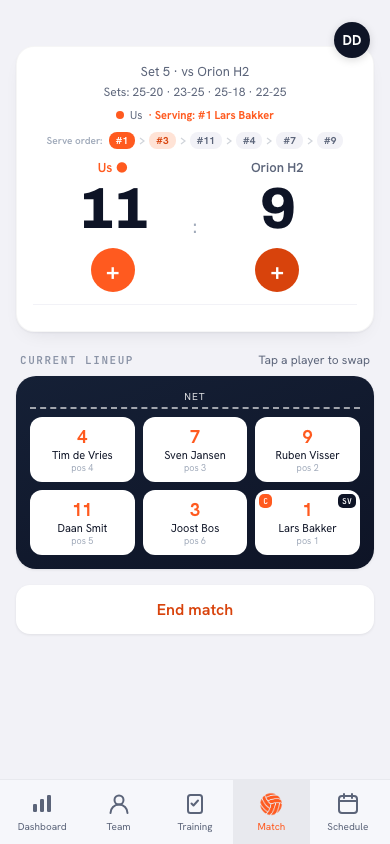
The Dutch regional league: always four sets
Here the Netherlands deviates from the international format. In the regional league of the Dutch federation, four sets are played as standard — even if a team is already leading 3-0. Each set won earns one match point, so a match ends 4-0, 3-1 or 2-2. There is no decisive fifth set. That format exists to make every match last equally long (handy for hall rental and transport) and to let a losing team win something too. In the national competition (third division and higher) the international best-of-five does apply, with a point system in which a 3-0 or 3-1 win is worth more than a 3-2.
Sets in other variants
- Beach volleyball: best-of-three, sets to 21 points and the third set to 15 — see the differences between indoor and beach.
- CMV mini volleyball: its own arrangements per level, often sets on the clock or to 25 points without a decisive set.
- Tournaments and cup rounds: organizers regularly choose shortened formats, such as best-of-three or sets to 15 — always check the tournament regulations.
Breaks, time-outs and substitutions per set
Between sets there is a break of three minutes, during which the teams switch sides. Within each set the coach has two time-outs of thirty seconds and six regular substitutions available; both counters reset each set. Whoever wants to look back at the set scores and scoring progression of all their matches can keep track of them per set.
What the set format means for your coaching
The format determines more than the length of the evening. Because every set starts from zero, a lost set is never a disaster: losing 25-12 hurts exactly as much in the set score as 26-24. Experienced coaches use that: if a set is hopelessly lost, that is the moment to give bench players minutes and rest your starters — the next set begins blank anyway. Conversely, it pays to have your strongest rotation on the court toward the end of a tight set, because points 20 through 25 decide the set. And in the fixed four-setters of the regional league every set counts for a match point: at a 2-1 lead, the fourth set is not a run-out set but simply a point you can grab or give away.
For filling in the match sheet: always note set scores from your own team's perspective (25-23, 23-25, 25-27...). That way you can read back at a glance how the match went — and you avoid confusion when reporting the result.
Frequently asked questions
Can a volleyball match end in a tie?
Not in the international best-of-five format: there is always a decision, in the fifth set if need be. In the Dutch regional league, where four sets are fixed, a match can end 2-2.
To how many points does the fifth set go?
To 15 points, with a margin of at least two points. At 8 points for either team the teams switch sides, and there is no point cap: 17-15 or higher occurs regularly.
How long does a volleyball match last?
A set lasts 20 to 25 minutes on average. A three-setter is therefore done in just over an hour, a five-setter can approach two hours. The fixed four-setters in the regional league usually last one and a half to two hours.
Why does a set go to 25 and no longer to 15?
Until 2000 the side-out system applied: only the serving team could score, with sets to 15. Since then every rally scores a point (rally-point) and sets go to 25 — which made matches more predictable in length and more exciting per point.

