
How to Keep Volleyball Stats on Paper: A Simple System
You do not need software for usable statistics, but you do need discipline: a sheet you can read back yourself, three things at most, and a system that can handle the pace of a rally. This is a method that holds up in the gym.
Decide first what you are not tracking
The classic mistake is a sheet with eight columns that is still half empty after a set and a half. A human tallying live can reliably follow two things at once, and three if they are practised. More than that is a fantasy.
So choose per block of the season. Working on serving? Track serving only. Working on attack? Attack plus errors. Spending a month on serve receive? Passing numbers only. That is not settling for less: four matches of reliable numbers on one skill are worth more than ten matches of a half-filled sheet on everything. Which numbers are worth having at all is covered in understanding volleyball statistics.
The sheet: rows are players, columns are actions
Take a landscape sheet of paper, a clipboard and a pencil — not a pen, because you will be correcting. On the left a column of jersey numbers, with two lines per player: one for sets one and two, one for sets three and four. Next to that a wide box per skill where you tally.
Write the date, the opponent and which sets are on the sheet across the top. That sounds unnecessary right up until March, when you find a stack of unlabelled sheets. And leave a narrow column on the right for two-word notes: 'block open line', 'serve at 1 hurting them'. Those notes often turn out to be more useful afterwards than the tally marks themselves.
The symbols
Use marks you can write in half a second and still recognise a week later. This is a set that is used widely around the world, and you can take it exactly as it is.
| Skill | Mark | Meaning |
|---|---|---|
| Attack | # | Kill, ball down |
| Attack | / | Blocked or error: point against |
| Attack | - | Ball comes back, no decision |
| Serve | Ace | Point outright |
| Serve | / | Error: net or out |
| Serve | + | Opponent out of system |
| Pass | 3 / 2 / 1 / 0 | Perfect / usable / emergency / error |
| Block | B | Stuff block |
You do not need more symbols than this, and every extra mark costs you speed. If you want it split by rotation, do not add columns — put a small underline beneath the mark when the team was in serve receive.
Keeping up with the pace of a rally
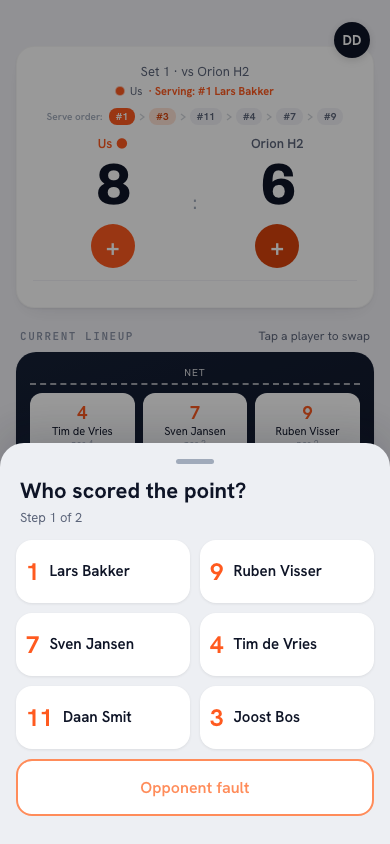
Tallying falls apart exactly when things get busy: long rallies, substitutions and the end of a set. Four habits fix that.
- Record only the last action of a rally if you are working alone. Try to capture every touch and you will lose the thread inside ten points.
- Follow one team, yours. Tracking both teams is a job for two people with two sheets.
- Put a dash in the margin at every time-out. That way you know afterwards which part of the set belonged to which score, and you can find where it turned.
- Update substitutions the moment they happen, with the score. Otherwise your per-player attribution is wrong, and that makes the whole sheet worthless.
If you are on the sideline alone and also have to coach, give the sheet away. An injured player, a substitute or a parent will do it better than a coach who is making changes in between — the same principle as in handing off live scoring.
From tally marks to percentages
Afterwards, in the car or at home, you work out two numbers. Hitting percentage is (kills minus errors) divided by total attempts: eight kills, three errors and twenty attempts gives (8 - 3) / 20 = .250. What that number is worth at each level is in hitting percentage explained. Passer rating is the average of your 3-2-1-0 scores: twenty receptions adding up to 42 gives 2.1.
Write those two numbers on the sheet itself and nothing more. A shoebox of sheets with the answers already on them is a season overview. A stack of sheets you still have to do arithmetic on is a stack of sheets.
Paper has real advantages: it is free, it never runs out of battery, it does not fail in a gym with no signal, and nobody gives you a look for being on your phone. For a team that measures four times a season to check a training goal, a clipboard is the better choice — not the second best one.
When to go digital instead
The line is drawn by frequency and by comparison. If you want to measure every match, line up per-player numbers across a whole season or look back at how someone has developed since November, retyping becomes the real work — and that is exactly the point where a stack of sheets quietly dies. If you track one skill twice a month to test a training goal, paper stays fine. See also point tracking per player for what a digital record adds on top.
Frequently asked questions
Which statistics should a beginner track on paper?
Start with one skill: kills and errors per player in attack. That gives you a hitting percentage straight away and can be tracked single-handed. Add passing or serving only once that first sheet stays complete for three matches running.
How many people do you need to tally?
One person for one team and at most two skills. If you want to follow both teams or add more skills, you need a second sheet and a second person.
How do you calculate a hitting percentage from paper?
Kills minus errors, divided by total attempts. Eight kills, three errors and twenty attempts gives .250. Write that result straight onto the sheet, otherwise the arithmetic never gets done.
Is paper more accurate than an app?
No, but it is calmer if you are only tracking one thing. The difference is what happens afterwards: paper is fine for one-off measurements, digital wins as soon as you want to compare matches and players across a whole season.