
Organising the volleyball season: the complete checklist
A season is rarely won or lost on tactics — usually it comes down to organisation: the roster that isn't settled until September, the goals that were never set, the evaluation that evaporates. This is the checklist that carries the year, from August to June.
August: the foundation
- Build your roster: 10–12 players, every position covered twice, gaps spotted early.
- Set up the admin: create the team, invite players, complete the profiles — one evening of work that pays off all year.
- Fill the calendar: add every practice with recurrence switched on for the regular practice nights, and put the known matches in as well. Do you play in the Dutch league? Then, as soon as the pool layout is known, you can import the whole match schedule from your Nevobo pool in one go — matches you already planned yourself are recognised and never added twice.
September: choosing a direction
- The first team meeting: expectations, agreements and the team goal — one evening without a ball that prevents months of arguments.
- Personal goals: one measurable season goal per player.
- Friendlies: three to five test matches, each with an explicit question to answer.
- Sort out the transport: for youth teams and teams with plenty of away trips, set up the driving rota once — home venue, kilometres, driver pool — and from then on the driving shares itself out across the season.
- Add the cup: playing the cup as well? For clubs in the Dutch league that is a separate pool with its own schedule and its own table, so you link it alongside your league pool and import it separately.
October–December: the rhythm
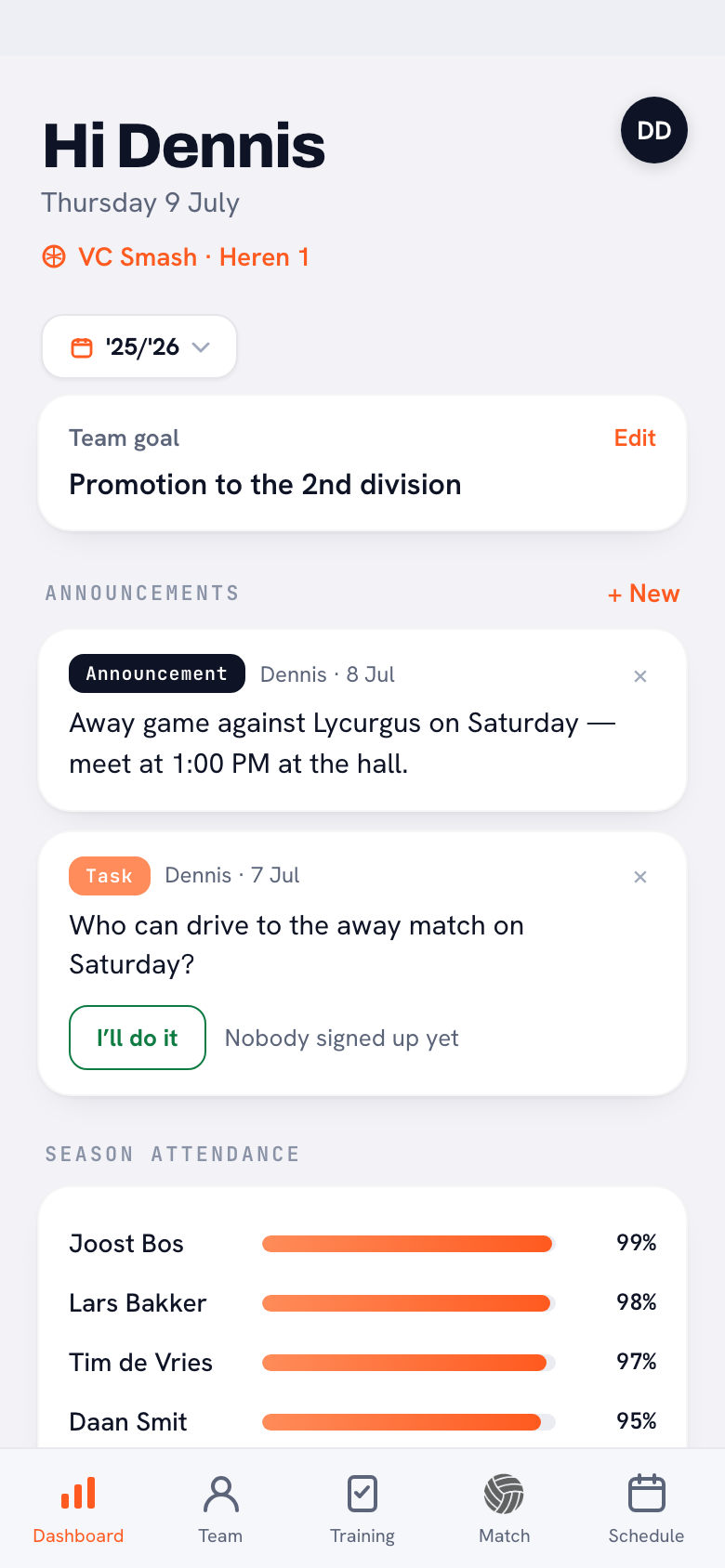
The league is under way; your job becomes consistency. Attendance and effort at every practice, every match tracked live, and one weekly glance at the dashboard: do attendance and form still match the plan? The secret of this block is keeping it small — five minutes of admin per week, as long as you do it every week.
January: the mid-winter review
Halfway through is the moment to adjust while you still can: a mid-season review per player, a reality check on the team goal if it has drifted, and using the winter break for the analysis the match weeks never leave room for.
February–April: harvesting and moving players up
The second half of the season runs on what you built in the first. One new task: from March onwards, prepare your promotion recommendations — early enough to let candidates try out with a higher team.
May–June: finish as if you're continuing
- Season analysis: the trends of twenty matches in three sentences.
- Team evaluation and player reviews: within two weeks of the final match.
- Prepare the handover: even if you're staying — it forces you to tidy up and write things down.
The common thread: record from day one. Every step in this checklist leans on data you collected in the steps before it. Start tracking in August and you get a mid-season review in January and a season analysis in May — for free.
Frequently asked questions
When should season preparation ideally start?
Six to eight weeks before the first league match: enough time for roster decisions, admin and three friendlies. A coach who is still puzzling in the first week of the league spends half the season playing catch-up.
How much time does the organisational side take on top of coaching?
After the August setup: fifteen minutes a week — ticking off attendance, closing out a match, one glance at the dashboard. The peaks are September (goals) and May (evaluations), a few evenings each.
What is the biggest organisational mistake new coaches make?
Trying to do everything themselves and track everything. Pick the five items from this checklist that help your team most, delegate the record-keeping where you can, and build it out further next season.

Your whole season in one place
Calendar, attendance, matches and growth — Koach carries the organisation, you coach.
Get started with Koach