
Volunteer appreciation ideas: twelve thank-yous for your club
The short answer
The best volunteer appreciation ideas are personal, specific and quick: say what someone did and what it made possible, within a week. Add a few fixed moments each season and one bigger moment a year, and make sure the quiet helpers are included, not just the familiar names.
Every club has volunteer appreciation ideas, but not every thank-you actually lands. A general word of thanks at the annual meeting reaches nobody personally. Here you read why recognition keeps volunteers, twelve ideas from small to big, who should say thank you and what to avoid.
Why thanking volunteers matters
Saying thank you sounds like good manners, but it is more than that. In a study of 8,131 volunteers from 642 sports clubs in ten European countries, recognition was the strongest factor in how satisfied volunteers were with their work (Nagel and colleagues, 2020). Recognition meant two things there: the feeling that your work is valued, and the club putting volunteer work in the spotlight now and then. Support and leadership from the club also counted, and so did material benefits, but clearly less. Club size and paid staff made no difference to satisfaction.
Two caveats from the same study. The researchers measured satisfaction, not who stayed; that satisfied volunteers are more likely to stay comes from earlier research. And volunteers who put in more than 300 hours a year were less satisfied than those who did fewer hours. A thank-you does not fix a load that is too heavy. Someone who has been doing everything for years first needs a second pair of hands; how to share the work more fairly is in club volunteers: do the job or buy it off.
Small and direct: five ideas for any week
- A personal word with a detail. Not "thanks for everything", but "thanks for opening the gym at 7:30 on Saturday; because of you the kids started on time". The detail shows you noticed.
- A thank-you from the people who benefited. Have the team shake hands with the scorer and the referee after the match, and let the youngest players thank the parent who drove. That often means more than a word from the board.
- A name in the club news. Write "Emma and Jake set up the courts on Saturday" instead of "thanks to all our volunteers". A thank-you in a busy group chat has sunk out of sight within an hour; why that happens is in why the WhatsApp group stops working.
- A handwritten card. A few lines on paper take two minutes and sometimes stay pinned to a noticeboard for years.
- Ask for their opinion. Recognition also means being taken seriously. Ask the volunteer behind the bar what could be better, and tell them later what you did with it.
Each season: four ideas that take a little more preparation
- A moment right after a big job. After the club tournament or the last home day, eat or drink something together with everyone who helped, including those who only cleaned up. Short, on the day itself, without a half-hour speech.
- A volunteer in the spotlight. Each month, feature one volunteer in the newsletter, on the website or on social media, with what they do and why. Ask first whether they want that, and always ask permission for a photo.
- Something with the club logo that they actually use. A jacket for whoever is on hall duty, a shirt for the people who help at the tournament. That is a gesture, not a reward; in the study above, material benefits counted for less than recognition.
- Show what was done together. Put in the annual report or the newsletter how many shifts were worked this season, by how many people, and which jobs got done without a rota. Whoever reads it sees that their hours are part of something bigger.
Once a year: three bigger moments
- A volunteer night or afternoon. A moment of its own, not tacked onto the annual general meeting. Invite everyone who did something, including the young people who helped with the youth teams. Set the date early in the season so it does not fall in the busiest weeks.
- Volunteer of the year. Let members nominate, and do not pick from the same three roles every year. A group can win too, for example the parents who ran the scorer's table every home day. A second award for a quiet helper keeps it from always going to the most visible person.
- Anniversaries and a real farewell. Mark five or ten years, and say goodbye to whoever stops, even after one season. People who leave without a word remember that. Some federations, local authorities or regions have their own awards for volunteers; find out what exists where you are.
Make the list first, then the thank-you. At the start of the season, write down in one place who does which regular job: bar, scorer's table, kit, equipment, website, the parent who pumps up the balls. Go through that list before every thank-you moment. That way you do not only thank the people you happened to see.
Who thanks the volunteers, and when?
A thank-you carries more weight when it comes from the right person. A few rules of thumb:
- Whoever asked, says thanks. The person who asked someone to do a job closes that job with a thank-you and a question about how it went. How to find new volunteers and handle that first contact is in how to recruit volunteers.
- The board for the big work. A committee that carried a whole tournament should hear it from the chair, preferably in public.
- Within a week. A thank-you for the October tournament that only comes in June sounds like a box being ticked. Thank people soon after the job, and save the big moments for the end of the season.
- At the start too. "Great to have you back" in September is recognition as well, and the moment to ask whether the job still suits them.
A gift for the coach is a topic of its own, with its own arrangements between parents; ideas are in gifts for a volleyball coach.
What to avoid when thanking volunteers
- Only the familiar names. The chair and the bar coordinator always get a mention. The parent who washes the jerseys, the player who counts the balls every week and the scorer on Saturday morning slip through the cracks.
- A stock thank-you line. "Without our volunteers this would not have been possible" sits under every newsletter and so says nothing to anyone.
- Thanking instead of relieving. Flowers for someone who puts in 300 hours a year do not solve their problem. Ask what they want to hand off, and find someone to take it on.
- A request inside the thank-you. "Thank you, and can you do it again next month?" turns the thank-you into a request. Keep the two a few days apart.
- Putting someone on stage who does not want it. Not everyone likes coming forward in front of the whole gym. Ask beforehand, and thank such a person privately instead.
- Comparing hours. A ranking of who did the most turns recognition into a contest, and those who can do less feel punished.
Nobody forgotten: with Koach Club
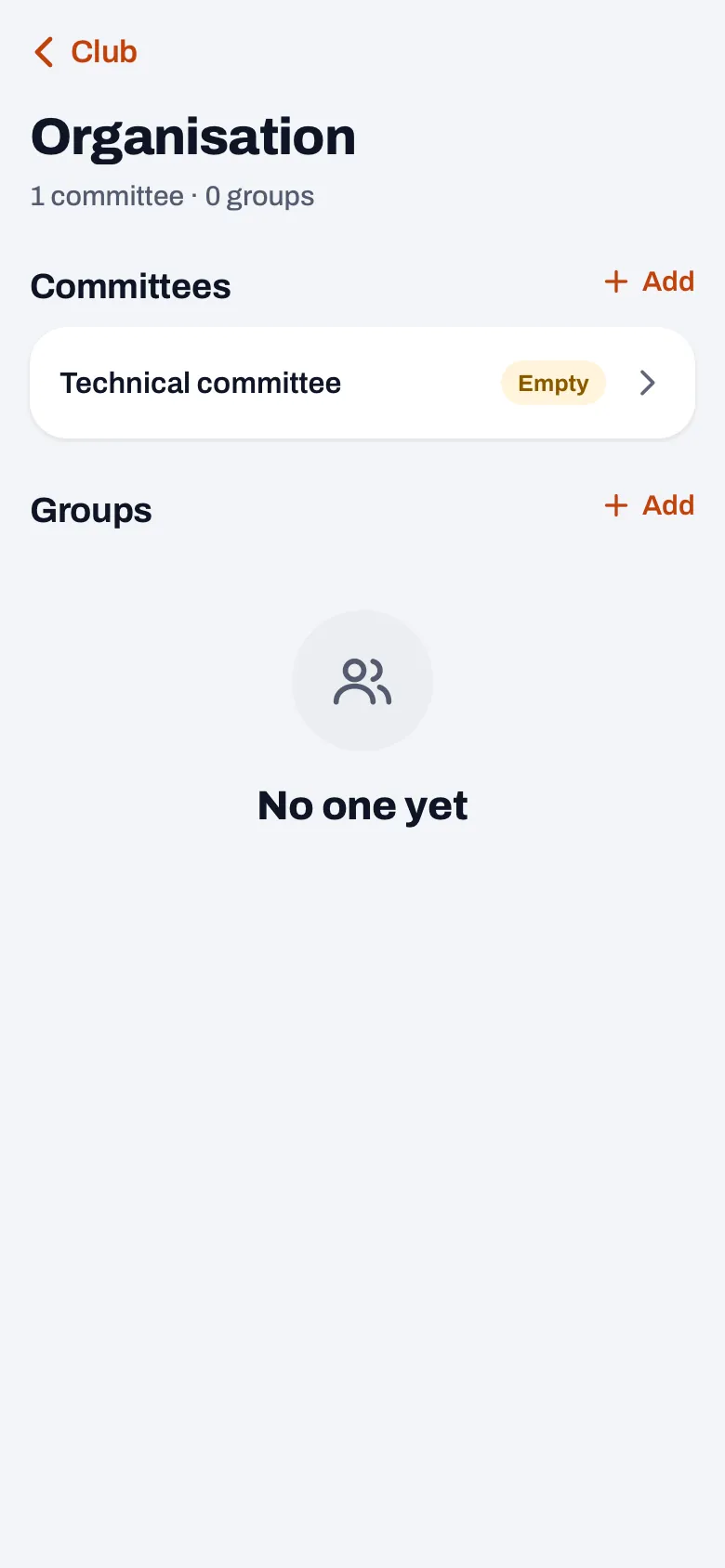
The hardest part of thanking people is not forgetting anyone. In the club section of Koach, the board records the committees with their members and roles under Organisation, plus free-form Groups, such as the players who help at the tournament. You pick from the players on the club teams, even if they do not have their own account yet. Parents, coaches and other helpers who are not on a team as a player cannot be added; you keep track of them separately. How to set up committees and groups is in recording committees and groups. If your club uses Duties, you see per member how many shifts they have worked: the bar duties and the shifts on Match day, such as referee, scorer and hall duty. Jobs outside those shifts, such as committee work, are not counted by the app; for those, use the list under Organisation.
A thank-you to the whole club goes out as a club announcement: under Profile, in Club announcements, tap New announcement, if your role in the club allows it. The announcement goes to all members of the club; see sending club announcements. If you are a coach and want to thank the parent who drove every week, you can do that with an announcement on your own team's dashboard. Organisation, Duties and club announcements are part of the Club plan; as a coach you can try the rest of Koach free for 14 days.
There is no trial on Club. For the whole club, get in touch with us. If you would rather start with your own team, try Koach as a coach free for 14 days, no credit card.
Koach for clubs Try Koach with your teamThe prices of Coach and Club are on the pricing page.
Frequently asked questions
How do you thank volunteers in a personal way?
Say exactly what someone did and what it made possible, and do it quickly, ideally within a week. A handwritten card, a thank-you from the team that benefited or a name in the club news works better than a general word of thanks. Let the thank-you come from the person who asked the volunteer, or from whoever benefited directly.
What can you give volunteers as a thank-you?
The words matter more than the gift. A gesture they use, such as a club jacket or shirt, or a shared meal after a big job, is fine, but without a personal word it does little. In a study of sports volunteers in ten European countries, recognition counted clearly more for their satisfaction than material benefits.
When is the best time to thank volunteers?
Soon after the job, plus a few fixed moments: after a big tournament, at the end of the season and perhaps at a volunteer night of its own. A word of appreciation also fits at the start of the season, together with the question of whether the job still suits them.
How do you choose a volunteer of the year?
Let members nominate candidates with a short reason, and let a small group choose. Make sure a group can win too and that the same roles do not get the spotlight every year. A second award for a quiet helper keeps the prize from always going to the most visible person.
Put your club in Koach
Get in touch about Club, or try Koach free for 14 days with your own team first.
Get started with KoachOr read first what the volleyball coaching app does.