
How to recruit volunteers for a sports club: finding new helpers
The short answer
If you want to know how to recruit volunteers, start with small, clear jobs instead of a general appeal. For each job, write down what it is, how much time it takes and when it is done, ask people in person and get the first contact right, so someone wants to stay after their first job.
How to recruit volunteers is a question most clubs answer with an appeal in the newsletter, and that rarely brings anyone in. This article is about the helpers beyond the fixed rotas and the coaches: how to make jobs small enough that people say yes, where to find those people and how to make sure they come back after the first time.
Why "volunteers wanted" brings in so little
To the reader, an appeal to everyone feels like a request without an end: how much time, for how long, and will I ever get out of it? That is exactly the barrier people name. In a survey of 7,006 adults in Great Britain (NCVO, Time Well Spent 2023), the most common reason for not volunteering was not wanting to make an ongoing commitment: 33 percent of those who had not volunteered in the past three years. What would most often encourage them was being able to decide how much time they give (30 percent). Being asked was mentioned by 15 percent, according to the chapter on barriers. The survey covered volunteering in general, not sports clubs, so read the numbers as a direction, not as a measure of your own club.
An appeal in the group chat has a problem of its own: within an hour it has sunk out of sight, see why the WhatsApp group stops working. This article is not about the fixed rotas for the bar and the scorer's table; how to share those across all members is in club volunteers: do the job or buy it off. If you are looking for coaches, read recruiting volunteer coaches who stay: the ask is bigger there and the approach is different.
Start with a job list, not an appeal
Sit down with the board for an hour and write down everything that happens in a season and is not on a rota. At a volleyball club you quickly end up with something like this:
- The club tournament: making the schedule, registrations, setting up the courts, arranging prizes.
- Kit and uniforms: handing out, collecting, reordering.
- Equipment: balls, nets, the pump and keeping the equipment room in order.
- Website, social media and match photos.
- Sponsorship: keeping in touch with current sponsors, finding a new one.
- Activities for the youth teams, such as a camp or an end of season party.
- Checking the accounts, taking the minutes, keeping the membership records up to date.
Then turn each job into a job card. That is one paragraph that someone reads in a minute and can say yes or no to. An example:
| On the card | Example |
|---|---|
| What | Setting up the courts for the youth tournament |
| When and how long | Saturday morning, 8:00 to 9:30 a.m. |
| How often | Once |
| With whom | With three others, led by someone who has done it before |
| What you need to know | Nothing, we explain it on the spot |
| Contact | One name with a phone number |
Break big roles into pieces. "Do you want to join the tournament committee?" sounds like a year of meetings. "Would you handle the tournament registrations this year?" is a job with a beginning and an end. The same goes for a secretary: the minutes, the email and the membership records can be three people. More small jobs means more people to ask, but also more people who say yes.
Where do you find new volunteers?
- Parents of youth players. They stand by the court every week and have a stake in the club running well. Do not only ask whether they want to help, but what they do in everyday life. Someone who does bookkeeping can check the accounts; someone who designs can make the tournament poster.
- Former players and members who stopped. They know the club and the people. A job keeps the connection, even when playing is no longer possible. Call rather than send a message.
- Teenagers. Players from about fourteen can help with the youngest kids, learn to keep score at the scorer's table or run social media. Give them a real job with their own responsibility, not just hauling boxes. Talk it over with the parents, and check what your federation allows for jobs like scoring or refereeing.
- Partners, grandparents and retirees. They are often available during the day: opening the gym on a weekday afternoon, shopping for the clubhouse, visiting a sponsor.
- Recreational players. Members of rec teams often play on their own evening and see little of the rest of the club. That is exactly why they are rarely asked.
- Outside the club. Neighbors of the sports hall, students, a local volunteer center or an online volunteering platform, if there is one in your area. Less comes in from outside, but a clear job such as maintaining the website sometimes attracts exactly the right person.
How to ask
Ask in person, with the job card, one person at a time. How to build that request, with a name, an end date, who they will work with and what they do not have to do, is worked out in recruiting volunteer coaches; for a small job it works the same way. Three things to add:
- A trial job. Ask someone for one time, then look back together on how it went. A yes for one Saturday is worth more than a no for a whole season. If you need someone for a big task, ask them first for one part of it: someone who did the registrations for one tournament and enjoyed it will more easily say yes to the whole tournament committee later.
- A no is a no for now. Write down who said no and why. Someone who had no time in October may well have time in March, or want a different job.
- Let whoever stops bring a successor. If a volunteer says they are stopping, ask them to find a successor together with you and bring that person along once. That way the know-how of the job is not lost. Other good moments to ask are the start of the season and the day after a successful tournament. New members are best matched to a job right when they register; how is in sharing the club work.
Put the open jobs in one visible place. A board in the clubhouse or a page on the website with the job cards that are still open, each with a name to call. Anyone who wants to help sees right away with what, and anyone who is asked already knows what it is about. Take a card down as soon as the job is filled.
The first contact decides whether someone stays
Someone who signs up has already taken the biggest step. What happens next decides whether there is a second time:
- Reply within a few days. Someone who signs up and hears nothing for two weeks concludes they were not needed.
- One point of contact. A name and a phone number, not a committee.
- Practical information in advance. Where to be, how to get in, what to bring, who will be working alongside them. Someone who stands in front of a locked door for half an hour on their first job will not come a second time.
- Do not ask for more right away. Someone who said yes once is not automatically on every list. Ask afterwards how it went, thank them and wait a while before the next request. How to make that thank-you land is in volunteer appreciation ideas.
- Keep track of who did what. Then next season you know whom to ask, even with a different board.
What differs by country and by club
The arrangements around volunteers are not the same everywhere. Check three things in advance, and follow your club's constitution and the law of your own country:
- Insurance. Whether volunteers are insured, and through whom (the club, the federation, the local or regional government), differs by country.
- Working with minors. In many countries there are rules or arrangements for volunteers who work with children, such as a background check. Which ones apply and whether they are mandatory, check with your federation.
- Expenses and minimum ages. What you may reimburse a volunteer, and from what age someone may do certain jobs, such as working behind a bar, differs by country.
Volunteers and their jobs in Koach
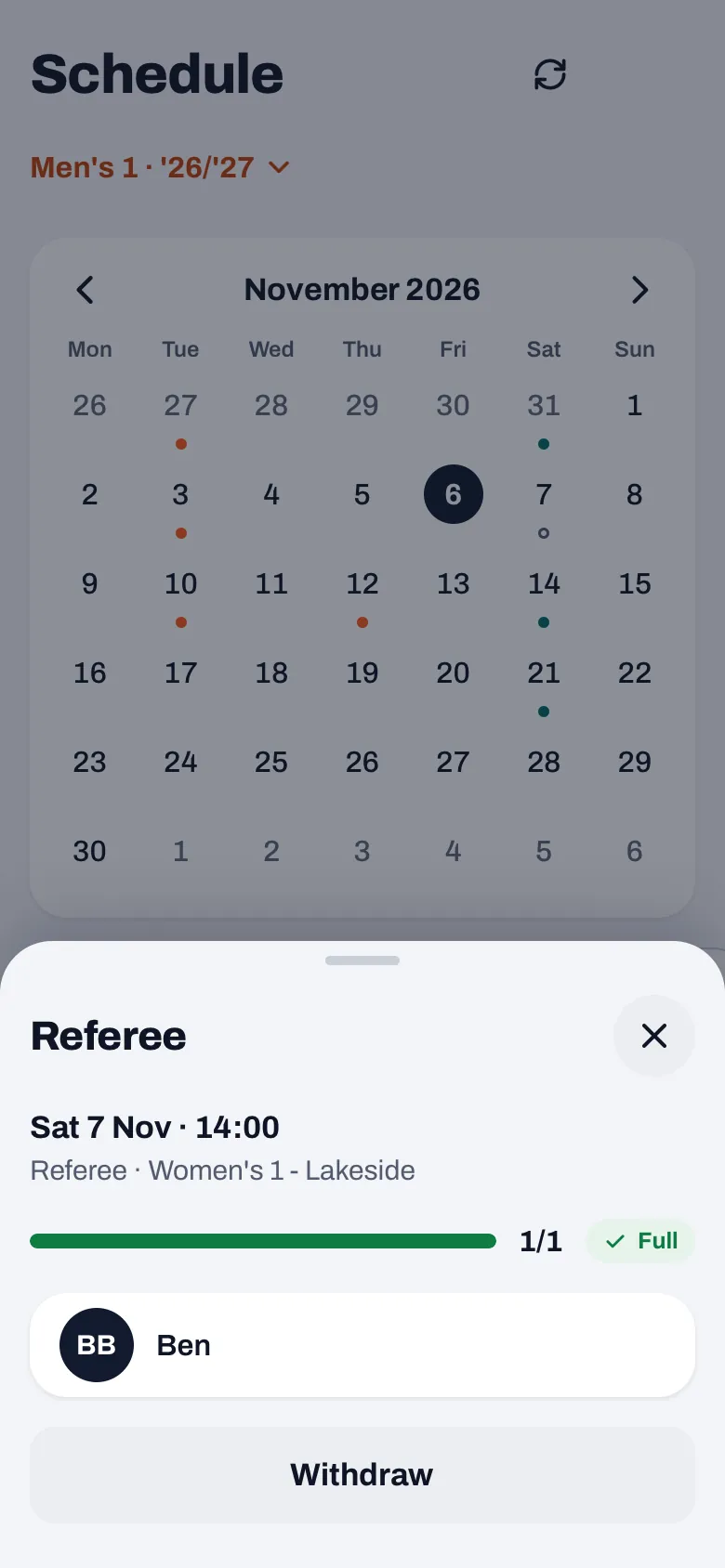
Koach does not find volunteers for you, but it does help make a job clear and visible. The club section holds the bar duties and the Match day shifts, such as referee, scorer and hall duty. Whoever is assigned sees their shift in their own schedule, with the date, the time and a Withdraw button if it does not work out. Since version 3.1, anyone assigned on Match day as referee, scorer or hall duty gets a notification about it, and a reminder the evening before. Exactly the clarity a job card needs: what, when and where.
For that, a volunteer does need an account. Under Club, in Members, choose the No account filter; anyone allowed to invite then sees Invite all N in the header of each team, where N is the number of members without an account. That way you invite the whole team at once, as players or as parents; see inviting club members. A job for your own team, such as who brings the ball bag, you post as the coach as a task in the announcements on the dashboard; whoever takes it taps I’ll do it. The club section is part of the Club plan; team tasks are also in Coach.
There is no trial on Club. For the whole club, get in touch with us. If you would rather start with your own team, try Koach as a coach free for 14 days, no credit card.
Koach for clubs Try Koach with your teamThe prices of Coach and Club are on the pricing page.
Frequently asked questions
How do you find new volunteers for a sports club?
First make a list of all the jobs outside the fixed rotas, and break big tasks into small jobs with a clear end time. Then ask people in person: parents of youth players, former players, teenagers, recreational players, and partners or grandparents who are free during the day. A concrete one-time job brings in more than a general appeal in the newsletter.
Why does nobody sign up to volunteer?
Usually because the request is too big or too vague. In a British survey by NCVO, a third of those who had not volunteered in the past three years said they did not want to make an ongoing commitment; that was the most common reason. An appeal without a time or an end date sounds exactly like that. A job with a beginning, an end and a contact person removes that barrier.
How do you ask parents to help at the club?
In person, with one concrete job: what, when, how long and with whom. Also ask what they do in everyday life, because a skill is often a good way in. Start with a one-time job and look back together on how it went. With youth members, it helps to ask the question at registration.
Do volunteers need insurance or a background check?
That differs by country, by federation and by club. Find out whether volunteers are insured through the club, the federation or the government, and which rules apply to volunteers who work with minors, such as a background check. Record the arrangements in line with your club's constitution and the law of your own country.
Put your club in Koach
Get in touch about Club, or try Koach free for 14 days with your own team first.
Get started with KoachOr read first what the volleyball coaching app does.