
What to eat before a volleyball match: timing by start time
Volleyball has a nutrition problem almost no other team sport shares. One week your team plays at half past nine in the morning, the next the first serve doesn't come until you would normally be on the sofa, and a tournament day lasts six hours with twenty-minute breaks. No single standard piece of advice fits all of that. What does fit is a simple model you shift around the start time.
Why general nutrition advice doesn't work here
Most sports nutrition advice assumes a match that starts at a normal time and lasts a predictable length. Volleyball meets neither condition. In most leagues, start times run from half past eight in the morning to quarter past nine at night — how late is actually allowed differs by federation and by venue, so check your own fixture list. And a match can be finished in seventy-five minutes or take two hours, because nobody knows in advance whether it will be three sets or five.
That makes eating before a match a planning question, not a diet question. You don't need to know how many grams of carbohydrate somebody needs. You need to know what time the first serve is and how many hours there are before it. The rest follows from that.
The basic model: 3 hours big, 1 hour small
Remember two moments and you are nearly there:
- 3 to 4 hours before the first serve: the normal meal. Rich in carbohydrate, with some protein alongside, and deliberately low in fat and fibre. Pasta with tomato sauce and chicken, rice with chicken and a little veg, bread with lean toppings, pancakes. No special products, no supplements — just food the player knows.
- 1 to 2 hours before the first serve: the small snack. Something you finish in two bites and that digests quickly: a banana, two slices of malt loaf or plain honey cake, a white roll with jam or honey, a currant bun, a cereal bar without a chocolate coating.
In the last thirty to forty-five minutes — so from the moment the warm-up starts — nothing substantial goes in any more. A few sips of drink, at most half a banana if somebody is genuinely hungry. The stomach has to be empty enough to jump and dive.
The rule you can apply anywhere: the closer to the first serve, the smaller, sweeter and simpler. If the big meal no longer fits in the time available, you don't move it forward and you don't cram it in — you make it smaller. That is exactly what happens in the four scenarios below.
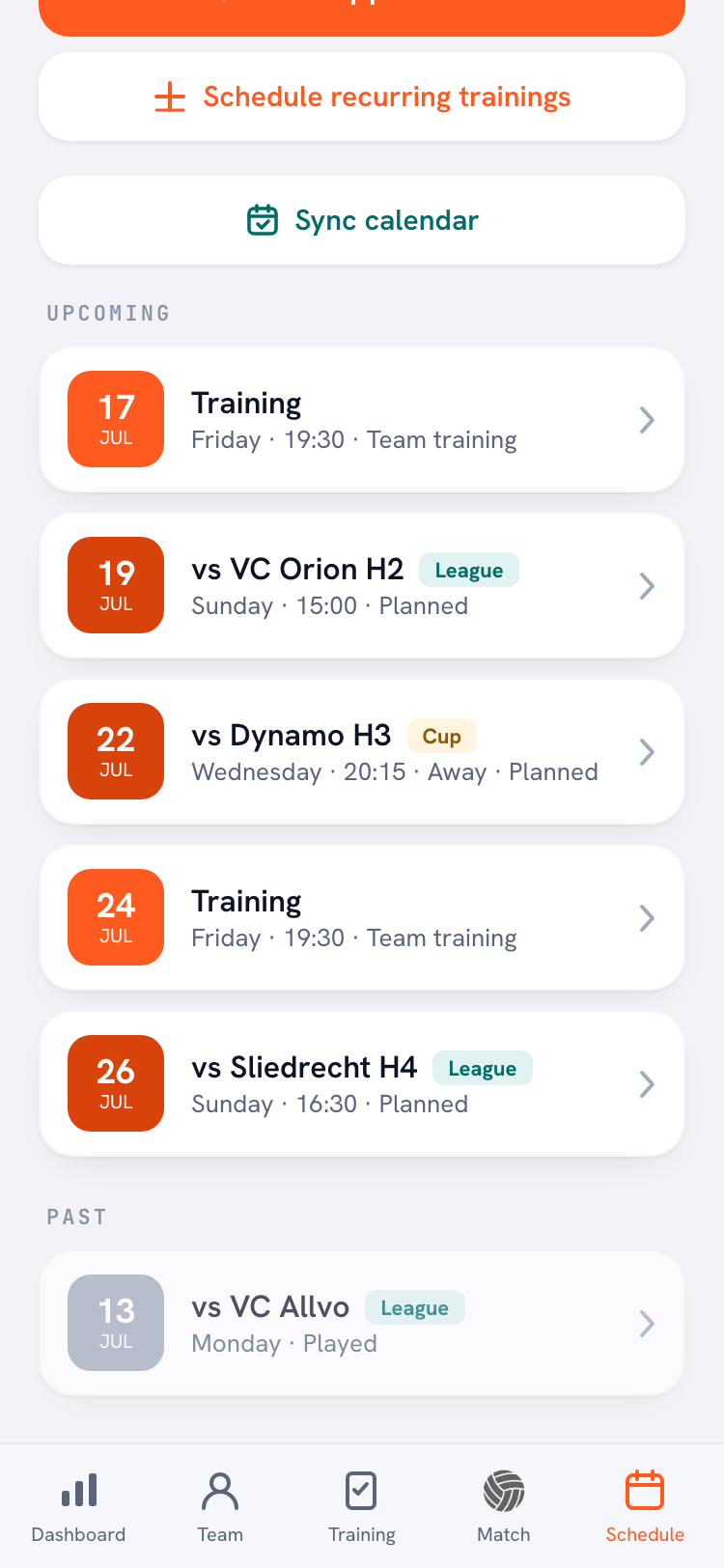
Working backwards is the only thing you ask of players, and it only succeeds if the start time hasn't been buried somewhere in a group chat. Put the match in the Koach team calendar with time and venue and anyone — player or parent — can subtract three hours themselves. For an away match, add the travel time on top: whoever leaves at half past one for a three o'clock match needs his snack in the car, not at a petrol station on the way. Sort that out together with the driving rota, so everyone knows well in advance what time they have to leave home.
Scenario 1: the morning match (first serve 09:30)
This is the scenario where the model breaks: eating three hours beforehand would mean getting up at half past six. You don't do that. You shift to a lighter breakfast closer to the match.
- 07:15 — breakfast. A good two hours before the first serve, and deliberately light: two slices of white bread with jam or honey, or a bowl of porridge, or yoghurt with a banana. No big wholemeal breakfast and no fried egg with bacon.
- 08:30 — in the car or on the way. A few sips of water. Anyone who barely got his bread down at seven eats a banana or some malt loaf here after all.
- 09:00 — in the hall. Drink during the warm-up, nothing else.
Plenty of players, and certainly plenty of children, simply can't get anything down early in the morning. Don't force it. With a morning match, the meal the evening before becomes the more important of the two: a normal, carbohydrate-rich evening meal at a normal time. If breakfast then only half happens, that is no disaster — as long as there is something in the bag for the journey. What you want to avoid is the player who starts at half past nine on a completely empty stomach and can't get into his approach by the second set.
Scenario 2: the afternoon match (first serve 15:00)
The easiest scenario, because the model fits it exactly.
- 11:30 — the normal meal. Three and a half hours beforehand. Bread, pasta or rice with lean toppings or a low-fat sauce.
- 13:30 — the small snack. Banana, malt loaf, currant bun.
- 14:15 — departure or arrival. Fill the bottle, drink during the warm-up.
The only trap here is the away match. As soon as there is an hour of travel in between, your whole clock shifts and you end up with a midday meal at half past ten or a snack that never happens. Take the snack with you instead of hoping there will be something available on the way.
Scenario 3: the late evening match (first serve 21:15)
For senior teams this is the scenario that goes wrong most often, and almost always in the same way: people eat at six and then nothing more. That leaves a good three hours between the last mouthful and the first whistle, plus another one and a half to two hours of match behind it. You then play the fifth set on the reserve tank.
- 17:45 — the evening meal. Three and a half hours beforehand, normal size, carbohydrate-rich and not fatty. Anyone coming straight from work eats this at five, at work or on the way.
- 19:45 to 20:15 — the snack. This is the part almost everybody skips and the one that pays off most in this scenario. A banana, a sandwich, malt loaf, a bar.
- 20:45 — in the hall. Drink during the warm-up, no more eating.
Two practical points. First: put that snack in the kit bag the night before, because at eight o'clock nobody thinks of it. Second: this is the scenario in which the clubhouse afterwards suddenly becomes very attractive, precisely because too little was eaten beforehand. What is best for your recovery after the match is in cooling down and recovery — this article stops at the first whistle.
Scenario 4: the tournament day
On a tournament day the model doesn't work at all, because there is no moment when you have three hours of rest. You can't eat well once; you have to top up small amounts all day. The rule of thumb that works best in practice:
- Breakfast as in scenario 1 — light, carbohydrate-rich, a good two hours before the first match.
- Every break: drink. Even if nobody is thirsty. A few sips per break adds up considerably over six hours.
- Every second break: eat something small. With twenty-minute breaks that comes down to roughly every three quarters of an hour: a banana, a piece of malt loaf, a currant bun or a rice cake with a topping.
- One long break is your lunch moment. If there is a gap of more than an hour somewhere, that is where you eat your only real meal of the day — and keep it lighter than at home.
What structurally goes wrong at tournaments is the clubhouse. A deep-fried snack in a bun during a twenty-minute break is still sitting in the stomach like a brick in the next match. So agree beforehand that the bag provides the basics and the clubhouse is at most a supplement. With youth teams it works well to have one parent manage the food bag: a crate with bananas, malt loaf, currant buns and extra water, plus a cool pack when it's warm. Just include that point in the tournament planning, alongside the driving rota and the playing times.
Drinking: before matters more than during
A volleyball hall is warm and you sweat more than you think, even though volleyball looks like a sport with a lot of standing still. The point is that during a match you have hardly any chance to top up: a break between sets lasts about three minutes and a time-out thirty seconds. What you didn't drink beforehand, you won't make up along the way.
- In the two hours before the match: roughly half a litre of water, spread out calmly. Not all at once just before the warm-up — then you are sloshing.
- During the warm-up: a few more sips.
- Every break between sets: a few sips, even without thirst.
- On a tournament day or in a very warm hall: more generously, and then something with sugar and salt is fine too. For a single match of an hour and a half, water is plenty; sports drink is not a necessity for club volleyball.
A simple check that needs no equipment: the colour of the urine in the hours before the match. Pale yellow is good, dark means you're behind. And make sure everybody brings their own filled bottle — in youth teams that is, along with shoes and knee pads, the third thing that is structurally forgotten, see also what your child needs for volleyball.
What to leave alone on match day
There are only four categories to remember, and they apply only to the hours before the match — not to the rest of the week.
- Fat. Fried food, creamy sauces, lots of cheese, crisps, a burger from the takeaway. Fat slows down stomach emptying, so it bothers you for longer than it benefits you.
- Lots of fibre just beforehand. Large amounts of wholemeal, pulses, a mountain of raw vegetables. Fine on a normal day, but in the last hours before a match the best-known cause of stomach trouble in the hall.
- Anything new. Match day is not a test day. An unfamiliar bar, a gel somebody recommended, a sandwich from a petrol station you have never eaten before: try that at a practice, never on a Saturday.
- Big portions close to the match. Half a pizza at eight for a match at quarter past nine isn't fuel, it's ballast.
What is not on this list matters just as much: there is no reason whatsoever to tell a player he should eat less. With youth players the opposite applies — anyone in a growth spurt is spending energy on growing as well as on volleyball, and therefore needs more, not less.
The energy at the end is the energy that counts
Here is the argument that convinces coaches most. A volleyball match has no clock that runs out: it ends the moment one of the teams has enough points. That means the decisive phase — the end of a long third set, or a fifth set you hadn't planned for — coincides exactly with the moment the energy starts to run out. Fatigue is also easy to see in volleyball: the pass drops, the approach gets shorter, the serve becomes either far too careful or far too wild, and the number of bad landings goes up.
That is why eating and drinking belong in your match routine, not in a talk. Concretely: put a tub of banana halves and pieces of malt loaf on the bench next to the bottles. If it goes to 1-1 in sets or the third set drags on, the break between sets is the moment to have everyone take two sips and let anyone who wants to take something small. Three minutes is enough for two bites. You don't have to say anything about it — it is simply there, every match.
And the clubhouse afterwards? That is not a problem. What you do before the first serve on ten match days weighs more than what you do once afterwards over a plate of chips, and the social side is the reason plenty of players keep playing volleyball at all. Anyone who does want to know more about it will find the nuance in the article on recovery after the match.
Key point: one normal meal 3 to 4 hours before the first serve and one small snack 1 to 2 hours before it. If that doesn't fit the start time, you don't shift the moment but the amount: the shorter the time to the first whistle, the smaller and simpler what you eat.
Youth: agree it with parents without making it a theme
In youth teams the practical problem isn't with the children but with the logistics: a child who has to be in the hall at half past eight, a tournament day whose length the parents underestimate, a bag with shoes in it but no bottle. You solve that with one message at the start of the season, not with repeated remarks from the sideline.
What works in a message like that is practical wording with no judgement in it. For example: "In the bag: a filled bottle and something small to eat — a banana or some malt loaf. For a tournament, double that. For a match at half past eight in the morning, a light breakfast is enough; if that doesn't work, Friday's evening meal matters more than Saturday's breakfast." That is all it takes. An announcement like that in Koach reaches all the parents at once, instead of disappearing into a group chat where half of them miss it. How to organise the rest of your communication with parents is in parents on the sideline.
More important is what you as a coach don't do. Don't make remarks to individual players about what they eat, how they look or what they should weigh — in any form, not as a joke and not as a compliment. Never discuss eating behaviour in front of the group. In this subject coaches have an organising role, not an advisory one: you make sure there is time and opportunity to eat and drink, the parent takes care of what is in the bag, and the child decides for itself how much it eats. If you see something you are worried about — a player who structurally eats nothing at tournaments, or who suddenly looks very different — raise it calmly with the parents and point them towards their doctor or a sports dietitian. That isn't passing the buck; it is the right route.
How to make it a team routine
Nutrition advice that demands individual discipline from every player doesn't work. Nutrition advice that sits inside the team's match routine does. Three things you arrange yourself as a coach that cost nobody anything:
- Communicate the start time early enough — a few days ahead at the latest, with travel time included, so players can work backwards.
- Name the meeting time and the eating moment in one breath for unusual start times: "Saturday 08:45 at the hall, so eat something around quarter past seven."
- Put the same tub on the bench every match, next to the bottles. After three matches nobody asks about it any more and everyone helps themselves in the break between sets.
For club volleyball that is all you need. Get this far and you have banked the gains — the next step isn't in food but in conditioning and in how you build the training week.
Frequently asked questions
How long before a volleyball match should you eat?
The normal meal belongs 3 to 4 hours before the first serve, and 1 to 2 hours before it you eat something small like a banana or a piece of malt loaf. If those 3 to 4 hours don't fit the start time, for example with a morning match, you eat closer to the match but clearly lighter.
What do you eat between matches on a tournament day?
Small amounts spread across the day: roughly every three quarters of an hour something like a banana, malt loaf, a currant bun or a rice cake with a topping, plus a few sips of drink every break. A large or fatty meal in a twenty-minute break is still in your stomach in the next match.
My child can't eat anything in the morning before a match. What now?
Don't force breakfast, but make the evening meal the day before the more important one: normal size and carbohydrate-rich. Also put a banana or some malt loaf in the bag for the journey, so at least something goes in before the first set.
Is sports drink necessary for volleyball?
For a single match of an hour and a half, water is more than enough. On a long tournament day or in a very warm hall, a drink with some sugar and salt can help, but try something like that at a practice first and never for the first time on a match day.
What is best avoided just before a match?
Fatty dishes, large amounts of fibre and anything you have never eaten before. Fat slows digestion, lots of fibre causes stomach trouble in the hall, and an unfamiliar product on match day is a gamble you never have to take.
As a coach, may I say anything about what a youth player eats?
Keep it to practical arrangements for the whole team and address those to the parents, not to the child. Remarks about an individual player's eating, appearance or weight are not part of the coaching role; if you are worried, discuss it with the parents and point them towards their doctor or a sports dietitian.