Why a Volleyball Player Gets Worse After a Growth Spurt
Last season she was the best passer on the team; now she is consistently half a meter away from the ball. Nothing is wrong with her effort and nothing has changed about practice — she has grown nine centimeters in eight months. That is not an excuse, it is an explanation, and it decides what you should and should not train over the coming months.
What actually happens during a growth spurt
Roughly between eleven and thirteen for girls and thirteen and fifteen for boys sits the peak of growth velocity: in the fastest year, kids grow eight to ten centimeters. That does not happen evenly. The bones lengthen first, the muscles and tendons around them follow, and the nervous system adjusts its control last of all. So for months there is a gap between how tall a child is and how well they can operate the body they now have.
On top of that, hands and feet finish growing before the torso and thighs do. A player who has gone up two shoe sizes in six months is not tripping because they are clumsy, but because their feet literally end somewhere other than their brain expects.
Why timing goes first
Anything that runs on precision degrades fastest. In volleyball you see this order specifically:
- The approach and the jump. Longer legs mean longer steps; the familiar three-step approach suddenly finishes half a meter past the ball.
- The contact point on the swing. A longer arm puts the hand higher, but the player still swings at the old height and therefore hits the ball late or on its underside.
- The contact point in passing and setting. The platform forms in a different place too, so balls spring off at odd angles.
- Movement. Longer levers turn more slowly. A player who has grown simply needs more force to start and stop as quickly as they did six months ago.
What strikingly often survives: court sense, reading the opponent, tactical understanding. That is precisely what you can lean on during this period.
How long the dip lasts
A clearly visible dip lasts three to six months for most players; the accelerated growth itself often runs on for twelve to eighteen months. Not every child gets a noticeable setback, by the way — players who grow more gradually or who move a lot in varied ways recalibrate along the way. What you want to avoid is a temporary dip having permanent consequences: a player dropping out of the squad, getting less court time, and therefore getting fewer repetitions at exactly the moment they need them most.
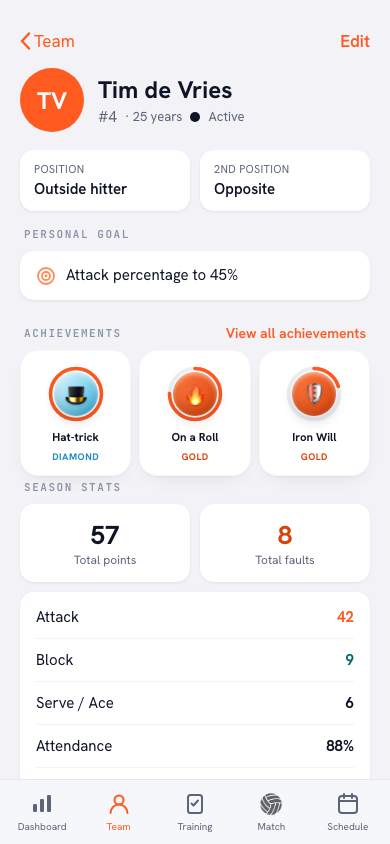
Which is exactly why it pays to record something about performance instead of trusting that you will remember it. The growth chart in Koach lines up performance across matches, so you can see whether a setback lasted three weeks or three months. How to read a line like that without reading too much into it is in reading the growth chart.
What you change as a coach
- Back to the basics. This is not the moment to add new skills. Repeat what the player already knew, because that movement has to be recalibrated to longer arms and legs.
- More reps, lower demands. Make target zones bigger and ball speeds lower, so the player keeps experiencing success while they recalibrate.
- Cut the jump load. Growth plates and tendon attachments are vulnerable in this phase; pain below the kneecap and heel pain are the classic signals. Reduce the number of maximal jumps per session and watch the landings.
- Bodyweight strength. Core stability, single-leg work and landing technique do more in this period than weights do.
- Say something about sleep and food. A kid growing ten centimeters a year needs more recovery and more fuel than a year ago. That is not a side issue.
More on safe loading in this phase is in injury prevention in volleyball.
What you tell the player and the parents
Tell them beforehand, not once it happens. A player who knows a dip comes with the territory does not get thrown by it; a player who thinks they have lost it starts forcing and makes it worse. Use the long-term line: someone who gains ten centimeters in a year will, two years from now, have a reach they are currently only suffering for. Parents usually need the same reassurance, because all they see is the matches. For team selection this means: never base a promotion recommendation on a snapshot taken in the months when a player is growing fast.
When it is not a growth spurt
Look further if the complaints do not fit the picture: pain at rest or at night, one-sided pain that does not settle, or a setback that runs longer than six months with no improvement at all. A dip that coincides with less enjoyment, frequent absence or friction in the group is usually not a physical story either. In that case look at motivation and team climate before you start tinkering with technique.
Frequently asked questions
Should a growing player train less?
Not less, but differently. Keep the training frequency the same while cutting the number of maximal jumps and explosive reps, and replace those with technique, coordination and core stability. That keeps the volume without the peak load.
Is the setback the same size for everyone?
No. Players who grow fast and a lot in a short window notice it clearly; those who grow gradually often barely do. Kids who move in varied ways alongside volleyball also adapt faster, because they are used to changing movement situations.
Can I do anything to prevent the dip?
Prevent, no; shorten, yes. Plenty of varied movement experience, attention to landings and continuing to repeat the basic skills all help a player relearn their new body faster.