
Can AI Track Volleyball Stats Automatically from Video?
The ads have been promising it for a few years now: mount a camera, play your match, and the statistics are waiting for you that evening. Part of that is genuinely true by now. Another part is still manual work being sold as automatic.
What 'AI statistics' means in practice
Behind that one phrase sit three very different products, and the confusion starts right there.
- The automatic camera. A wide-angle camera that films the whole court and crops in on the action in software, so it looks like someone is panning along. Providers like Veo and Pixellot sit in this corner. The output is video, not numbers.
- The video analysis layer. Software that cuts the recording into rallies, throws away dead time and labels clips. This is where most of the real progress of the last few years is, and it is also where the biggest time saving is.
- Statistic extraction. Software that tries to work out from the footage who touched the ball and what the outcome was. This is the hardest step and at the same time the one the marketing focuses on.
Many packages combine all three, which is why 'automatic statistics' in practice often means: automatically cut footage in which you still have to tick what happened.
What a camera system does well
Ball tracking and rally detection are solved problems. Software reliably pulls the rallies out of a two-hour recording and discards the fifty minutes in which nothing happens. That alone changes your week: reviewing no longer costs two hours but forty minutes, and all forty are actual volleyball.
Also good: recognising the serving turn, the set boundaries and the score, certainly if the scoreboard is in frame. And with decent light and clear jersey numbers, player recognition works reasonably well — although 'decent light' in an average club gym is an assumption you should verify before you buy anything.
Where it goes wrong
The problems all sit at the same point: a camera sees movement, not intent.
- Intent. Was that soft ball over the block a deliberate tip or a mishit spike? For your stats that is the difference between a good choice and an error. A camera cannot know.
- Pass quality. Rating a reception 3-2-1-0 is a judgement about what the setter could still do with that ball. Systems guess at it from the ball's trajectory, and that judgement regularly differs from the coach's.
- Who touched the ball. On a double block or a fingertip deflection, attribution is unreliable — precisely at the moments you want to count.
- Libero replacements and rotation. Systems lose the thread on quick swaps, and then the per-player attribution shifts one position across.
- The timing. You get the analysis afterwards. During a time-out it is no use to you, and that is exactly when you want to know how your hitter is doing.
What it costs, roughly
Exact prices change per year and per country, so always ask for a quote. The ratios, though, are stable. An automatic camera with a subscription runs into four figures a year for a club, and for that you mainly get footage. Analysis software with statistics features comes on top, usually per team or per season. A fixed ceiling-mounted camera covering the whole gym only pays off once several teams use it.
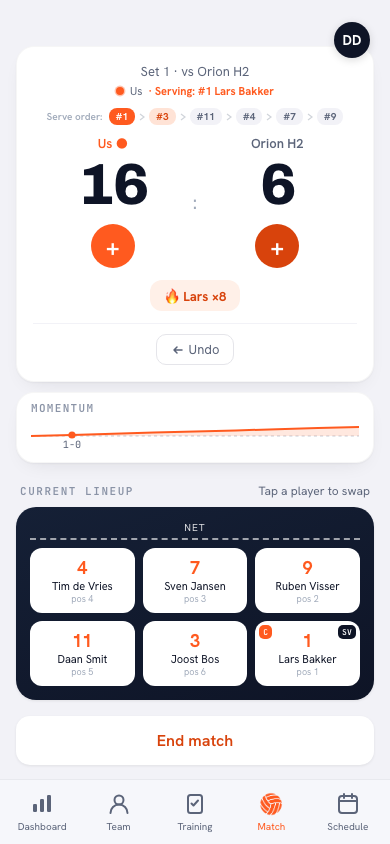
Set the alternative next to it: a phone on a tripod costs nothing extra and produces usable footage, provided you place it properly — see where to put the camera. Until camera systems get cheap enough for club level, tapping the point type in Koach while you watch is still the fastest route to per-player numbers.
The sum that actually works: do not ask 'what can the system do' but 'what is a minute of my time worth'. Automatically cutting rallies saves you well over an hour every week and is often worth the money at club level. Automatically deriving statistics saves you twenty minutes at best and produces numbers you would not dare to trust blindly.
What it is worth to a club team right now
For a team in a regional league the order is: film first, cut second, and only then think about automatic statistics. The return is in footage you can review quickly with your team, not in numbers a camera invented for you. Anyone serious about their stats taps them in: two taps per point, reliable, and it gives you the split into attack, block and serve from the point types straight away.
And when you scout or review, combine the two: numbers tell you how often, video tells you why. That combination is worked out further in scouting an opponent and the post-match review with data.
Frequently asked questions
Can AI analyse a volleyball match on its own without me doing anything?
Partly. Cutting rallies, following the score and recognising players works well by now. Judgements such as pass quality or the intent behind a ball remain human work, and those are exactly what make statistics usable.
Is an AI camera worth it for a club team?
Usually only if several teams share it. The biggest gain is in automatically cut footage, not in automatically derived numbers. For a team that reviews occasionally, a phone on a tripod does the same job.
How reliable are automatically generated statistics?
Plain counts like points and errors come out reasonably; per-player attribution becomes unreliable on block touches and libero replacements. Always check one set by hand before you draw conclusions.
What is faster: tapping live or tagging video afterwards?
Tapping live. Two taps per point costs you nothing extra after the match, while tagging afterwards easily takes half an hour per set, even with the rallies already cut.

Try it yourself in Koach
Less admin, more coaching.
Get started with KoachOr read first what the volleyball coaching app does.