
Deaf volleyball: coaching deaf and hard of hearing players
The short answer
Volleyball with deaf and hard of hearing players is just volleyball: the same ball, net and rules. What you adapt is communication: fixed signs, explanations the player can see, set roles on court and teammates who pass on the whistle. Deaf volleyball is also a sport of its own, up to the Deaflympics.
Deaf volleyball players do not need a different game, they need different agreements. A volleyball gym runs on sound: the whistle, teammates calling the ball, the coach on the sideline. Here you read how to include a deaf or hard of hearing player on a regular team, and what exists in organized deaf volleyball.
Coaching a deaf or hard of hearing player: start with the player
Deaf or hard of hearing says little about what someone needs in the gym. One player hears part of what is said with a hearing aid or cochlear implant, another hears nothing. One lip-reads, another uses the sign language of their country, such as ASL or BSL, and a third does both. The only thing that works is asking. In the first week, have a short conversation with the player, and with a child also with the parents:
- How can you follow me best? Lip-reading, signing, something on paper, or a combination. And from which side and at what distance.
- What changes in the gym? Ask whether echo, a second practice on the next court or music makes it harder to follow.
- Do you wear a hearing aid or implant at practice, and what if it has to come out? Then you know whether your agreements also have to work without sound. To be safe, assume they do.
- What may the team know, and who tells them? Some players explain it themselves, others want to hear as little about it as possible. That is their choice.
Medical questions about hearing or a hearing aid belong with the player's doctor or their own specialist, not with the coach. Your job is communication in the game. How to adapt the game itself for players with a physical or intellectual disability is covered separately in adaptive volleyball. For a deaf or hard of hearing player, the ball, the net and the rules usually do not need to change at all.
Explaining at practice: show it
Most explanation at practice happens by voice, often while the coach is already walking to the next cone. For a deaf player, that explanation is lost. A few habits solve a lot, and the rest of the team benefits too:
- Gather first, then talk. Put the group in a half circle in front of you, with the player at the front. Do not talk while walking away, with your back to the group or with a whistle in your mouth.
- Face the light. Do not stand with your back to a window: against the light, nobody can read your lips.
- Demonstrate instead of explaining. Have two players run the drill slowly, and point to where the ball goes. A sketch on a whiteboard or phone helps with movement paths.
- Write down the key points. The name of the drill, the count and the one focus point on a whiteboard by the court. Lip-reading does not catch every word, so write down numbers and names in particular.
- Check by doing. "Do you understand?" almost always gets a yes. Let the first repetition run calmly and watch.
Agree on two fixed signs and keep them the same all season: one to get attention, for example a wave within their field of vision or a tap on the shoulder, and one for stop that the rest of the team uses too. Ask the player which sign they prefer; not everyone likes a tap on the shoulder. If you are new to coaching, the basics of a practice are in starting as a volleyball coach.
Calling on court: from voice to agreement
Teams lean on calling: who takes the ball, whether a ball is going out, where the block is. How to get a quiet team talking is in volleyball communication drills. With a deaf player on court, part of that calling only works one way: they can call the ball and the others hear them, but they do not hear the others. Three things cover that:
- Fixed responsibilities instead of a last-second call. Agree per rotation who takes the ball between two players, who takes the short ball and who takes the deep one. What is agreed in advance does not need to be called.
- The deaf player calls the ball, if they want to. Their "mine" is simply audible to the others. That way the team's most important agreement stays in place: whoever calls it, takes it.
- Signals before the serve. Between two rallies there is time for eye contact. Beach players use hand signals behind their back to show what they plan; indoors you can do the same for the blocking plan or the serving target. Keep it to a few signs everyone knows.
To be honest, not every call can be replaced. An "out" call on a ball just crossing the line comes too late as a gesture. So train extra on judging balls near the lines, so the player learns to see for themselves what is going out.
Let the player explain the agreements. Agree on the signs with the player first, then have them show the signs to the team in a short drill. After three practices, ask which agreement works and which does not, and write the list of signs on a card in the team bag, so a fill-in player knows them too.
The whistle, timeouts and substitutions in a match
In a match, the most important sound comes from the referee. The rules help here, because the referee does not only whistle but also uses hand signals.
- The serve. The first referee authorizes the service (Rule 12.3) and indicates the direction of the service with the official hand signal. Teach your server to look for that signal. After that, they have 8 seconds (Rule 12.4.4). If they serve before the whistle, the service is cancelled and repeated (Rule 12.4.5); it is not a fault, but it breaks the rhythm.
- The end of a rally. If the deaf player keeps playing after a whistle, teammates raise their arms or stop visibly. After the whistle that ends a rally, the referees show with official hand signals which team serves and what the fault was (Rules 22.2.3 and 30.1). Teach your team to read those signals, with the explanation in referee hand signals in volleyball.
- The timeout. Crouch down so the player can see your face, talk briefly and point things out on a whiteboard or tablet. One point per timeout is enough; that goes for everyone.
- Substitutions. Agree how the player coming off knows: a teammate taps them, or you hold up the jersey number with your fingers or on a card.
Before the match, tell the referee and the opposing captain that a deaf or hard of hearing player is playing. Then they understand why the player sometimes plays on, and the referee can make sure their signals are easy to see.
The FIVB rules say nothing about hearing aids in so many words. Rule 4.5.1 forbids objects that may cause injury or give an artificial advantage, and Rule 4.5.2 explicitly allows glasses or lenses, at the player's own risk. Hearing aids are not mentioned. So whether a hearing aid or the processor of a cochlear implant is allowed in your competition is something to check in advance with your federation or the organizer.
Deaf volleyball: its own tournaments, up to the Deaflympics
Besides playing on a regular team, there is deaf volleyball. Internationally it falls under the International Committee of Sports for the Deaf (ICSD). Volleyball has been on the Deaflympics program since 1969 and beach volleyball since 2005, according to the ICSD volleyball page and its beach volleyball page. It is played under FIVB rules, according to the Deaflympics technical regulations for volleyball.
Who may take part in ICSD competitions is set out in the ICSD Audiogram Regulations: a hearing loss of at least 55 dB, averaged over three frequencies, in the better ear. Hearing aids and other sound amplification, including the external parts of a cochlear implant, are not allowed during warm-up or in the competition area. So there everyone plays without sound, and agreements without sound are a given. For competitions in your own country, the rules of the organization there apply.
Each country can have one national deaf sports organization as a member of the ICSD, the ICSD writes. That organization can tell you which competitions, tournaments and national team selections exist in your country; that varies a lot from country to country. A player can also do both: practice with their own club during the week and also play deaf volleyball.
Show rather than tell: in Koach
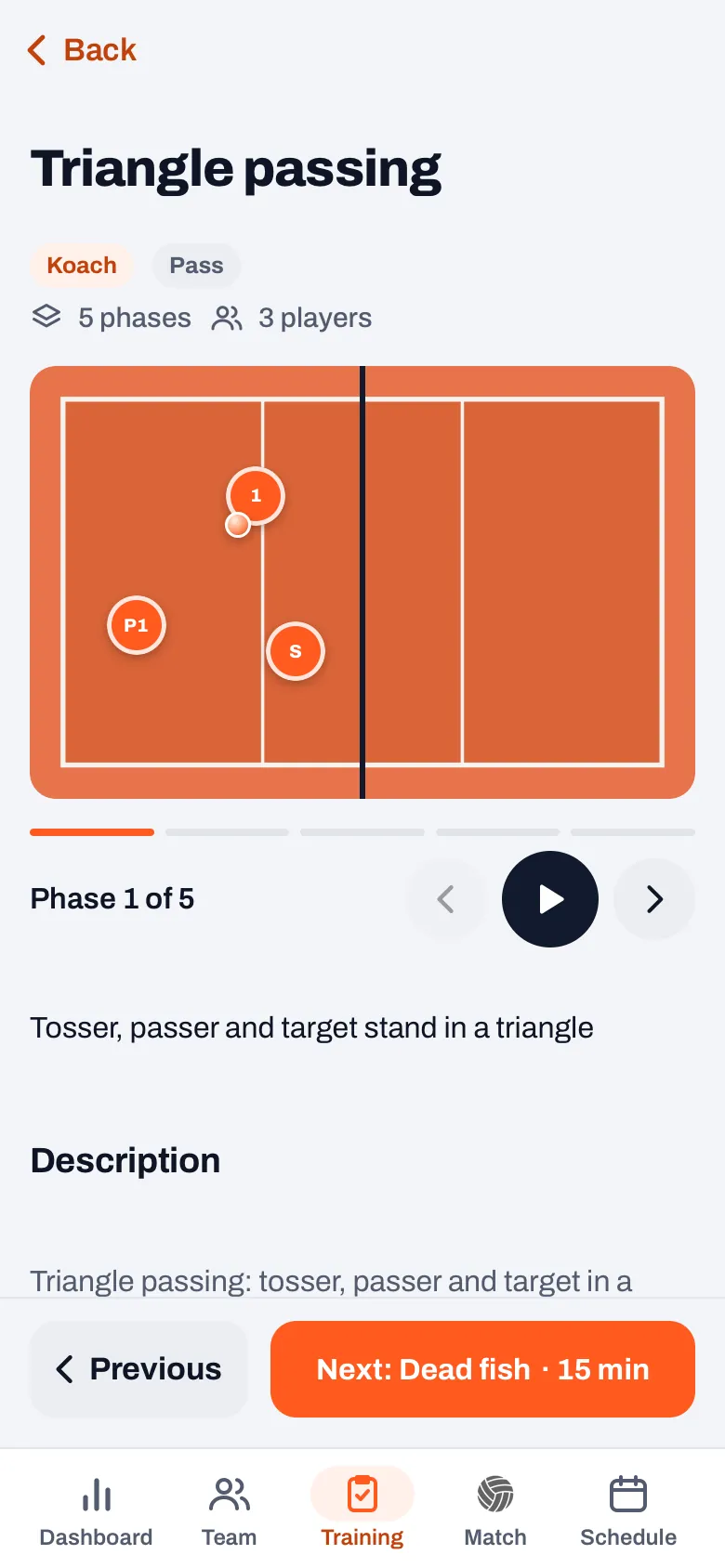
Koach does not translate sign language and does not add captions. What the app does do is make a lot of your explanation visible. The drills are drawn on the court, phase by phase with an animation of the players and the ball, a short text and a play button, so on a phone or tablet by the court you can show how a drill runs. If the player has their own account, they see the plan for the practice and can open each drill beforehand, with the same animation. A single drill they want to watch at home, you send with Homework on that drill; they then find it on their dashboard. Practical information, such as a different gym or an earlier meeting time, goes on the team dashboard as an announcement, so nobody depends on what was said in the locker room.
14 days free, no credit card. Set up your next practice and show the drills on your phone or tablet by the court.
Try Koach with your teamAs a player or parent you pay nothing; what Koach costs the coach after the trial is on the pricing page.
Frequently asked questions
Can a deaf player play on a regular volleyball team?
Yes. The ball, net and rules stay the same; what changes is communication. Agree with the player how they can follow you best, use fixed signs for attention and for stopping, set responsibilities on court in advance and have teammates pass on the whistle. Many deaf and hard of hearing players play on a regular team, sometimes alongside deaf volleyball.
Can you play volleyball with a hearing aid?
At practice, you agree on that with the player. The FIVB rules do not mention hearing aids; they forbid objects that may cause injury or give an artificial advantage. Whether a hearing aid or cochlear implant is allowed in an official match, check in advance with your federation or the organizer. At ICSD events such as the Deaflympics, hearing aids and the external parts of an implant are not allowed during warm-up or in the competition area.
How does a deaf player know the referee has blown the whistle?
By looking. When authorizing the serve, the first referee indicates the direction, and after every rally the referee shows with an official hand signal which team serves and what happened. Also agree that teammates stop visibly or raise their arms when the whistle goes, and tell the referee beforehand that a deaf player is on the team.
What is deaf volleyball?
Volleyball for deaf and hard of hearing players, played under FIVB rules, with its own tournaments and championships. Internationally it falls under the ICSD. Volleyball has been part of the Deaflympics since 1969, beach volleyball since 2005. To play in ICSD competitions you need a hearing loss of at least 55 dB in the better ear, and you play without a hearing aid or implant during the match. Competitions in your own country may have their own rules.
Is there a national deaf volleyball team?
In many countries there is, but it varies by country. Each country can have one national deaf sports organization as a member of the ICSD. That organization knows which competitions, tournaments and selections exist and how to sign up. Check the ICSD website to see whether your country has a member organization.
Show your drills instead of explaining them
14 days free, no credit card. After a week you know whether it makes your explanations easier.
Get started with KoachOr read first what the volleyball coaching app does.