
Retaining youth players: the jump to senior volleyball
You rarely notice it in one player. You notice it in a team allocation that no longer adds up in June: there is no team left for the oldest youth group, or the youngest senior team starts with seven. Players dropping out between 15 and 20 is seldom about motivation and nearly always about a year group falling apart at a moment that was in the calendar months earlier. That makes it a planning problem — and planning problems can be solved.
Count your members by year of birth, not by team
Most clubs only see the drop-out when the team allocation grinds to a halt. That is because the membership is organised in teams, and a team hides exactly what you would want to know. Twelve teams that all have just enough players look healthy right up to the day two of them fall over at once.
There is one count that makes it visible and that takes you half an hour: line up all your members by year of birth, regardless of which team they play in. At a club of 240 members that might look like this:
- Age 13: 24 members
- Age 14: 22 members
- Age 15: 19 members
- Age 16: 14 members
- Age 17: 8 members
- Age 18: 5 members
- Age 19: 6 members
This is a worked example, not a norm. What you see in it is a dip: up to about fifteen the numbers hold up reasonably well, after which they halve across two or three year groups and level off into a remnant. Whether your club has that dip too, and between exactly which two birth years, you only know once you count. That spot is no coincidence: it is tied to the age at which your youth categories end, and that boundary differs by federation and by country. So look it up in your own federation's regulations instead of copying it from an article.
Do the count every year on the same date — 1 May works well, comfortably before most registration deadlines — and keep the previous list. Only with two lists side by side can you say anything: not "we are losing youth players", but "of last year's 22 fourteen-year-olds, 19 are still playing this year, and of the 14 sixteen-year-olds, 8".
The four moments where a year group breaks
Drop-out in this age group is not a steady drip but a series of shocks. There are four of them, all four are predictable, and all four fall at a moment you can point to in the calendar in advance.
- The last youth year runs out. The category ends and there is nothing ready that this group fits into as a group — only a senior team that is too high or too low, or no place at all. This is the one moment where you lose a player without anything having been wrong.
- The exam year and the first part-time job. Around sixteen and seventeen, Tuesday evening gets competition from paid work and from a school year that genuinely counts. Recognisable in the absences: they stop being random and start falling structurally on the same evening or always in the last half hour.
- Studying and moving away. Between seventeen and twenty a share of them leave for another city. Here your influence largely stops, and you are allowed to say so plainly.
- The team falls over. Two stop for the reasons above, and within half a season it is five. This is the only one of the four caused entirely by the club, and usually the biggest single item.
Numbers two and three you can only soften. Numbers one and four are organisational, and that is where your gains are.
Two who quit often cost you five
Take a youth team of nine players. Two stop: you have seven. That looks manageable, because you can still train and still play. But something has changed that nobody says out loud. At nine players, an absence is a notification. At seven, it is somebody else's problem. At six there is no substitute left and one injury means you start with five. And at five the match doesn't go ahead.
That puts the practical floor at around eight: six on court plus two substitutes, so that one injury, one shift at the part-time job and one weekend away don't immediately combine into a cancellation. Once a year group drops below that eight, the character of every absence changes. It is no longer "I can't make it", but "because of me it isn't happening". It is precisely under that pressure that the third, fourth and fifth player drop out — not because they no longer want to, but because it is no longer fun being the one who has to hold it together.
So treat eight not as a comfort figure but as an alarm threshold. As soon as a year group threatens to fall below it, merging is the cheapest intervention you have: with the year group below, with another team, or as a whole a step upwards. The condition is that you do it before it goes wrong, because a group that gets merged after three cancellations experiences that as being disbanded. How to build and explain such an allocation is in team allocation in youth volleyball.
The question you ask in January, not in June
Almost every club asks in May or June who is carrying on next season. That is too late, for a simple reason: by then the team entries and the coaching allocation are often already fixed or about to close. You do hear the news, but you can no longer do anything with it.
Ask the question ten to fourteen weeks before your last playing day. Count that back from your own calendar, because season length and registration dates differ by federation and by country; what matters is the number of weeks, not the month. It is also not a survey and not a form, but five minutes per player after training, with three sentences:
- "I'm putting the teams together for next season and I don't want to make assumptions. Are you playing with us next year?"
- If they hesitate: "What would have to be right for you to do it — the evening, the travel time, the level, or who you're in a team with?"
- "You don't have to decide now. I'll come back to you briefly in six weeks."
Three kinds of answer come out of it: yes, no, and don't know. That middle group is your workload — not the noes. Note down the answer and the reason behind the hesitation for each player, because if five players say "the evening" you don't have an engagement problem but a hall scheduling problem, and you solve that in a completely different way. After one round you no longer have a feeling but a list you can plan with.
If someone sticks with no, leave it there. The conversation with an individual player who wants to quit is a different conversation, with a different structure and usually with the parents present; that is worked out in my child wants to quit volleyball. Here it is about the year group: how many players do I have in September, and does a team still fit around them.
Keep the team together, even if it has to be a level lower
The most expensive habit in the move to seniors is splitting players by level. Four go to the third team, two to the fifth, two are left over and belong nowhere. On paper it adds up: everyone is at their own level. In practice you are pulling a group of friends apart at exactly the age when that group is the main reason anyone still turns up.
The alternative is less tidy and works better: enter the year group as one senior team, if necessary one or two levels below what the strongest players can handle. Alongside that, let those strongest two train with a higher team, or fill in there when it suits. You then give up half a season of development for two players. Split the group and you lose more than that on average. Do check with your own federation what is allowed beforehand: whether a player may be listed in two teams and how often they may fill in differs by country and by competition, and you want to know that before the registration and not after.
So put the registration deadline deliberately into your season plan, with the reference date of your member count in front of it. How to put those moments into the club calendar is in organising your volleyball season.
Three intermediate steps between all and nothing
Many players don't stop because they want to stop, but because the only choice the club offers is "twice a week plus Saturday". Anyone who can no longer manage that has only cancelling left. Three intermediate forms catch that:
- A recreational strand. One evening a week, no league commitment, but the same hall and the same people. This is the most underrated way out of the performance strand: an eighteen-year-old who no longer has two evenings because of a part-time job stays a member instead of disappearing. How to train such a group without turning it into a disguised competition session is in training recreational volleyball players.
- A format for those leaving to study. Training along in the holidays, filling in when numbers are short, joining the club tournament. Keep the expectation low and the offer concrete: "you're welcome on any Tuesday you're home, and you don't have to cancel." Whether a separate membership type fits with that and what it costs differs per club and per federation — check with your membership administration before you promise it.
- A job instead of a team. Coach of a mini group, referee, coach of a youth team. Ask that personally and with a boundary built in — "one group, one evening, until Christmas, and then we look again" — because an open-ended request nearly always gets a no at this age. What does and doesn't work in the asking itself is in recruiting coaches for your club.
The first months with the seniors are the real fault line
Whoever does make the step isn't home yet. In the first months three things change at once, and each of them is manageable on its own; together they are the reason a share still drops out in November.
- The serve. A player who was a perfectly good passer in youth is suddenly the weakest link in reception with the seniors. That is not a decline but a jump in level, and he has to hear that out loud — otherwise he draws his own conclusion.
- The evening. Training starts later, matches last longer and Saturday runs on into the evening. For someone in an exam year that is a genuine objection, not an excuse.
- The role. From key player in the youth team to eighth man in a senior squad. This is the most predictable trap of the three, and there is a worked-out approach for it: see keeping bench players engaged.
Three interventions cushion that. Let the oldest youth group train with the seniors in the second half of the season already, as a fixed additional trainer rather than a one-off experiment — how to count someone like that in attendance without having them in the squad is in additional trainers and guest players. Then agree the playing time for the first three months in advance, out loud, with the senior coach present, so nobody has to guess in October. And pair every newcomer with a teammate over twenty-five with one concrete task: phone that player if they have missed two sessions.
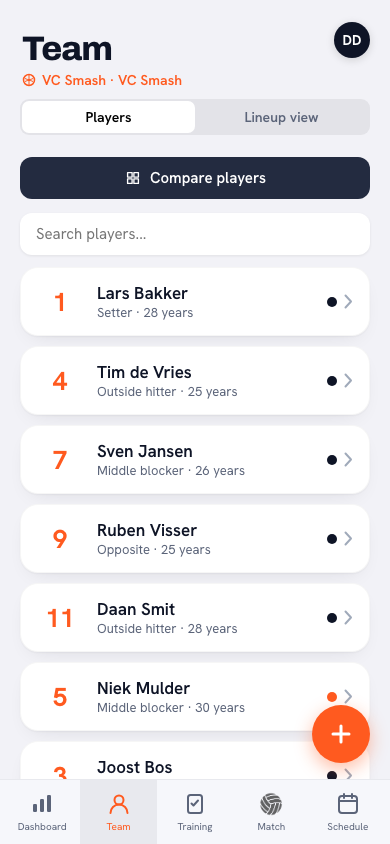
What you also want to see is the first ten weeks in numbers. If attendance and playing time are tracked per player — in Koach they sit side by side per season — you can see within two months which newcomer is only making half the sessions. That is the moment for a five-minute conversation, not the message in February that he is quitting.
Three numbers to look back on next year
A retention policy you don't measure is a good intention. You don't need a dashboard for it; three numbers a year, on one sheet of A4, is enough.
- Retention per year of birth. How many of the members from birth year X are still there a year later. From 22 to 19 is 86 per cent; from 14 to 8 is 57 per cent. That second number tells you which year group to intervene in, and it is almost never the year group everyone is talking about.
- The thinnest year group on the reference date. The number of players in your smallest year group on 1 May. Below eight that is no longer an observation but a decision point: merge, top up, or don't register this year and carry on as a training group.
- The hesitaters who stayed. How many "don't knows" you noted in January, and how many of those players actually turned up at the first session in September. This is the only number that shows whether your conversations achieve anything.
Take those three into your season review and measure on the same date every year. After two seasons the technical committee is no longer talking about the impression that a lot of youth players are leaving, but about why the sixteen-year-old year group halves while the fourteen-year-olds hold up.
Key point: drop-out between 15 and 20 is rarely a motivation problem and usually a supply problem. At the moment a year group runs out of the youth section, there has to be something ready that they fit into together. Arrange that only in June and you have arranged it too late for half the group.
Frequently asked questions
At what age does drop-out usually start?
That differs per club and is worth counting for yourself. The kink often coincides with the end of the youth categories, and that age boundary differs by federation and by country — so check it in your own federation's regulations. Line your members up by year of birth once a year and within half an hour you can see where your dip sits.
Only five players are left in my oldest youth team. What now?
Find the connection before the registration deadline, not after it. Three workable options: merge with the year group below, enter the group as a whole with the seniors at a lower level, or don't register this season and carry on as a training group until you are back at eight. A group that is only merged after three cancellations experiences that as being disbanded.
Should I move players up to the level they can handle, or keep them with their friends?
For retaining the year group, the group weighs more heavily than the level at this age. The practical middle way: keep the team together in a lower senior team and let the one or two strongest players train or fill in with a higher team alongside that. Do check with your own federation whether a player may be listed in two teams and how often they may fill in.
When should I ask who is still playing next season?
Ten to fourteen weeks before your last playing day, and not in May or June, because by then the team entries are usually fixed. Count those weeks back from your own competition calendar, since the length differs by federation. Come back briefly six weeks later to everyone who said 'don't know'.
How do I keep players who are going to study in another city?
Keep the expectation low and the offer concrete: training along in the holidays, filling in when numbers are short, joining the club tournament, with no obligation to cancel. Whether a separate membership type goes with that and what it costs differs per club and per federation — check that with your membership administration before you promise anything.
Isn't it simply normal for young people to stop at that age?
Partly, yes: studying, moving away and an exam year are outside your influence and you don't have to feel guilty about them. But the fourth cause — a team falling over after two players have left — is not a force of nature but an organisational consequence, and at most clubs that item is the largest of the four.