
Dealing With Difficult Parents as a Coach: What to Do Courtside
The father coaching from the stands while you are coaching. The parent tearing into an inexperienced referee. The mother who brings up playing time the moment the last ball hits the floor. Dealing with difficult parents as a coach is part of the job nobody prepares you for, and it is rarely solved with one good conversation. This piece is about the moment itself: what you do during the match, what you save for a calmer moment, and where the line lies between your task and the club's.
Dealing with difficult parents as a coach: four types on the sideline and what they are really asking
It helps to start with what you see rather than with what you think of it. Almost all the trouble on the sideline falls into four types, and behind each of them is a question the parent does not ask.
- The co-coach. They shout instructions across the court while you are giving them too. What lies underneath is rarely distrust; usually it is helplessness. They see their child hesitate and can't reach them. First move: make sure the player hears your voice, not that the parent stops.
- The referee parent. They comment on every decision, louder as the match gets tighter. Underneath: someone has to stand up for my child. First move: you don't join in, and you protect the referee — who in youth matches is often a beginner or a volunteer.
- The playing-time parent. They bring up minutes, often right after the last point. The real question is almost never arithmetic: do you actually see my child, and do they have a future here? First move: acknowledge the question, but not there and not then.
- The pusher. They focus mainly on their own child, with criticism after every error. This is the hardest of the four, because the player pays the price, not you. First move: you watch the child, not the parent — how the child is sitting on the bench is the signal that counts.
Important: none of these four is necessarily a bad person, and none of the four can be solved during a rally. The agreements that take away some of this behaviour before the season starts — and how to make them with the group — are in agreements with parents on the sideline. Below is about the match in which those agreements don't exist yet, or don't work. If you also coach your own child in this team, something else is at play that you don't have with the other parents; that is in coaching your own child.
The parent coaching from the stands: what you do during the rally
You don't solve this during a rally. Every second you spend on the stands is a second in which you are not coaching your own team — and that is exactly the problem you wanted to solve.
What does work is giving the player your voice. A player who gets two instructions at once carries out neither; they freeze. So give a short, concrete instruction at the moment the parent also shouts something — one word is enough. Look at the player, not at the stands. That way you override the instruction without anyone having to be corrected.
In the break that follows, you say it to the player and not to the parent: "You listen to me, even if someone shouts something else." That takes the choice away from them, and that is half the burden.
You only have the conversation with the parent if it happens again, and then briefly, kindly and out of earshot of the team. One sentence is usually enough: you coach from the sideline, so that the players only have to listen to one voice. Don't do it during the break of a tight match and not with your back to the court, because then you have two problems at once.
The parent tearing into an inexperienced referee
Here the line lies differently from the other three, and you may treat it that way. In youth matches the referee is often someone still learning the job, or a volunteer who does it because otherwise nobody would. Protecting them is not a question of sportsmanship but part of your job: an inexperienced referee who is received like that easily quits, and then soon there is nobody left to referee your matches.
Three things, in this order:
- Don't join in yourself. No sigh, no hand gesture, no approving glance at the stands. One reaction from the coach turns grumbling into a chorus.
- Say something neutral out loud that the whole bench hears: "We play on." You are not addressing anyone, but you are setting a standard. Often that is enough.
- If it continues, say it directly once, during a break in play, calmly and in one sentence: they are still learning and this helps nobody. Don't argue about the decision itself — that concedes to the parent that the decision is the subject.
Afterwards you do two more things: you thank the referee where your players can see it, and you let the person at the club who organises the referees know that this happened. Not as a complaint about the parent, but because the club is the one that needs to know.
The parent who brings up playing time right after the match
This is the moment when it is easy to say something you regret the following week. You are drained, the team is standing around, and the next team wants to get on court. There is no worse place for this conversation, and that is exactly why it happens there.
Your goal in that minute is therefore not to explain, but to move the conversation: you acknowledge that the question exists, you say it can't be done here, and you name a moment when you will call. How to say that in three sentences without it sounding like a brush-off is written out in the three sentences on the sideline with an angry parent. What is specific to the playing-time question is what you do not do with it in that minute:
- No numbers from memory. At that moment you don't know exactly how much this child has played in recent weeks, and a number that later turns out to be wrong will follow you for the rest of the season.
- No promise. "He'll start next week" is quickly said under pressure and depends on injuries, attendance and the score on match day.
- No judgement about the child's level in a gym where that child is standing, and nothing about another player.
Then look at the child, not the parent. A player who has just seen their father or mother march up to the coach is often carrying more than the match. One ordinary sentence about how they played is enough. What you can explain in the later conversation is how you divide playing time and what that standard is based on; the policy behind it is in dividing playing time fairly.
What you save for a calmer moment (and why you never talk it out in the gym)
In the gym you have only heard one side of the story, and what you say there gets retold by others. So that same evening do one thing, and no more: write down three lines. What happened, what you said, and on what date. Factual, without judgement, and short enough that you keep it up. It gives you two things: you don't have to rely on your memory next week, and if it becomes a club matter, you have something more than an impression.
The conversation itself — when you call, how you open it, how long you make it, what you do if someone stays angry and when you stop defending — is a skill of its own and is fully worked out in the same article on the conversation with an angry parent. Prepare that conversation with your three lines beside you.
When it is no longer a sideline problem
There is a line, and it is good to draw it for yourself before the season rather than in the moment. On the sideline there are four situations you no longer solve as a coach during the match:
- Shouting at children — their own or someone else's.
- Remarks about someone else's child, in any form.
- Following the referee or seeking them out after the match.
- The same behaviour again, after you have clearly drawn a line once.
If it happens during the match, your place is with the team. If there is someone from the club in the gym — a board member, another coach, the person managing the venue — ask them to talk to the parent, so that you are not standing with your back to the court between rallies.
After that it is no longer a sideline problem but a club matter. A volunteer coach should not decide on their own about a parent's access. When the club takes over and how to hand it over openly is in the last part of the article on the conversation with an angry parent.
During the match you coach the court, not the stands. Everything you say to a parent during a match, you say with your team as the audience. Keep it to one sentence during a break in play, and save the rest for a moment when no children are listening.
What Koach does and doesn't do for you here
This is a behaviour problem, not an app problem, so the honest list is short. What the app does do is remove part of the trigger and make one conversation easier for you.
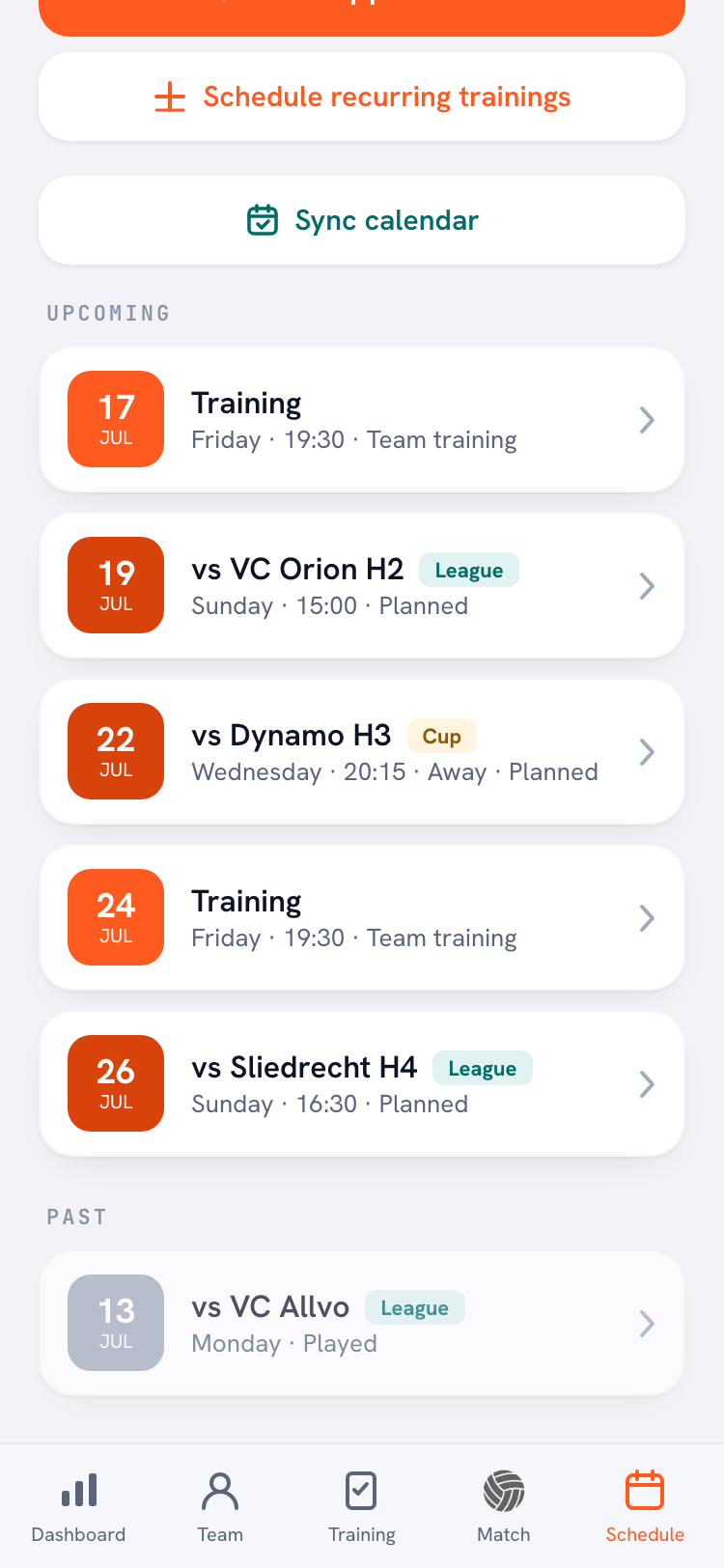
For a player you can use 'Invite a parent' to create a separate parent account linked to their child. That parent sees the dashboard and the calendar with practices, matches and club duties such as bar duty, and for a driving rota their own trip. They see no statistics, no attendance and no homework — those stay with the coach and the player. How to set that up is in adding parents to your team, and exactly what a parent gets to see is in the explanation of the app for parents. Announcements, polls and tasks go on the team board, where a task stays until someone picks it up. What there isn't: a chat function. So you don't have discussions about playing time in the app, and that is just as well.
The second thing is more concrete. Playing time per season is on your coach dashboard, per player. That turns the playing-time conversation from an exchange of impressions into a conversation about numbers you can put on the table — and it also protects you against your own memory, which in a conversation like that is always on your side. Those numbers are for the coach: a parent does not see them in their own account.
If you want to take those two things off the sideline: put your schedule and your driving rota in one place, invite your team's parents with their own account, and keep track of playing time per season. You can try Koach free for 14 days.
Frequently asked questions
How do I deal with difficult parents as a coach?
Separate the moment from the conversation. During the match you do as little as possible: you make sure your players hear your voice and you don't get drawn into comments about the referee. You have the conversation about the substance later, at an agreed moment and not in the gym. Write down three factual lines about what happened that same evening, so you go into that conversation with more than a memory.
What do I do with a parent who complains about their child's playing time?
Don't enter into the conversation at that moment. Acknowledge the question, say why it can't be done there and name a concrete moment when you will call. Don't give numbers from memory, don't make promises about playing time and don't talk about another player. In the conversation itself you are in a stronger position if you can explain your standard for playing time and have the numbers to hand.
When is a parent involved and when is it too much?
Look at the behaviour, not the person. Cheering, driving, washing kit and caring is involvement, even when it is loud. It becomes too much as soon as it is about someone else's child, as soon as the referee becomes the target, or as soon as your players hear two voices at once during a rally. The clearest signal is the player: a child who looks at the stands first after every error and only then at the court is playing for someone other than the team.
Can I ask a parent not to come to the sideline any more?
That is almost never a decision for the coach alone. You can name behaviour and set a boundary, but access to the gym is a club decision. So report it to the youth coordinator or the board, with your notes, and let the club take over. That protects you, and it also makes the measure more sustainable than if one volunteer takes it on their own.
Should I talk about it with the team?
With the team as a whole, usually not: then you make it an issue that most players weren't bothered by. With the player involved, yes, and briefly. One sentence is enough: they listen to you, even if someone shouts something else. That takes the choice away from them, and that is what a player is struggling with at a moment like that.


Try it yourself in Koach
Less admin, more coaching.
Get started with KoachOr read first what the volleyball coaching app does.