
Late to Volleyball Practice: What the Player and the Coach Do
The door opens, the warm-up is under way, everyone looks up. You are late to volleyball practice. What do you do in that first minute, and what does it mean for the coach who built the drill around ten players? This piece answers that question first, and then the coach's question: how do you read a pattern in it, instead of turning it into an irritation every week?
You are late to practice: what do you do in the first minute?
It happens to everyone. The bus was late, the lesson ran over, parking took ages. What happens next is in your own hands, and the difference is in the first minute.
- Don't walk through the drill. Stay at the side until the coach sees you or there is a natural pause. Sneaking along the wall to your friends and joining in halfway through a rally disrupts the drill for ten other people.
- Say one sentence, not a story. "Sorry, the bus was delayed — I'll just warm up." Nothing more is needed at that moment. If there is more to tell, do it after practice.
- Don't skip your warm-up. You are late, not warm. Do a short version at the side: a few laps, loosen your shoulders, a few jumps. Stepping into an attacking drill with cold ankles and shoulders increases the risk of injury.
- Join where the coach puts you. Not with the group you would most like to be in. The coach has already made the pairs and groups, and you are the one joining.
Why this matters: a coach builds a practice around a number of players. A drill in pairs runs differently with nine than with ten, and a game form just explained has to be explained again for you. That is not a disaster, but it is what it costs the coach — and with those four steps it costs as little as possible.
Being late and not letting anyone know are two different things
For your coach it makes a big difference whether you come in ten minutes late or whether they don't know if you are coming at all.
Late means: you are there, just later. The coach can still use you, and after a quarter of an hour nobody notices any more. Not letting anyone know means: the coach is counting on you, makes pairs with you in them and perhaps waits a bit before starting — and you don't come. That second one costs a practice much more than the first.
In between is the situation that goes wrong most often: you know in advance that you will be late, and you don't say so. Then it is simply a surprise for the coach, who starts the warm-up for the second time when you walk in. If you know in advance, let people know in advance. How signing up and out works is in letting your coach know your attendance as a player. And someone who is there but doesn't train, for example because of an injury, is something else again; see present without playing.
What your coach sees on their sheet when you come in late
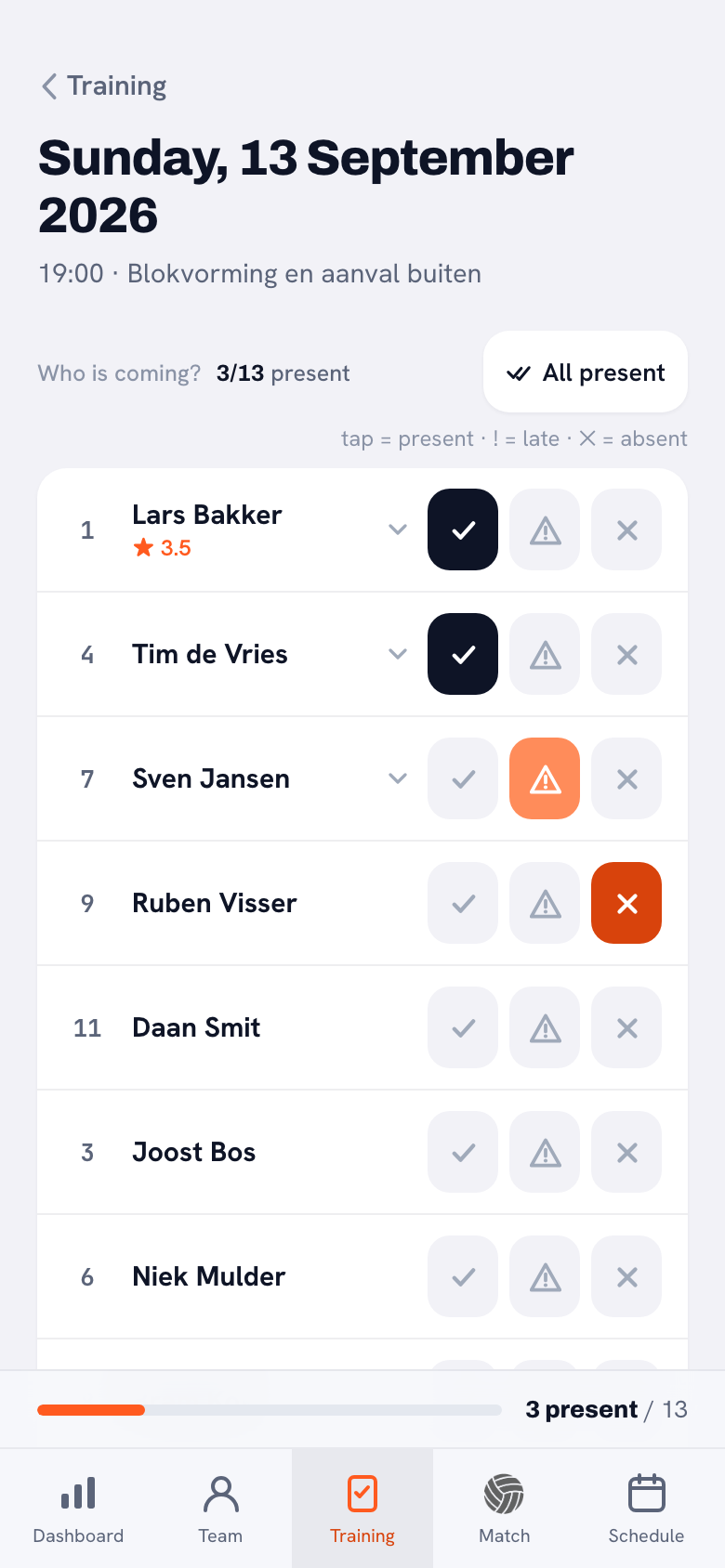
A coach who works in Koach has three statuses per player on the practice sheet: present, late and absent. Late is coloured orange. For attendance it counts as present — you were there, after all — but it is counted separately. So over a season the coach sees not only how often you were there, but also how often you came in late.
That sounds like a list you are on, but it works the other way too. Someone who is late once in a season is recorded as once — and not as "always late", which is sometimes what it becomes in someone's head after an irritating evening.
What you can do yourself: if you know in advance that you will be late, sign up for that practice and add a note, for example "I'll be a bit late". Your coach sees it when preparing the practice. Who fills in which status and where you can see your own percentage is in the article on letting your coach know your attendance.
For the coach: what you can't conclude from one evening
It is eight o'clock, you have seven players, and at five past two more walk in. The irritation is real and understandable. But that one evening says almost nothing: a bus, a lesson that ran over, a parent who had to work late. It is not a pattern yet and certainly not a character trait.
The reaction coaches later regret is saying something about it the first time in front of the whole group. It costs your drill time, and it mainly teaches a player that next time they had better stay away altogether if they are running late. That is exactly the opposite of what you want.
What you do the first time is small. Start on time with whoever is there, and don't restart the warm-up for every latecomer — they warm up at the side. Nod, point to where they join, carry on. And record it. How to keep track of that without it costing your practice is in logging late arrivals and making them discussable; how to track attendance in general is in tracking attendance.
Reading the pattern: three out of twelve is not bad luck
Once or twice in a season is life. Three times in the last twelve practices — a quarter — is a pattern worth one question. The difference is that by the third time you no longer go on your feeling but on a count.
For that, the coach dashboard in the app has the Often late card: the players who were late most often this season, five at most, with for each player at how many practices out of the total and a percentage. Tap a name and you go to the player card. It is a count, not a judgement: the reason isn't in it, and you still have to ask for that.
Before you ask that question, look at the shape of the pattern:
- Always the same evening of the week. Then it is almost always logistics: a lesson, a timetable, whoever is driving. You solve that with an agreement, not with a remark.
- Always a few minutes. Then the start time as it is currently agreed may not be achievable for this player.
- Spread out, and more often in recent weeks. That is the signal to take seriously. It may be about time, but also about motivation — and then the conversation is about something other than the clock.
How to have that conversation is in the article on making late arrivals discussable. In the meantime, don't let it seep into your rating of effort: coming late is attendance, not work ethic on court. Mix the two and you get an effort score that no longer says anything; see rating player effort.
Count before you say anything. The player who is 'always' late often turns out to have been late three times when you count, and the player you never notice sometimes just as often. A count protects both of them — and you.
The agreement in advance: when is late too late?
A lot of irritation about lateness is really about an agreement that was never made. At the start of the season, make three things explicit:
- What "on time" means. If practice starts at eight, are you changed and in the gym by then, or do you only walk in then? Either can work, but not both at once.
- What you do if you know you will be late. Let people know in advance, with your status or a message — not explain afterwards.
- What you do when you come in. Warm up at the side and join at the next pause. Then nobody has to think about it in the moment.
Make that agreement with the team instead of announcing it; how to go about that is in making team agreements. And don't forget the players who join halfway through the season. They don't automatically know the unwritten rules; what to give them on day one is in new for players.
When someone doesn't let you know at all
This is the more expensive problem. Not late, but unknown: a player who hasn't said anything and doesn't come, or only walks in when you have already started with an odd number.
Part of that you can catch in advance. In the app, anyone who hasn't responded for a practice yet — no sign-up and no cancellation — gets a reminder two days beforehand, and a linked parent gets one about their child. How that works and why the evening before is too late is in the reminder 48 hours beforehand. Anyone who cancels is asked why, so that absent also tells you something.
If a player structurally neither cancels nor comes, it is no longer about being late but about attendance and commitment. That is a different subject with its own approach; see improving practice attendance.
Try it yourself in Koach
At your next practice, set the statuses on the practice sheet: present, late or absent. After a few weeks your dashboard shows who comes in late more often, with the number of practices next to it, and you no longer have to rely on your memory. Players add a note to their status themselves if they know they will be late, and anyone who was present at least five practices without being late once gets the Never Late badge. The trial lasts fourteen days.
Frequently asked questions
I'm late to volleyball practice — what do I say to my coach?
One short sentence when you come in, for example that the bus was delayed and that you'll just warm up. A longer explanation belongs after practice, not in the middle of a drill. If you know it will happen more often, say that straight away too: then your coach can take it into account instead of being surprised every week.
I already know I'll be late next week. How do I let them know in advance?
Tell your coach at the end of this practice, and also add it to next week's practice. In Koach you sign up for that practice and add a note, for example 'I'll be a bit late'. Your coach sees it when preparing the practice and can adjust the groups accordingly. What else you see in the app as a player is in the app from the player's point of view.
Should a latecomer make up the warm-up?
Yes, but a short version and at the side, not the whole warm-up while the rest have moved on. The point is not that they make something up as a punishment, but that they don't step into a jumping or attacking drill with cold muscles. Then have them join at the next pause in the drill.
My child is late because school or the minibus runs late — what can I do as a parent?
Tell the coach once, in advance and calmly, rather than every week afterwards. Ask straight away how your child can best join when arriving later, so they don't have to ask again every time. If your child has their own player account, they can sign up for that practice and add a note themselves saying they will be late. What else you see and receive in the app as a parent is in Koach for parents.

Try it yourself in Koach
Less admin, more coaching.
Get started with KoachOr read first what the volleyball coaching app does.