
Sports club annual report: a template with team stats
The short answer
A sports club annual report tells members what the club did over the past year: board, membership, sport, volunteers and events, plus a look ahead. The financial part comes from the treasurer's books. If your volleyball club uses Koach, the sports section comes from the app: players, results and attendance per team.
A sports club annual report is something you write once a year, usually when the annual general meeting is already on the calendar. Below is a template you can copy, with a note for each section on where the information comes from. If the coaches at your volleyball club use Koach, you no longer have to retype the sports section by hand.
What goes in a sports club annual report?
An annual report tells members what the club did over the past year and where it stands now. It is how the board accounts for its work, usually at the annual general meeting (AGM). New board members, sponsors and grant funders also read it to understand what kind of club you are. Whether you are required to publish one, and by when, depends on your constitution or bylaws and on the rules in the country where your club is based.
Keep two documents apart. The financial report, the annual accounts, often with a budget for the new year, is prepared by the treasurer from the books. The annual report itself is the story around it: board, membership, sport, volunteers and events. A useful annual report has three qualities:
- The same structure every year. Members can then lay the years side by side and see for themselves whether the club is growing or shrinking.
- Numbers with a source. "The youth section had a good year" says little; the number of youth teams and their practice attendance say far more.
- Short. Aim for something people can read in fifteen minutes. Tables and details go in an appendix.
Sports club annual report template: ten sections
Copy this structure into your own document. Each section lists what belongs in it and who provides it.
- Foreword. Half a page from the chair: the year in a few sentences, what went well, what fell short and who you want to thank.
- Board and organization. Who served on the board and the committees, who stepped down, how often the board met and which decisions members need to know about.
- Membership. Members at the start and at the end of the year, new members, cancellations and the split between juniors and seniors. This comes from your membership records.
- Season review. For each team the number of players, the coaches, the results and practice attendance, with a few lines on the highs and lows.
- Youth. How many youth teams you had, how players moved up to the next team and what was organized for young players.
- Coaches and volunteers. Who coached, who took a course, and the people behind the scenes: referees, scorekeepers, bar duty and equipment.
- Facilities. Which gyms you practiced and played in, how much court time you had and what changed.
- Events and communication. Tournaments, club days, the website and social media.
- Sponsorship and finances in brief. Your sponsors, and two or three sentences from the financial report with a pointer to that document.
- Looking ahead. Goals for the coming year, concrete enough to check twelve months from now.
Section four usually takes the longest. The numbers sit with every coach, each in a different form: a list on paper, a spreadsheet, a group chat. Whoever collects them has to chase each coach separately, and even then ends up with numbers that were not counted the same way.
Where do the numbers for the annual report come from?
An annual report almost never comes out of one system, and it does not need to. Here is where each part comes from, and what a volleyball club can take from Koach.
| What you need | Where it comes from | From Koach |
|---|---|---|
| Member numbers, new members and cancellations | Membership records | No |
| Annual accounts and budget | The treasurer's books | No |
| Teams, players and coaches | Club export | Yes |
| Played, won and lost per team | Club report and club export | Yes |
| Practice attendance per team | Club report, club dashboard and club export | Yes |
| Points per player, if coaches track them | Club export | Yes |
| Sponsors and events | Board and committees | No |
You can do the sports section without an app, too: set up a shared spreadsheet with one row per team (players, played, won, lost, attendance) and ask every coach to fill it in before the season ends. It costs nothing and works with any program. It does depend on coaches actually filling it in, and anyone who did not take attendance at every practice will have to guess after the fact.
The sports section from Koach: three places
If the coaches at your volleyball club use Koach, the material for section four is already there. You need the Club plan, and you find it in three places.
The club report: every team on one line
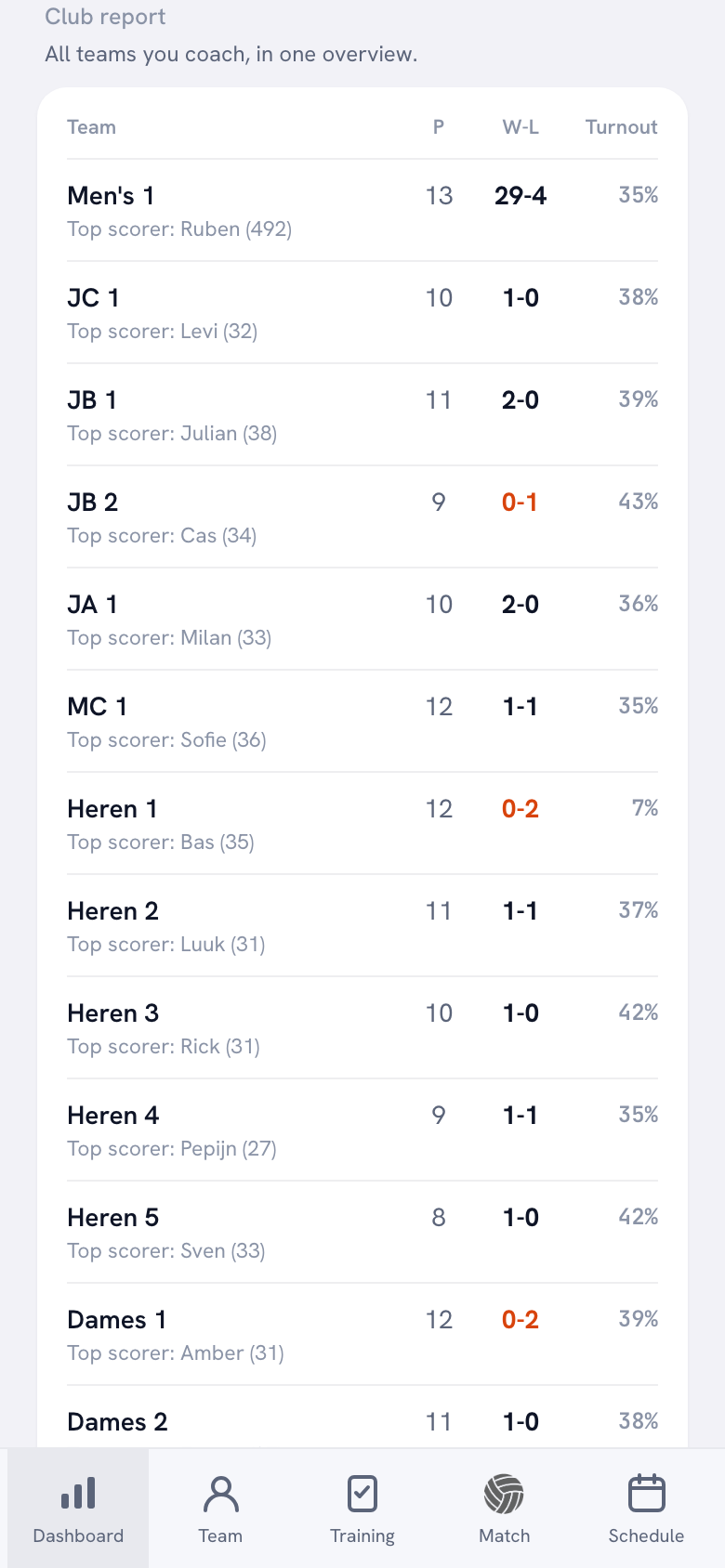
In your Profile, below your teams, is the Club report block, with the line "All teams you coach, in one overview." For each team you see the number of players, matches won and lost, attendance and the top scorer. The report covers the current season for each team, and attendance only counts practices that have already taken place and where attendance was recorded. Export club report (CSV) gives you those numbers as a file, with the columns Team, Players, Played, W, L, Turnout % and Top scorer.
The block appears when you are on the Club plan and are the owner or a coach of at least two teams. If you are on every team, you have the whole sports section in one table. If you do not coach a team yourself, say as a board member, you will not see this block; use the club dashboard and the export below instead. How a coach with several teams uses the report day to day is covered in managing multiple teams with the club report.
We set up Koach Club together with you. Club has no free trial: leave your details, and we will get in touch and set up the teams and coaches with you. From then on, the sports section of your next annual report grows with every practice and match your coaches record. Coaching a single team yourself? Then try Koach free for 14 days with that team.
Book an intro call Start with your own teamThe Overview tab of the club dashboard
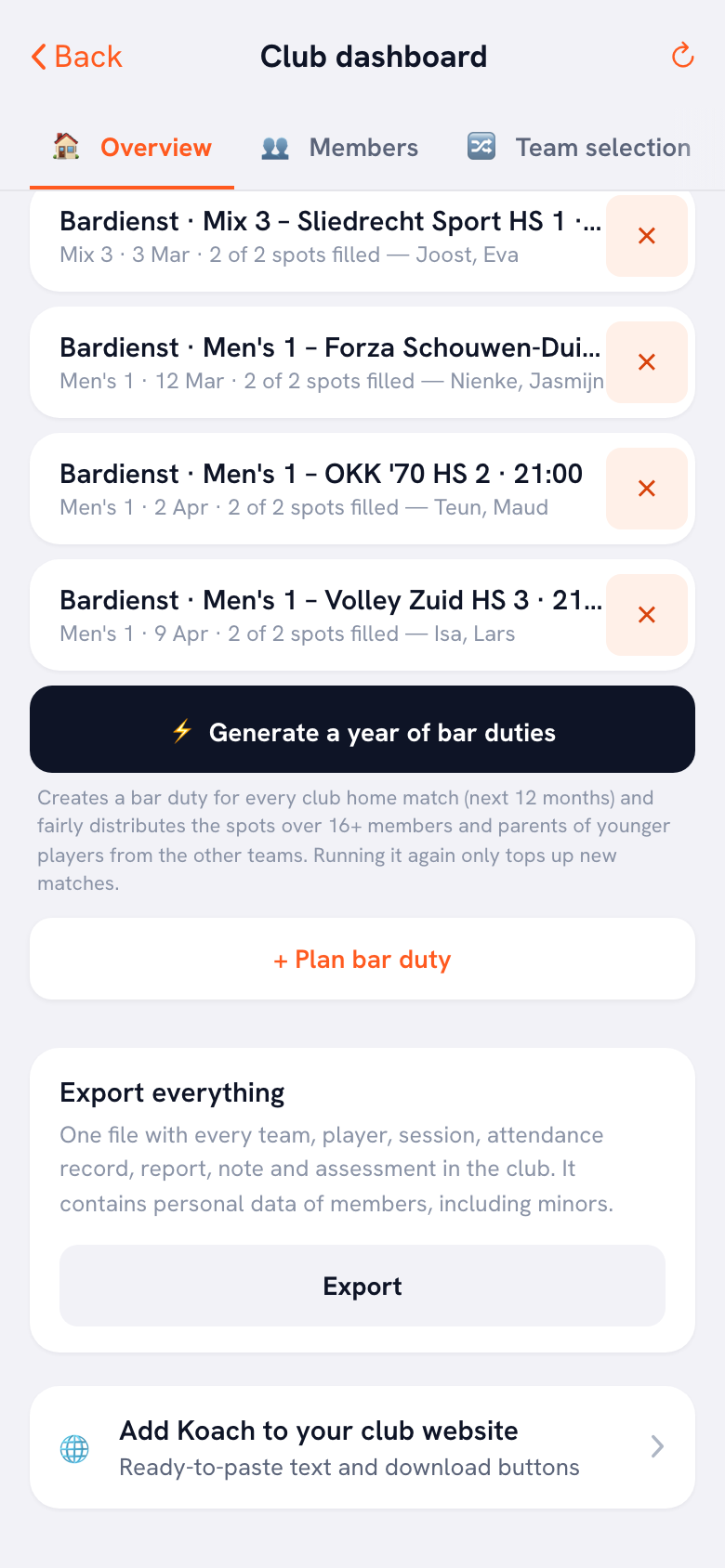
The Overview tab of your club dashboard shows the numbers for the whole club: how many teams, players and linked accounts there are, and for each team the attendance and the number of scheduled practices and matches. Here too, attendance only counts this season's practices where attendance was recorded. Put the screen next to the draft of your annual report at the board meeting, and you see right away which team is still missing numbers.
Export everything: the whole club in one ZIP
At the bottom of the Overview is Export everything. Tap Export and you get a ZIP of CSV files with, among other things, the club's teams, players, coaches, practices, attendance, matches and stats, plus a summary of what is inside. For the annual report you mainly need the teams, the coaches, the matches (with date, opponent, home or away and the result) and the attendance. If the club is too large for one file, the app offers to take the Last twelve months, which lines up with a report that covers one year.
Only the club manager and a board member can export. What exactly is in the files, and what is deliberately left out, is explained in the club export with all your club's data.
From export to section: how to write the sports section
- Pick your period. Koach counts by season, and your club year may run differently. State at the top of the section which season the numbers cover, so nobody compares two different periods. The club export contains everything the club has recorded, with a date on every practice and match, so you can filter out your own club year in a spreadsheet.
- Make one row per team. Number of players, won and lost, attendance. The club report already gives you that row; in the club export you count each team's matches played in the matches file.
- Ask every coach for two sentences. What was the highlight, and what does the team take into next season? A coach who has run an end-of-season review with their team already has those sentences.
- Add up for the club. The number of teams, players and coaches. Be careful when adding up: someone who plays or coaches on two teams can appear twice. Also pick one source for the player count: the club dashboard counts only active rostered players, while the club report and the club export count everyone on a team's player list, including anyone set to Inactive or who only trains with the team.
- Put the table in the appendix. In the text, name the three things that stand out; the full table per team goes at the back.
What does not belong in an annual report
An annual report goes to every member, and sometimes to sponsors or onto the website. The club export contains members' personal data, including that of minors: dates of birth, coaches' notes and assessments. Take only totals from it. Name players, even a top scorer, only if they agree, or for junior members their parents; never include notes or assessments. Do not leave the ZIP in a shared folder afterwards. Which member data a club may keep, and for how long, is covered in data protection and member data in a sports club.
Ask for attendance before the season ends. The club report and the club dashboard only count practices where attendance was recorded. Ask your coaches to update their lists a few weeks before the last practice, so every team has an attendance figure by the time you write the annual report.
What Koach does not do for your annual report
- No financial report. Under Contributions Koach tracks who owes what, but Koach does not process payments and does not produce annual accounts, a balance sheet or a budget. That stays with the treasurer.
- No membership records. Member numbers, new members and cancellations come from your own records; Koach does not replace them.
- No ready-made document. Koach gives you CSV files, not a formatted annual report and not a PDF. You write the text in your own document, using the template above.
- Volleyball only. If your club also runs other sports, those numbers come from somewhere else.
- Only what coaches record. If a coach does not take attendance, that team has no attendance figure. If nobody tracks the matches, live or afterwards with Enter stats afterwards, there are no points per player.
Who is this for, and what does it cost?
This works for a volleyball club whose coaches use Koach for attendance and matches, with a board that no longer wants to gather the sports section by email. It is a weaker fit for a club where only a few coaches use the app: you get a report with gaps, and you still have to chase the rest.
The club report, the club dashboard and the club export are part of the Club plan: €9.99 per month for unlimited teams and coaches, or €8.33 per month on a yearly plan. Club has no free trial; on the page for volleyball clubs you request an intro call, and we set up the club with you. Coaching a single team yourself? Try Koach free for 14 days, then choose Coach for €2.99 per month. All prices are on the pricing page; if you subscribe through the App Store or Google Play, you pay the store price in your own currency. How to plan the rest of the season around your teams is in the volleyball season checklist.
Frequently asked questions
What is the difference between an annual report and a financial report?
The annual report tells what the club did: board, membership, sport, volunteers and events. The financial report, the annual accounts, often with a budget for the new year, shows where the money came from and where it went. The treasurer prepares that from the books. At the annual general meeting they are usually presented together, but they are two documents, each with its own author.
Does a sports club have to publish an annual report?
That depends on your constitution or bylaws and on the rules in the country where the club is based. So check the constitution first: it often says when the board reports to the members and what that report includes. Even if nothing requires it, a short annual report is useful. New board members, sponsors and members then see in one document where the club stands.
Can Koach write our annual report for us?
No. Koach delivers the sports section as CSV files: the club report with players, matches won and lost, attendance and the top scorer for each team, and the club export with teams, coaches, matches and attendance. The app does not produce a formatted annual report or a PDF, and it holds no financial figures or membership numbers. You write the text yourself, for example with the ten-section template.
What team stats should a sports club annual report include?
For each team: the number of players, the coaches, matches played, won and lost, and practice attendance, with two sentences from the coach about the season. If you want more, mention a championship or a promotion. Keep each team to one line and put the full table in an appendix, or the story gets lost among the numbers.
How much does the club report cost, and is there a free trial?
The club report, the club dashboard and the club export are part of Club: €9.99 per month, or €8.33 per month on a yearly plan, for unlimited teams and coaches. Club has no free trial; you request an intro call on the clubs page, and we set up the club with you. Coaching one team? Then try Koach free for 14 days first, no credit card required.



Get the sports section of your annual report from Koach
We set up Koach Club with you: book an intro call on the clubs page. Coaching one team? Start your 14-day free trial below.
Get started with KoachOr read first what the volleyball coaching app does.