
Volleyball skills test for PE: a fair way to assess your class
The short answer
The fairest volleyball skills test in PE class is a short test per skill in which you count something, such as bumping back ten tossed balls, plus observations during games. Explain beforehand what you assess, only test what you have practiced, and look at progress too, not just at the final level.
A volleyball skills test in PE class is harder than it looks. In one class, club players stand next to students who have never played a ball over a net, and a grade from one afternoon often says more about form and nerves than about what someone can do. Here you read what to test, how to count and how to stay fair.
What do you assess in volleyball in PE?
How a school assesses differs by country and often by school: with a grade, a level, a description or not at all. For that, follow your own school's agreements and the curriculum that applies to you. What holds almost everywhere: an assessment is only fair if students know beforehand what you are looking at, if you only assess what you have practiced in class, and if the conditions and choices are the same for everyone.
In volleyball in PE there are four parts you can assess:
- Forearm passing: taking a ball low with a still platform and passing it back to a classmate.
- Overhead passing: playing a high ball above the forehead, with the fingers and not the palms.
- Serve: getting the ball over the net and into the court.
- Game play: playing together, being in your spot, calling the ball, knowing the rules and staying sporting.
Choose two or three per unit. A series of four lessons on catch volleyball, overhead passing, forearm passing and a tournament is in the volleyball PE lesson; this assessment belongs at the end of a series like that.
A simple test per skill
A good test is short, everyone does it the same way, and you count something you can see. The examples below are meant for students of about ten to fifteen and set up so that a whole class does one or two of them in a fifteen-minute part of a lesson, in pairs or groups of three at four or five stations in the gym.
| Skill | How the test works | What you count |
|---|---|---|
| Forearm pass | A classmate tosses ten balls with an arc from three meters away, the student bumps them back | Balls the tosser can catch with one step at most |
| Overhead pass | Tossing the ball up yourself and keeping it up with overhead passes above your head, two attempts | The best run of contacts in a row |
| Serve | Ten serves over the net; for each serve the student chooses the distance: close to the net, halfway or behind the end line | Serves in the court, for example 1, 2 or 3 points per distance |
| Wall ball (optional) | Overhead or forearm passes against a wall, above a line on the wall, thirty seconds | Contacts above the line |
Three things keep a test like this fair. The tosser matters a lot: have students who toss well toss for each other, or toss yourself when in doubt. Use the same kind of ball, or give everyone the same choice. And let students practice the test one lesson earlier so they know what is coming: then you measure skill, not surprise.
Let students count for each other. Give each group of three a card with the test: one plays, one tosses, one counts and writes it down. Then they rotate. You walk around and watch the borderline cases. That way the whole class does the test in one part of a lesson, and students also learn to look at what is going well.
An example rubric in four levels
A count alone does not tell the whole story: a student who bumps back seven balls with bent arms and wandering feet is somewhere else than a student who plays seven with a still platform. A description per level, also called a rubric, helps with that. This is our own example, not a national standard; adjust the wording to your students and translate the levels into whatever your school uses.
| Level | Technique | In the game |
|---|---|---|
| 1. Beginning | Still often catches the ball or plays it with the hands; the ball rarely goes to the partner | Waits for the ball to come; plays it straight back over the net |
| 2. Developing | Plays the ball with the right technique when it comes straight and soft; arms or hands still unsteady | Moves toward the ball; sometimes tries a second contact |
| 3. Competent | Plays most balls to the partner with a still platform or a good hand shape, also after a step to the side | Calls the ball; the team often plays two or three contacts |
| 4. Advanced | Also plays a difficult ball under control to a target; serves from behind the end line | Plays into the open space and helps teammates find their spot |
Give students this overview at the start of the unit. Then they see what the next step is, and the assessment at the end is no surprise. Club coaches use lists like this too, with more parts and a finer scale; see the volleyball player evaluation form and the volleyball skills checklist. For a PE class that is usually too detailed.
Assess in the game or with separate tests?
Both, because they measure different things. A separate test is the same for everyone and easy to count, but says little about how a student plays. In the game you see exactly that, but a lot depends on teammates and opponents there, and you cannot follow thirty students at once.
This is how you combine them:
- Technique with the test. The counts from the table, plus the level for technique.
- Game play in three against three. Choose eight to ten students per lesson to follow, with two or three fixed questions: do they move to the ball, do they call, does the team play three contacts? In a class of thirty you have followed everyone once in a focused way after three lessons; a fourth lesson lets you take another look at anyone you were unsure about.
- Mix up the groups of three. Do not assess a student only in a group that plays together particularly well or particularly badly.
- Let students rate themselves. At the end, ask which level they think they are at and why. The difference with your judgment is often the best conversation of the whole unit.
Fair to club players and to students who are afraid of the ball
Almost every class has students who have played at a club for years and students who would rather avoid the ball. A test on one afternoon favors the first group, while the second may have learned the most.
- Measure at the start and at the end. Do the same test in the first lesson and in the last. Whether progress counts toward the final assessment is up to your school; but if you measure it, you can at least show it and name it.
- Give club players their own goal. A club player who starts at level 4 cannot go any higher. Assess them on what they do in the game: whether they help teammates play better, distribute the ball and stay sporting.
- Allow a choice of distance or ball. A student who finds the ball scary performs worse under pressure than they can. Let them choose a softer ball or a shorter distance, and count that in the points, as with the serve in the test. That way they take part instead of looking away. How to deal with fear of the ball is in helping a kid who is afraid of the ball.
- Do not assess technique by power. A tall or strong student gets the ball over the net more easily. For forearm and overhead passing, look at the execution and the direction, not at how hard the ball goes; for the serve, the distance is a choice the student makes.
If you want to see how to teach the techniques before you test, read how to teach kids to bump, and for what fits each age, coaching youth volleyball by age.
Assessing in a scrimmage, at your club
Koach is an app for teams and clubs, not for schools: there are no class lists and no grades for students. If you also coach a club team or a school team besides teaching, you know the same question: how do you see in the game who can do what? That is what the Practice game is for: you split your players into team A and team B and track the game. In Simple you tap per rally who scores and who makes the error. In Expert you rate every action from 0 to 5, and with Focus you pick a few skills, for example only Reception, so you rate only those.
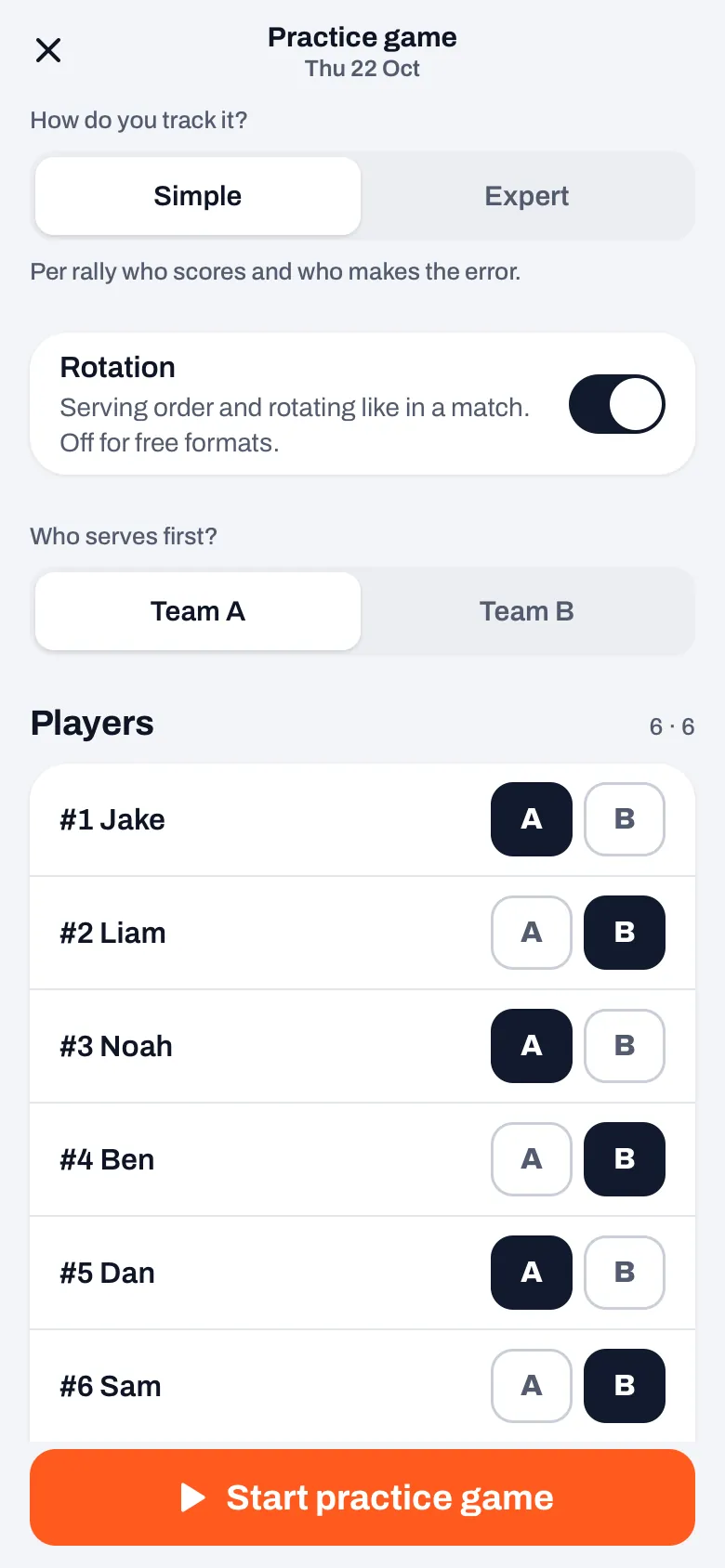
Afterward you see for each player the points, the errors and, in Expert, the average rating per skill. The ratings are for coaches only and do not count as a match; with Share as PDF you share or save the overview. How to set up and split such a game is in the volleyball scrimmage. What Koach costs after the 14 free days is on the pricing page.
14 days free, no credit card. Track a scrimmage with your team in Expert and see for each player how reception went.
Try Koach with your teamFrequently asked questions
How do you make a volleyball skills test for PE?
Pick two or three skills you have practiced in class, such as the forearm pass, the overhead pass and the serve. For each skill, set a short task in which you count something, for example bumping back ten tossed balls or ten serves over the net. Let students practice the test one lesson earlier, make sure everyone has the same ball and tosser, and add a description per level to the count.
What is a volleyball rubric?
A rubric is an overview that describes per level what you see. For volleyball in PE you could use four levels, for example, from beginning to advanced, with one column for technique and one for the game. That way students see what the next step is. How you turn the levels into a grade or assessment is up to your school.
How do you assess a student who already plays club volleyball?
A club player usually passes the technical test easily and has little room to grow there. So give them their own goal in the game: helping teammates play better, distributing the ball, staying sporting and helping explain. That way you assess what they show in these lessons, not just what they could already do before the unit started.
Should you assess volleyball in PE on technique or in the game?
Preferably both. A separate test is the same for everyone and easy to count, but says little about how a student plays. In the game you see teamwork, calling and choosing a position. Follow a few students per lesson in three against three with fixed questions, and mix up the groups so no one depends on a single group.

See in a scrimmage who can do what
14 days free, no credit card. Track a practice game and see the ratings for each player.
Get started with KoachOr read first what the volleyball coaching app does.