
Benefits of volleyball: what the sport gives your child and you
The short answer
The benefits of volleyball: it is moderate to vigorous exercise with lots of jumping, which is good for fitness and bones; it teaches teamwork because you can't play the ball twice in a row; and there are no physical duels with the opponent. You can play it at any age.
The benefits of volleyball seem obvious: you move and you are part of a team. But what exactly does it give a nine-year-old, or a parent who wants to start playing, and what about injuries? This is what is known, with the sources, and where volleyball falls short.
What volleyball does for your body
How demanding volleyball is depends on how you play. The Compendium of Physical Activities, the list in which researchers record the energy cost of activities, gives recreational volleyball 3 METs, competitive indoor volleyball 6 METs and beach volleyball 8 METs (Compendium of Physical Activities, sports). One MET is what you use at rest. The WHO calls 3 to 6 METs moderate intensity and 6 METs or more vigorous (WHO guidelines 2020, Bull and colleagues). So recreational play is moderate exercise, while an indoor match or a game on the sand is vigorous. What that costs in energy is covered in how many calories volleyball burns.
For children and young people aged 5 to 17, the same WHO guideline recommends an average of at least 60 minutes of moderate to vigorous activity a day, and on at least three days a week vigorous activity and activities that strengthen muscles and bones. Volleyball, with its jumps and landings, belongs to that last group: the US National Heart, Lung, and Blood Institute names volleyball as an example of bone-strengthening activity for children aged 6 to 17 (NHLBI on physical activity).
One caveat: a practice is not an hour of nonstop movement. You wait your turn, listen to explanations and drink. Two practices and a match a week provide a good share of what a child needs, but not all of it. Cycling to school and playing outside are still needed.
Volleyball also trains something you can't express in METs: reacting to a ball that changes direction quickly, judging where it will land, and jumping and landing with control. Because the ball isn't allowed to bounce, you have to think ahead at every contact.
What volleyball teaches a child besides exercise
Volleyball is a team sport in which you win nothing on your own. A player may not play the ball twice in a row (a block not counted), so every attack starts with a pass from one player and a set from another. A child who wants the ball has to call for it; a player who doesn't call sees the ball drop between two players. Teamwork and talking are not a side issue, but the way the game works.
Every rally ends with a point, and often with an error. A child makes a lot of them in every practice, and the next rally simply starts again. A child who learns to want the next ball after an error gets something out of that outside the gym too.
Research supports that picture, with a caveat. A systematic review by Eime and colleagues (2013) found that children and adolescents who play sport more often have better self-esteem, more social interaction and fewer depressive symptoms, and more strongly in team sports than in individual activities. Most studies show an association, not a cause: children who already feel good may also be more likely to take up sport.
How safe is volleyball?
Volleyball has one big difference from soccer, hockey or basketball: the net separates the teams. There are no duels, tackles or slide tackles for the ball. Contact with an opponent mainly happens under the net, when a player lands on someone else's foot after a block or an attack.
That doesn't mean nothing happens. A systematic review of volleyball research (Kilic and colleagues, 2017) found that the ankle, knee and shoulder are where volleyball players get injured most often, and that preventive measures for ankle and knee problems work. In growing children there is also overload around the knee when the number of jumps goes up too quickly. A good coach builds up the jumps and teaches children to land; what that looks like is covered in injury prevention in volleyball.
If a complaint persists or the pain is severe, see a doctor, a sports physician or a physical therapist. Playing on because the team needs you often turns a small problem into a long one.
For adults too, even if you start later
For adults the same WHO guideline recommends 150 to 300 minutes of moderate activity a week, or 75 to 150 minutes of vigorous activity, and for people over 65 also balance and strength exercises on at least three days a week (Bull and colleagues, 2020). An evening of recreational volleyball and a practice at a club provide a good share of that, with a social life thrown in that you don't get at the gym.
You can play volleyball at any level: recreationally, in a league, on the sand or in a mixed team. If you start as an adult, starting volleyball as an adult explains how to go about it. What changes in load and game formats after fifty is covered in volleyball for seniors.
Where volleyball falls short
- Waiting. In a poorly organized practice, children spend more time standing in line than playing, and then little is left of all the benefits. What a good practice looks like at each age is covered in coaching youth volleyball by age.
- A difficult start. Because the ball isn't allowed to bounce, it takes a long time before young children play a real rally. Clubs solve that with throwing and catching, small courts and light balls. From what age that works is covered in what age a child can start playing volleyball.
- Short and explosive. Volleyball consists of short rallies with breaks in between. For endurance over longer periods, running, cycling or swimming are a good addition.
- An indoor sport with fixed times. You depend on gym hours and a team. If you want to play more flexibly, combine the club with recreational play or beach volleyball in summer.
Ask about fun, not about the result. After practice, don't ask your child whether they won, but what the most fun game was. Children who enjoy a sport stay, and staying is the condition for everything in this article.
Keeping track as a parent
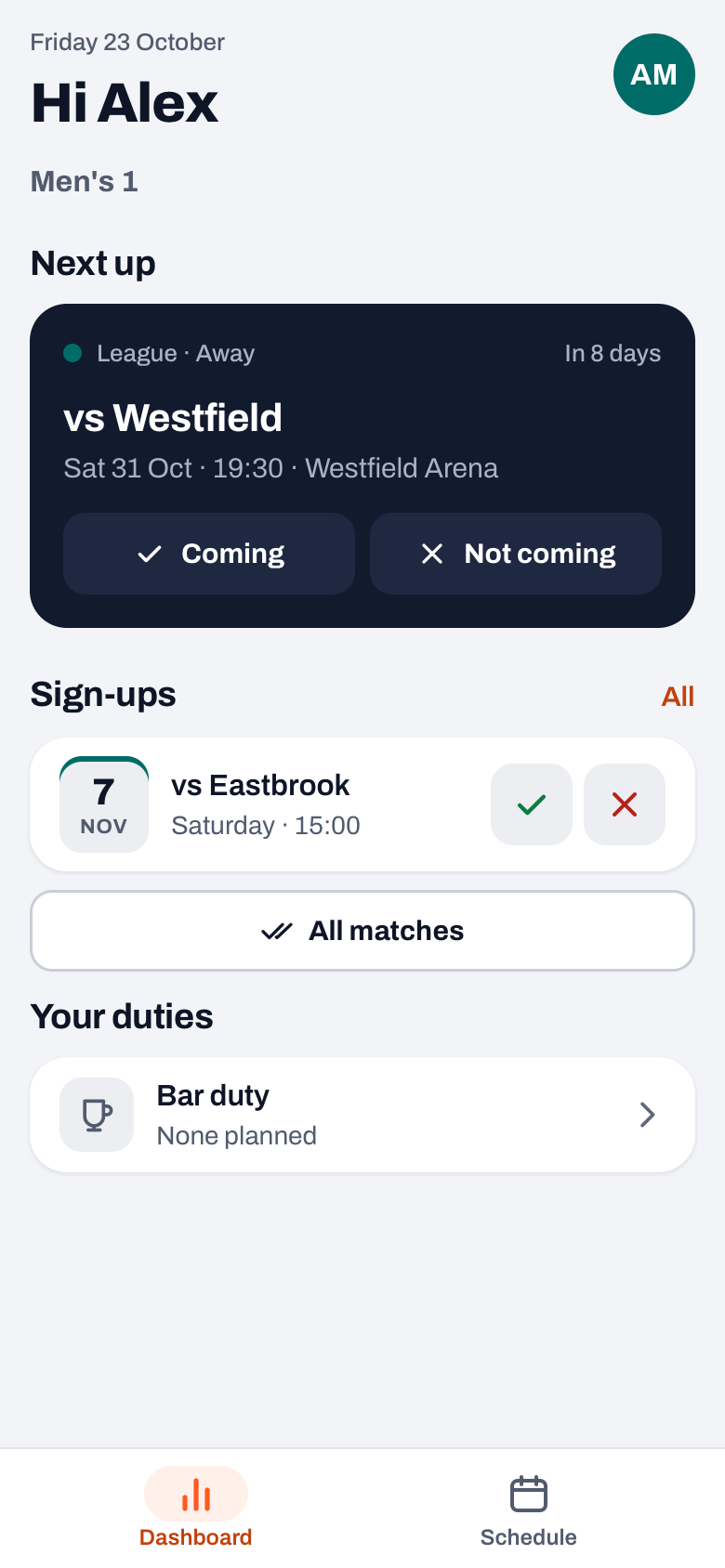
With a team that uses Koach, you get your own account as a parent. You pay nothing for it: it falls under the team's subscription. Your dashboard shows the next event, and there you mark your child as Coming or Not coming. Under Sign-ups are the matches still waiting for an answer, and under Your duties you see a duty you do for the club, such as bar duty. The schedule shows everything for the coming weeks.
If you coach yourself, or are about to: in Koach you plan practices, keep track of attendance and follow how players develop. You can try it free for 14 days; what it costs after that is on the pricing page.
14 days free, no credit card. Do you coach a team yourself? Add it tonight and invite players and parents with a link.
Try Koach with your teamFrequently asked questions
Is volleyball good for kids?
Yes, as long as practice suits their age. Volleyball is moderate to vigorous exercise with lots of jumping and landing, which the WHO guidelines for children recommend, and it is a team sport without physical duels with the opponent. A review (Eime and colleagues, 2013) found better self-esteem and more social interaction more often in children who play sport. Do look for practices with small groups and lots of ball contact.
Is volleyball a sport with a lot of injuries?
The net separates the teams, so there are no duels and collisions like in soccer or hockey. According to a review (Kilic and colleagues, 2017), injuries mainly affect the ankle, knee and shoulder, often from a landing under the net or from adding jumps too quickly. Prevention with landing technique and a good build-up helps. If a complaint persists, see a doctor, a sports physician or a physical therapist.
Does my child get enough exercise from volleyball?
Part of it, not all. The WHO recommends an average of 60 minutes of moderate to vigorous activity a day for children. A 90-minute practice also includes waiting, explanations and water breaks, so two practices and a match a week don't fully cover that standard. Cycling, walking and playing outside are still needed.
Can you still start volleyball as an adult?
Yes. Many clubs have recreational teams you can join without experience, and you can learn the skills at any age. Build up the load gradually, because jumping and landing ask something of knees and ankles that aren't used to it. If you have heart, back or joint problems, talk to your doctor first.


Do you coach a team yourself?
14 days free, no credit card. Parents sign up their children themselves, you keep the overview.
Get started with KoachOr read first what the volleyball coaching app does.