
Sports club rules template: what to include, with examples
The short answer
A sports club rules template turns the constitution into practical rules: types of members, fees, cancelling membership, volunteer duties, kit and use of the gym. The rules may not conflict with the constitution or the law. Who adopts them is set in the constitution: often the general meeting, sometimes the board.
With a sports club rules template you settle what the constitution leaves open: who can become a member, when you cancel, how fees work and who staffs the bar. Here you read what belongs in the rules, get a twelve-section outline to copy, and see how to keep it up to date.
What are club rules, and what are they not?
The constitution (in some clubs called the bylaws or articles) is the foundation of a club: its purpose, its bodies, who may decide what and how the club ends. It is deliberately general, and changing it is cumbersome in many countries. The club rules are the practical elaboration of it. They cover the things members actually run into, and they are easier to change. In English-speaking clubs this document goes by several names, such as club rules, standing orders or internal regulations; what matters is that it sits below the constitution.
The order of precedence is the same in nearly every country: first the law, then the constitution, then the club rules, and below that individual decisions of the board or the general meeting. If the rules contradict the constitution, the constitution applies. Besides the constitution and the rules, a club often has other documents. This is how they relate:
| Document | What it covers | Who usually adopts it |
|---|---|---|
| Constitution | Purpose, bodies, powers, general meeting, dissolution | The founders; a change by the general meeting, often with formal requirements from the law |
| Club rules | Membership, fees, cancelling, duties, kit, gym | The general meeting, sometimes the board |
| Code of conduct | How everyone treats each other, and where to report something | The board or the general meeting |
| Individual decisions | Amounts, rosters, carrying out the rules | Board or general meeting, per decision |
The code of conduct is about behavior; there is a separate example in a code of conduct for sports clubs. The club rules are about day-to-day practice. Association law differs by country: what follows is a structure that works almost everywhere. What is mandatory for you and who adopts what follows from your constitution and the law of your own country.
What goes in club rules? An outline in twelve sections
You can copy this outline as a template. For the sections that cause the most discussion, there is a sample clause; fill in the parts in brackets yourself.
- General. What the rules are for and what takes precedence. "These rules elaborate the constitution of [club name]. In case of conflict with the constitution or the law, those prevail."
- Types of members. Playing members, recreational players, youth members and non-playing members, and what each may do and pays. Honorary members and supporters, if your club has them.
- Joining and trial sessions. How someone becomes a member and from when. "A new member may join practice for free [three] times. Membership starts on the day the completed registration form is received."
- Fees and other contributions. Who sets the amount, how and when you pay, discounts and joining mid-season, and what happens with late payment. "The general meeting sets the membership fee each year. Members pay [in one payment before date / in installments]. Anyone who has not paid after two reminders can be temporarily excluded from practices and matches by the board." How to handle collecting the fees is in collecting membership fees at a club.
- Cancelling membership. How, with whom and by when, and what you still pay afterwards. "Membership can only be cancelled by email to [address], no later than [date] for the following season. Anyone who cancels later pays the fee until the end of the season, because gym rental and team registration are already fixed by then." Also write down what does not count: a message to the coach or in the team's group chat. Why such a group works poorly for agreements is in why the WhatsApp group gets stuck for a volleyball team.
- Volunteer duties. Who has duties (from what age, per member or per family), how many shifts per season, who is exempt, whether you can buy out and what happens when someone doesn't show up. The choices behind this are in volunteers at a sports club.
- Teams, practices and matches. Who selects the teams, how and when you cancel, and who pays a federation fine caused by a member, for example by not showing up to referee.
- Kit and equipment. Whether a match uniform is mandatory, who pays for it, who owns it and whether it has to be returned on cancelling. And under what conditions members may borrow club equipment.
- Facilities. Indoor shoes, food and drink, locker rooms, who locks up and who pays for damage. Refer to the house rules of the gym's owner instead of copying them.
- Communication and privacy. Which channels the club uses for official communication, which member data you record, who can see it and how you handle photos. Which data you may keep and for how long is in which member data a sports club keeps.
- Board, committees and money. Who has which task, who may spend on behalf of the club and up to what amount, how expense claims work and who checks the books.
- Sanctions and final provisions. A reference to the code of conduct and to the sanctions in the constitution, how the rules are changed and from what date this version applies.
How to adopt the rules
- Write the draft with a small group. A board member, the membership secretary and someone who selects the teams. They know what the discussions of recent seasons were about.
- Compare it with the constitution. If the constitution already covers something, just refer to it. If something in the draft is settled differently in the constitution, delete it.
- Let members read along beforehand. Put the draft on the website a few weeks before the meeting, with an address for comments.
- Have it adopted by whoever the constitution names. Usually that is the general meeting; how to prepare it, with notice, agenda and voting, is in the annual general meeting of a club.
- Put the version and date at the top and publish it in one fixed place. New members receive it when they join.
Four mistakes that make club rules useless
- Amounts and dates in the text. If you put the fee or the cancellation date in the rules, you have to change them every year. Put in the rules who sets the amount, and the amount itself in a decision and on the website.
- Rules nobody enforces. A fine that is never imposed makes the rest of the rules less serious too. Delete what you don't carry out.
- Duplicate texts. If the same rule is in the constitution, the club rules and the code of conduct, those versions drift apart after a few years. Put it in one place and refer to it from the others.
- Nobody knows where they are. Rules that only sit in the secretary's folder don't help anyone in a dispute about a cancellation.
Keep amounts out of the text. Write in the rules: the general meeting sets the membership fee each year. Then the rules don't have to go back to the meeting when only the amount changes, and there is never an old version with a different amount going around.
The rules in practice with Koach Club
We make Koach, an app for volleyball coaches and their club, so read this part as an explanation of our own product. Koach doesn't write your rules and doesn't store them as a document. But two sections from the outline above become practical with it.
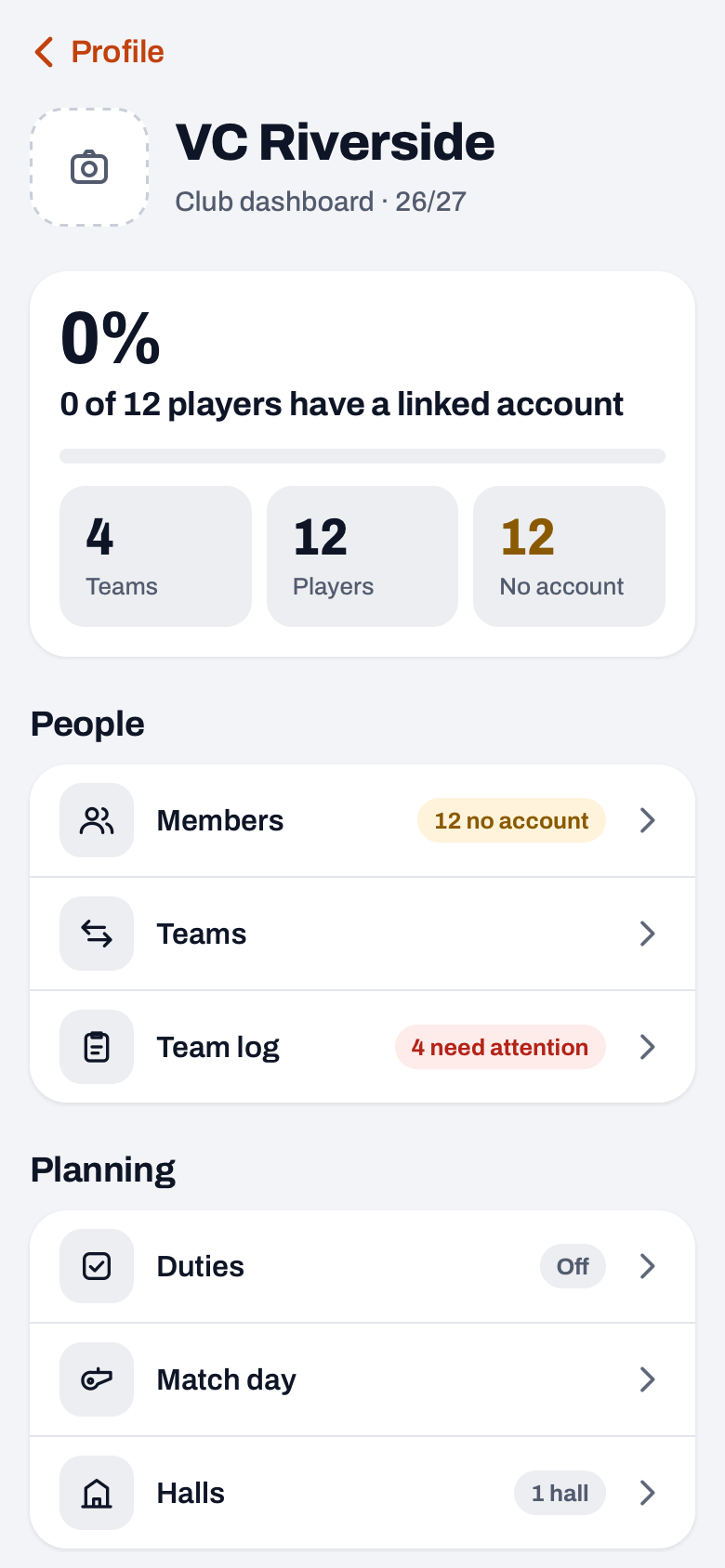
- Volunteer duties (section 6). Under Duties in the club dashboard you set a target per member per season, with Exempt under age and Trainers exempt. Koach keeps count of who has done their shifts, and with Members see own standing each member can see where they stand.
- Contributions (section 4). Under Fees you create an item with an amount and due date using New fee, choose a whole team or individual members at Who has to pay?, and add a payment link. For each member you see whether it is open or paid. Koach doesn't process payments itself.
You announce new or changed rules with a club announcement: under Profile, at Club, tap Club announcements and then New announcement. It reaches every coach, player and parent in the club's teams. You can't attach a file, so say in the message where the rules can be found.
We set up Koach Club together with you. Club has no trial period: let us know through the form how many teams you have, and we will show you how duties and fees work. If you coach a team yourself, you can start with that team free for 14 days.
Book an introduction Start with your own teamWhat Club costs is on the pricing page, and what else the club side does is on the page for clubs.
Frequently asked questions
Does a club have to have club rules?
That differs by country and is sometimes stated in the constitution itself. In many countries they are not mandatory, but without rules the board has to fall back on loose agreements in every discussion about cancelling, fees or duties. So first check your constitution and the law of your own country, and if in doubt ask your sports federation.
What is the difference between a constitution and club rules?
The constitution lays the foundation: the purpose of the club, its bodies, who may decide what and how the club ends. The club rules work that out in practical rules on membership, fees, cancelling, duties and the gym. The rules may not contradict the constitution, and they are usually easier to change.
Who can change the club rules?
That is in the constitution. Often it is the general meeting, sometimes the board. Put a change on the agenda, let members read the new draft beforehand and, once adopted, note the date and version number at the top, so it is clear which text applies.
Can the membership fee be in the club rules?
It can, but it is impractical. An amount in the rules means you have to change the rules every year when the fee changes. Instead, put in the rules who sets the fee and how members pay, and keep the amount itself in a decision of the general meeting and on the website.



Make duties and fees visible
Club has no trial: book an introduction on the page for clubs. If you coach a team yourself, start below.
Get started with KoachOr read first what the volleyball coaching app does.