
Volleyball circuit training: two station plans you can copy
The short answer
Volleyball circuit training means training in stations: small groups each do one exercise and move on to the next one at a signal. For volleyball you combine jumping, strength, core and footwork with ball stations, for example eight stations of 40 seconds of work and 20 seconds to switch.
Volleyball circuit training gets a whole group working at once, with little equipment and without lines. Here you read how to set up a circuit, you find two plans you can use as they are, a physical circuit and a skills circuit, and you read what to watch out for with youth players.
What is circuit training, and what does it give a volleyball player?
In circuit training the exercises are set up in fixed spots in the gym: the stations. The group is split into small groups, each group starts at a different station, and at a signal everyone moves on to the next one. After a full round every player has done every exercise.
For a volleyball coach that has four advantages. Everyone works at the same time, so nobody stands in a line. You need little equipment per station. You can mix physical stations and ball stations. And it scales: if four more players show up, you make the groups bigger or add a station. The drawback is that you cannot correct at every station. So choose exercises players already know and that explain themselves; an attack with an approach or a new skill does not belong in a circuit.
A circuit is something different from the conditioning block in conditioning for volleyball players, where the whole group works on one format at the same time. Where a circuit fits in your practice is covered further down and in running a volleyball practice.
How to set up a circuit: stations, times and groups
- As many stations as groups. Two to three players per station works best: enough to help each other, too few to wait. Twelve players gives six stations of two or four of three. If you have more stations than groups, one station stays empty; that is a rest stop straight away.
- Work and switch. A workable ratio is 40 seconds of work and 20 seconds to move on. With eight stations a round then takes eight minutes. For beginners and youth players, 30 seconds of work and 30 seconds to switch works better.
- Alternate heavy and light. Never put two jumping stations in a row, and alternate legs, core and arms. That way one muscle group recovers while another works.
- A card per station. Name, a simple drawing and one coaching point. Then nobody needs to ask what the idea is after the first round.
- A trial round. The first round at half pace, with 20 seconds per station and 10 to move on. That way everyone has seen every exercise before the pace goes up.
- One signal and one direction. A whistle or music that stops, and everyone moves on in the same direction.
Circuit 1: a physical circuit for volleyball players from about age 14
Eight stations, 40 seconds of work and 20 seconds to switch. After the four-minute trial round, do two rounds of eight minutes with a two-minute break in between. That keeps you busy for 22 minutes, not counting the warm-up. You need a net, two cones, a line on the floor, a wall and a volleyball.
| Station | Exercise | What to watch |
|---|---|---|
| 1. Legs | Bodyweight squat | Knees in line with the toes, back straight, lower slowly |
| 2. Core | Forearm plank | Body in one line, hips not up |
| 3. Jump | Block jumps at the net | Hands at shoulder height, extend in the jump, land softly on two feet |
| 4. Shoulder | Hit a volleyball against the wall with the attack arm swing and catch it again | Elbow high, hit at half speed |
| 5. Footwork | Side shuffle between two cones three meters apart | Stay low, feet do not touch |
| 6. Core | Side plank, switch sides halfway | Hips up, shoulder above the elbow |
| 7. Jump | Quick little hops back and forth over a line | On the balls of the feet, small and quick |
| 8. Upper body | Push-ups, on the knees or on the toes | Trunk straight, chest toward the floor |
Make it harder with tempo and execution first, not with weight: 45 seconds of work and 15 to switch, or a third round. If you want to work with dumbbells or a medicine ball, only do so once the execution is right without weight.
Circuit 2: a skills circuit for youth and PE class
Six stations with a ball, 60 seconds of work and 30 seconds to switch: one round takes nine minutes. Every station has a count, so players have a record to beat. It works from about age ten up to adult beginners.
- Wall pass. Forearm pass against the wall, above a line two meters up. How many in a row without the ball touching the floor?
- Self-setting. Set the ball above your head, the same height every time. How many in a row?
- Serve to a target. Underhand serve from a short distance to a mat or a zone on the other side. How many hits out of ten?
- Catching in setting position. In pairs, throw over the net and catch the ball above the forehead, with the hands in the shape of a set. How many without a miss?
- Cone race. From the ready position sideways to a cone, touch it, back and the other way. How many cones within the time?
- Reaction ball. A partner drops a ball from shoulder height; the player moves off from the ready position and catches it after one bounce. How far away does it still work?
With a class of thirty, make six groups of five and put two balls at each station, or build the same circuit twice and halve the groups. More about a volleyball PE lesson with a whole class is in volleyball in PE class, and more drills for movement and reaction in volleyball coordination drills.
Start the season with a baseline. In the first round, have players write their count on the station card for each station. After six weeks, do exactly the same circuit again. Progress that players can count themselves makes a circuit a lot less boring.
How hard, how often, and where in practice?
- Place in practice. A skills circuit can come right after the warm-up. A physical circuit with jumps goes at the end of practice or as a block of its own, not just before a technique block in which players learn something new: you do not learn timing on tired legs.
- Over the season. In preseason a physical circuit can be done once or twice a week. In season you keep it shorter, and in a week with two matches you leave it out.
- Count the jumps. A circuit with two jumping stations comes on top of all the jumps in the rest of practice. After a night full of attacking and blocking, choose stations without jumps.
- Youth. Children and young teens work with their own body weight, with short work blocks and with attention to the landing. From what age strength training with weights makes sense is covered in strength training for young players.
- Pain is a stop sign. A player who feels pain during an exercise stops at that station and does another station or rests. Ongoing or severe complaints are something for a doctor, sports physician or physical therapist.
Your circuit in the Koach practice plan
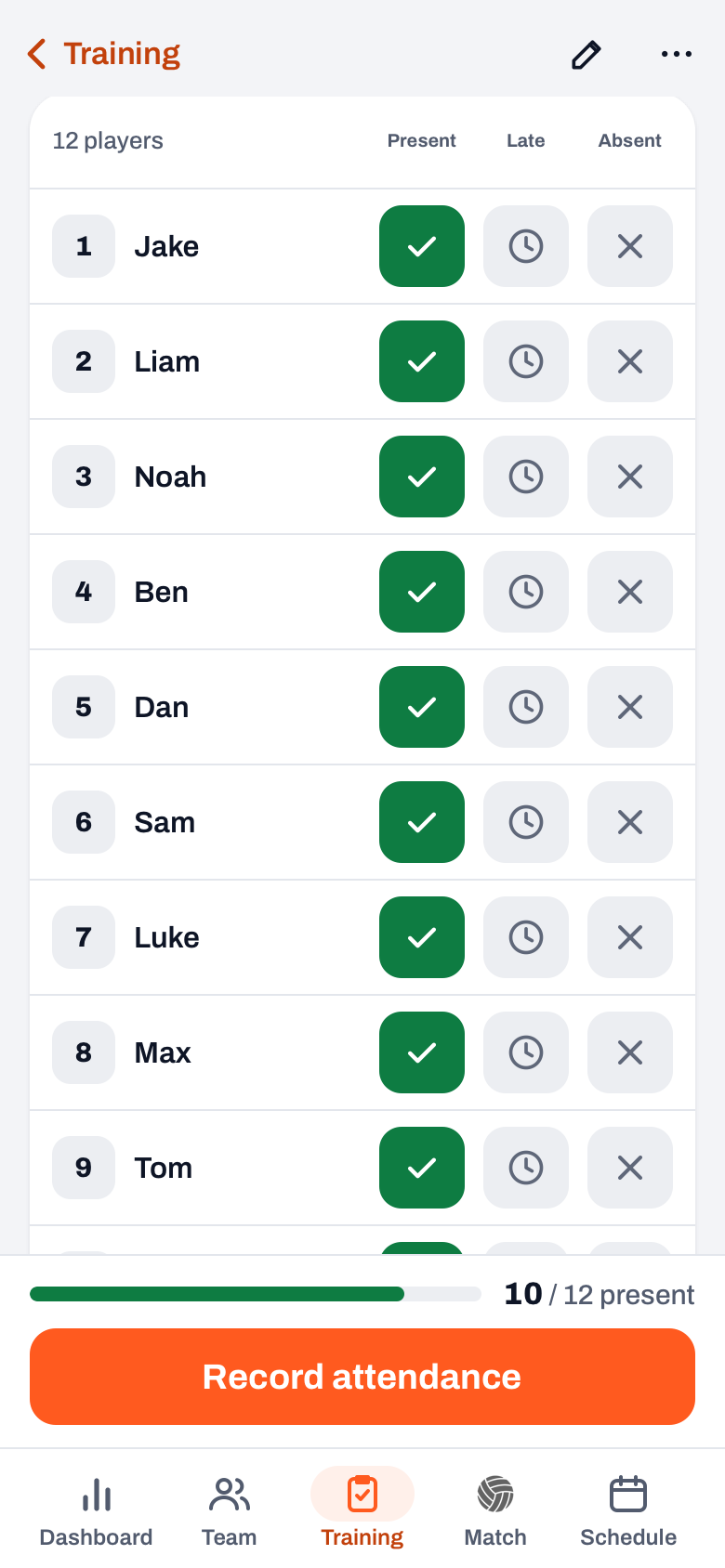
How many groups you make depends on who is there. In Koach you tick Present, Late or Absent for each player at the practice, and at the bottom you see how many players are there. That tells you how many stations you can fill.
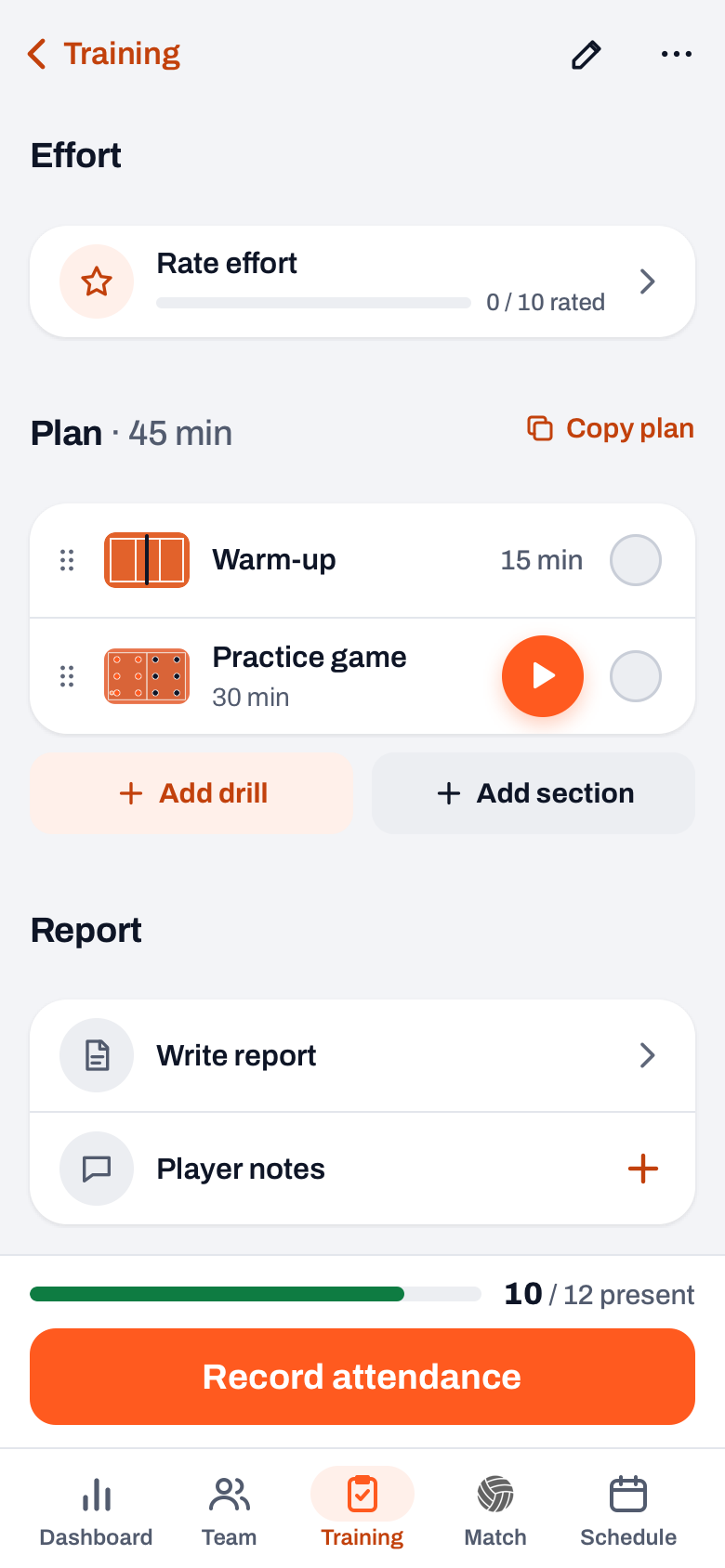
You put the circuit itself in the practice plan as one section. Tap + Add section, call it something like "Physical circuit", set the duration to 25 minutes and write the stations with their times under Add description. That way a substitute coach has the plan at hand too. If the circuit works, save the plan through the menu with Save as template and bring it back next time with Copy plan. Individual drills for a station are in the app's drill library and on the drill pages.
14 days free, no credit card. Put your circuit in the plan of your next practice as a section and copy it back next week.
Plan your circuit in KoachWhat Koach costs after the trial is on the pricing page.
Frequently asked questions
How long does a volleyball circuit training session take?
Count on twenty to thirty minutes within a 90-minute practice. Eight stations of 40 seconds of work and 20 seconds to switch make a round of eight minutes; two rounds with a short break and a trial round add up to just over twenty minutes. In preseason you can also run a whole practice as a circuit, with ball stations in between.
How many stations does a circuit have?
As many as you have groups, with two to three players per station. For a team of twelve, six to eight stations is practical. More stations with fewer players means less waiting, but also more equipment and more explaining. Keep the exercises simple, so every station runs without you after one trial round.
Is circuit training suitable for children?
Yes, as long as you keep it playful: exercises with a ball and a count, short work blocks and no extra weight. Children enjoy beating a record, and a circuit keeps a large group busy at once. Pay particular attention to a soft landing on jumps and alternate demanding stations with easier ones.
Can you train skills in a circuit?
Yes, as long as they are skills players already have. Passing against the wall, self-setting, serving to a target and catching in setting position work well, because players can repeat them without correction. A new skill or an attack with an approach is better taught in a format where you are standing next to them.


Put your circuit in your plan tonight
14 days free, no credit card. Next week you copy it with one tap.
Get started with KoachOr read first what the volleyball coaching app does.