
Volunteer hours tracker for your club: template or app?
The short answer
A volunteer hours tracker can be a simple spreadsheet: one row per task and a running total per member against the target. That works until someone disputes their total. In Koach Club, club duties count the shifts straight from the schedule, with a fixed value per duty type, and the club can let each member see only their own standing.
Most clubs start their volunteer hours tracker as a spreadsheet, and that is not a bad place to start: Google Sheets is free and everyone knows how it works. Below you will see how to build that template so it lasts a whole season, where it breaks down, and when club duties in Koach Club take over the counting.
What should a volunteer hours tracker do?
A club that makes volunteering mandatory wants to answer one question at the end of the season: who did what was asked of them, and who did not? To answer it fairly, your tracker needs six things, whether it is a spreadsheet or an app:
- Every task as its own row. Who, which date, what kind of task and how many hours or points. A bare number next to someone's name is impossible to explain later.
- A fixed value per type of task. If a bar shift counts as three hours, it counts as three hours for everyone. That ends the debate about who left ten minutes early.
- A target per season, with exemptions. How many hours each member owes, and who is exempt, such as juniors under a certain age or the coaches.
- A difference between assigned and done. Being on the schedule is no proof that someone actually showed up that night.
- Nothing that quietly disappears. A task that has been counted stays counted, even if someone edits the schedule or the list later.
- A personal total for every member. Everyone wants to check their own hours without seeing everyone else's.
A volunteer hours tracker template in Google Sheets or Excel
Three tabs will get you through a whole season. Build them in this order:
- Types. Two columns: the type of task (bar duty, referee, scorer, cleaning) and how many hours it counts for. That way everyone gets the same hours for the same task, and you change a value in one place only.
- Log. One row per task, with the columns Date, Name, Type, Hours, Confirmed by and Notes (columns A to F). Pull the hours from the Types tab with VLOOKUP, so nobody has to type a number: in row 2 that is =VLOOKUP(C2,Types!A:B,2,FALSE). Only fill in Confirmed by once someone on the board knows the task was actually done; an empty cell then means assigned, but not confirmed yet.
- Standing. One row per member with Name, Target, Done and To go (columns A to D). Done adds up the log with SUMIF: with the name in column A, that becomes =SUMIF(Log!B:B,A2,Log!D:D). To count confirmed tasks only, use SUMIFS with a second condition: =SUMIFS(Log!D:D,Log!B:B,A2,Log!E:E,"<>"). To go is the target minus what has been done, but never below zero: =MAX(0,B2-C2). For an exempt member, set the target to zero and note the reason in an extra column.
If your spreadsheet uses a locale with a decimal comma, as in Germany or the Netherlands, separate the arguments with semicolons instead of commas. A non-English version of Excel also uses translated function names.
Share the file only with the people who keep it up to date, and set the log so that only they can edit it. Letting members check their hours without seeing everyone else's does not work in a single shared file without extra effort, such as a separate overview per member.
Where the template breaks down
As long as one person keeps the list and nobody questions it, this works fine. The trouble starts at three moments:
- The schedule and the tracker are two separate files. After every shift, someone has to copy the people who were on the schedule into the log by hand. Every shift that gets missed is missing from the totals, and the member only finds out when they are told they are behind.
- Overwriting a cell leaves no reason behind. An online spreadsheet usually keeps a version history, but you have to dig through it change by change, and there is no explanation attached. Six months from now, nobody will remember why that 3 became a 0.
- Members start asking. Halfway through the season, everyone wants to know how many hours they still owe. The person keeping the tracker turns into a help desk, fielding messages, screenshots and arguments at the bar.
We set up Koach Club together with you. Tell us how you count shifts today, and we will show you how club duties take over. Coaching one team yourself? Then you can start in the app right away.
Request an intro Start with your own teamHow club duties in Koach replace your template
In Koach Club the count lives in the Club dashboard, under Club duties. Club managers and board members can open it; a regular member only sees their own standing. If the feature is still off, turn it on with Set up club duties. Each of the three tabs in your template has a counterpart there.
- The Types tab becomes Duty types, at the bottom of the Settings sheet. Under Add duty type you name the duty, choose under Used for whether it is bar duty, referee, scorer or hall duty, and enter under Counts as how much it is worth. On the same sheet, type the word that follows the numbers under Unit, for example hours or points. So a bar shift that counted as three hours in your template becomes 3, with hours as the unit. If you change a value later, everything already counted keeps its old value.
- The Standing tab becomes the Standing sheet. You set the target and the exemptions under Settings: in Target per season, enter how much each member has to do. Below it are Exempt under the age of and the Coaches are exempt switch. For the age limit, Koach looks at the date of birth: anyone without one is not covered by that exemption.
- The log fills itself. The shifts come from the schedule that is already in Koach: bar duty plus the match day roles referee, scorer and hall duty. Anyone who was assigned and did not cancel is added to the count the day after the shift. Nobody retypes the schedule anymore.
- The Confirmed by column becomes the Confirm sheet. It lists the shifts nobody has confirmed yet, with a check mark on each row for done and a cross for a no-show. On the Standing sheet you see next to every name how many shifts are not confirmed yet.
A worked example: with a target of 12 hours, bar duty counting as 3 and refereeing as 2, a member with two bar shifts and one refereeing shift stands at 8 of 12. The Standing sheet puts whoever is furthest behind at the top, and an exempt member shows Exempt instead of a number. What has been booked cannot be thrown away: even if a shift later disappears from the schedule, the record of who worked it stays. For a step by step setup, see tracking club duties at your sports club.
What your members see
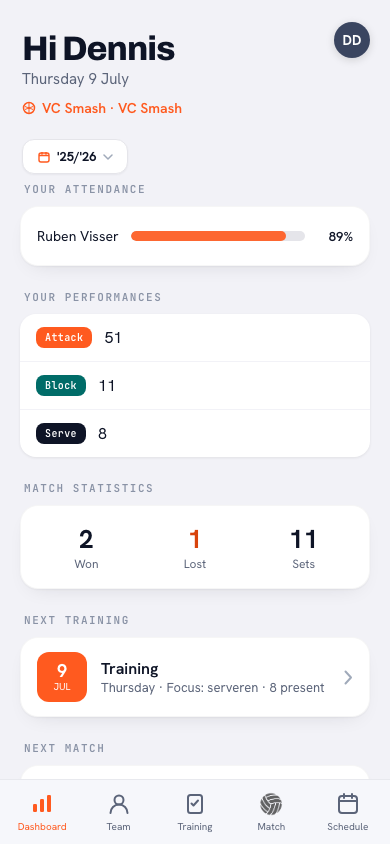
When Members can see their own standing is on, every member with a target gets the My duties card on their own dashboard, with a line such as "8 of 12 hours done" and the label On track or Behind. A parent also sees what has been counted for their children at this club. Only club managers and board members can see another member's standing. That closes the help desk: anyone who wants to know where they stand checks for themselves. What members see exactly, and what they can do when a number looks wrong, is covered in your own club duty standing in the app.
Spreadsheet or club duties: side by side
We make Koach, so read this as the maker's overview. For many clubs a spreadsheet is simply the right choice, especially when most of the volunteer work is not bar duty or match day shifts.
| What you want | Spreadsheet | Koach club duties |
|---|---|---|
| Cost | Free in Google Sheets | In Club, €9.99 per month |
| Hours or points per type of task | Yes | Yes |
| Committee work and work days too | Yes | No |
| Pull shifts from the schedule | No, by hand | Yes |
| Target with exemptions for age and coaches | Yes, by hand | Yes |
| Assigned kept separate from confirmed | With its own column | Yes, Confirm sheet |
| Nothing gets erased | No, any cell can be overwritten | Yes |
| Members see only their own standing | Only with extra work | Yes |
| Actual time worked per person | Yes, if you enter it | No |
| Count a long and a short bar shift differently | Yes | No |
When club duties fit, and when they do not
They fit if your club has required shifts around matches, such as the bar, refereeing, scoring and hall duty, and already schedules them in Koach or wants to. Scheduling itself is a separate topic. How to set up a schedule in a spreadsheet is covered in a volunteer schedule for your club; how Koach does it, in scheduling bar duty for the whole club and assigning a referee and scorer for every home match.
They do not fit, or not on their own, in these cases:
- You want to count all volunteer work. Club duties do not count committee work, a work day or setting up a tournament; they only count shifts that are scheduled in Koach. Keep tracking that other work in your template.
- You want actual hours worked. Koach does not measure time worked; it counts the fixed value of the duty type for each shift. Each role (bar duty, referee, scorer, hall duty) also has a single value, so a long and a short bar shift count the same.
- You want to collect a buy-out fee. Koach does not process money. Under Contributions the club keeps track of who owes what, with the club's own payment link. Whether buying out is allowed at your club is a policy decision: see volunteering or buying out.
- You coach one team on Coach. Club duties are part of the club module, which only comes with Club.
- You want to bring your existing list across. Koach has no import for members or spreadsheets. The count runs on the shifts that are in Koach.
What does a volunteer hours tracker app cost?
A spreadsheet in Google Sheets costs nothing, apart from the evenings of whoever maintains it. Club duties come with Koach Club: €9.99 per month, or €8.33 per month billed yearly, with unlimited teams and coaches. Players and parents use the app for free. Club has no trial: leave your details through the form on the clubs page, and we will get in touch and set up your club with you. If you coach one team yourself, you can try Koach with that team free for 14 days, no credit card needed; club duties do belong to the club module in Club. All prices are on the pricing page. Want to map out your club's whole season? Start with organizing the volleyball season.
Switch over when a new season starts. Hours from your spreadsheet do not carry over into Koach, so let the count begin when the season begins. Copy the exact value per duty type that your template used and keep the target the same. Then 8 of 12 in Koach means the same as it did in your old list.
Frequently asked questions
How do I track volunteer hours in Excel or Google Sheets?
Create three tabs: Types with the hours per type of task, a Log with one row per task (date, name, type, hours, confirmed by) and a Standing tab per member with the target and the total. Add up the total with SUMIF. Let the hours come from the Types tab so nobody types them by hand, and set the target to zero for an exempt member.
Can Koach track volunteer hours as hours?
Yes, because you choose the unit yourself. Under Settings you type hours in the Unit field, and for each duty type you enter under Counts as how many hours it is worth. Koach does not measure time worked: every completed shift counts the fixed value of its type, and each role (bar duty, referee, scorer, hall duty) has a single value. So a long and a short bar shift count the same. If you need that distinction, keep it in a spreadsheet.
What volunteer work does Koach count?
The shifts that are scheduled in Koach: bar duty and the match day roles referee, scorer and hall duty. Club duties do not count committee work, a work day or setting up a tournament. Keep that work in a simple list alongside Koach, and let the app count the shifts around your matches.
Can members see each other's volunteer hours in Koach?
No. With the Members can see their own standing switch, every member with a target gets the My duties card on their dashboard, showing only their own standing. A parent also sees what has been counted for their children at this club. Only club managers and board members see the full list with everyone on it, in the Club dashboard.
Is there a free trial of Koach club duties?
No. Club duties are part of Koach Club, and Club has no trial. Leave your details through the form on the clubs page, and we will get in touch and set up your club with you. Club costs €9.99 per month, or €8.33 per month billed yearly, with unlimited teams and coaches. Players and parents use the app for free. The 14 day trial, with no credit card, is only for Coach, with one team.



Let Koach count your club's shifts
Club has no trial: request an intro through the clubs page and we will set up your club with you. Coaching one team yourself? Start right away.
Get started with KoachOr read first what the volleyball coaching app does.