
Tactics
Serving strategy, reception formations and defensive systems for smarter volleyball.
Volleyball tactics: from serve pressure to defensive system
Volleyball tactics for coaches: serve pressure, serve-receive formations, attack tempos and defensive systems — what to pick when and how to train it.
Read article →
Running the 6-2 system: penetration, rotations and pitfalls
The 6-2 system in practice: how setter penetration works, the rotations and pitfalls, and which teams benefit from two setters who also attack.
Read article →
Serving strategy: where do you serve and why?
Serving strategy in volleyball: where to serve and why.
Read article →
Serve-receive formations: passing with 3, 4 or 5 players?
Serve-receive formations in volleyball: passing with 3, 4 or 5 players? Pros and cons per formation, who you pull out of the pass, and how to choose.
Read article →
Defensive systems: perimeter and rotation defense explained
Defensive systems in volleyball explained: perimeter defense and rotation defense, who covers which zone behind the block and what fits your team.
Read article →
Volleyball block and defense: playing in the shadow of the block
Volleyball block and defense: which part of the court your block shadows with a line or cross-court block, where your defenders stand and how to train it.
Read article →
Attack tempos: from high ball to first tempo
Attack tempos in volleyball: from the high ball to the first tempo.
Read article →
Volleyball offensive plays: the X, tandem and double quick
Volleyball offensive plays explained: the X, tandem, double quick and slide combination, with approach routes, timing and a four-step progression.
Read article →
Out of system: scoring when the pass isn't perfect
Playing out of system in volleyball: how to score when the pass isn't perfect.
Read article →
Free ball and down ball: the underrated moments
Free ball and down ball in volleyball: the difference, how your team shifts on the call 'free' or 'down', and why these moments decide free points.
Read article →
The 5-2 Volleyball Rotation: Two Front-Row Setters
Two setters who set whenever they are in the front row.
Read article →
The 6-6 Volleyball Rotation for Beginners Explained
The 6-6 volleyball rotation for beginners: the simplest system there is.
Read article →
What Does the Off Blocker Do in Volleyball? Three Jobs
The three jobs of the front-row player who is not blocking: get off the net, cover the tip and start the approach in time for transition.
Read article →
Why Do Middle Blockers Get Subbed Out in the Back Row?
Why do middle blockers get subbed out for the libero in the back row? How the swap works per rotation, what it costs in playing time and when to skip it.
Read article →
Who Takes the Ball Between Two Passers in Serve Receive?
Who takes the ball between two passers in volleyball? A fixed rule for the seam in serve receive, with claim calls, short versus deep and how to train it.
Read article →
How to Read the Setter in Volleyball: Five Tells
How to tell where the setter is going to set: five tells in the shoulders, hands and distance to the net, plus the tendencies you can scout before the match.
Read article →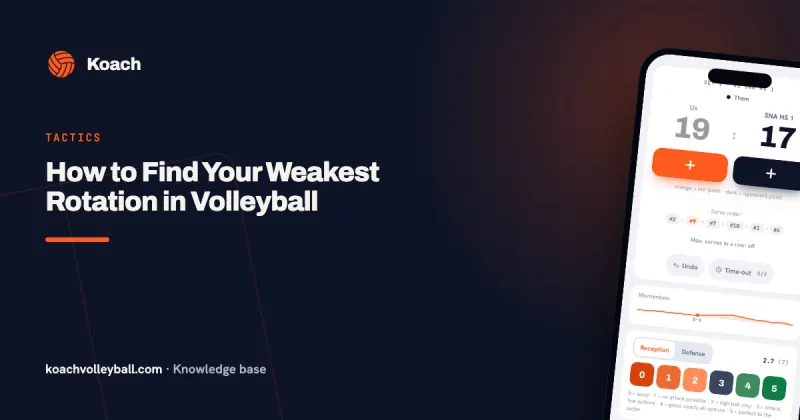
How to Find Your Weakest Rotation in Volleyball
How to find your weakest rotation in volleyball: what to measure per rotation, how to tally it in a single match and five repairs that genuinely work.
Read article →
Should You Serve or Receive First in Volleyball?
Should you serve or receive first in volleyball? What side-out means for the choice, why top teams almost always receive and when serving is the smarter call.
Read article →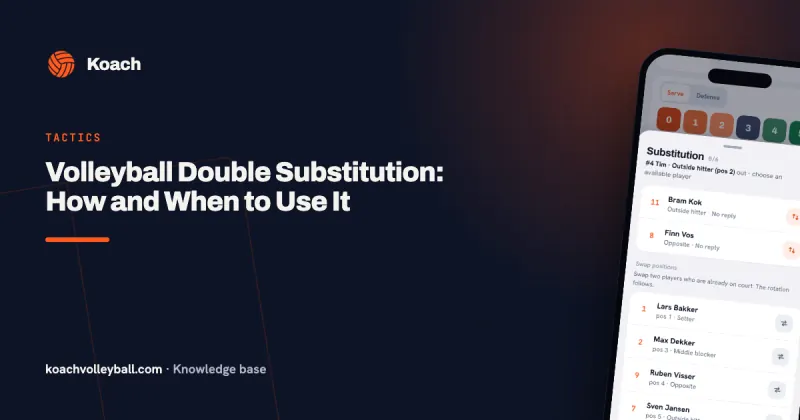
Volleyball Double Substitution: How and When to Use It
Setter and opposite swap at the same time, so you attack with three hitters for three rotations.
Read article →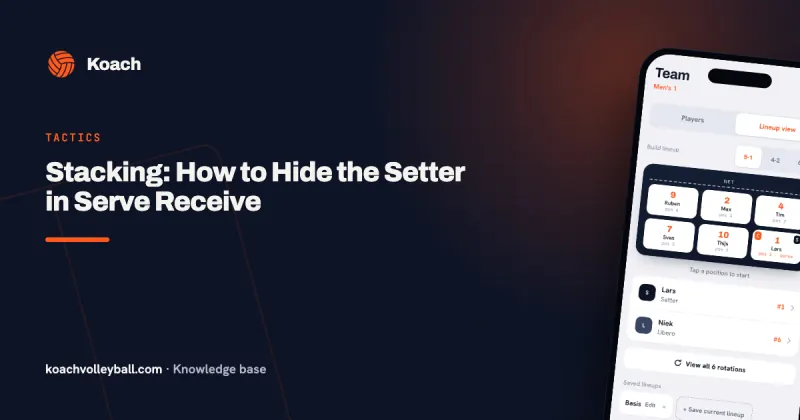
Stacking: How to Hide the Setter in Serve Receive
How to hide the setter in serve receive: stacking explained rotation by rotation, so your setter starts as close to the net as the overlap rules allow.
Read article →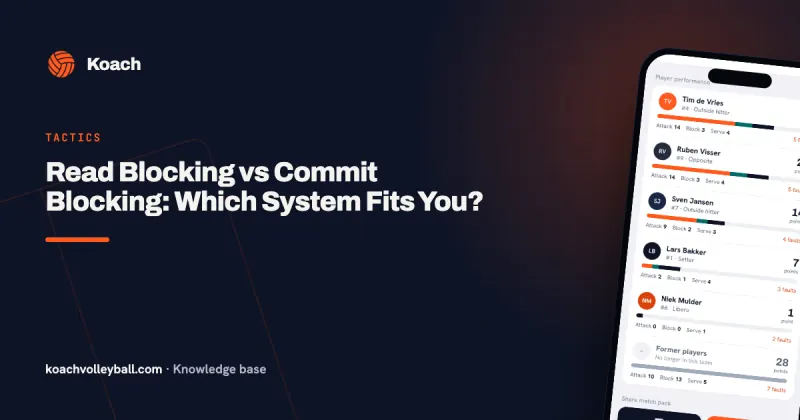
Read Blocking vs Commit Blocking: Which System Fits You?
Read blocking vs commit blocking: the difference between the two systems, what committing costs you at the pins and which system suits which team.
Read article →
Double block in volleyball: who sets the block and who closes?
Double block in volleyball: who sets the block, how the middle closes, what the hands take away and when to send three.
Read article →
What Does an Opposite Hitter Do in Volleyball?
What does an opposite hitter do in volleyball? The right-side player's jobs in attack, at the block and as second setter — and why she almost never passes.
Read article →
What Does a Middle Blocker Do in Volleyball? Six Moments
Her jobs per phase of the rally: out of serve receive, the approach, the block, transition, covering the hitter and the serve itself.
Read article →
What Does an Outside Hitter Do in Volleyball? Four Jobs
The four jobs, passing, attacking from the left, blocking and defending, and why this is the most complete role on a volleyball court.
Read article →
Outside hitter vs opposite: the difference in volleyball
Outside hitter vs opposite: who passes and who does not, the spot in the rotation, which sets they get, who they block and which player fits each position.
Read article →
How to Cover Your Hitter in Volleyball: Where to Stand
The two rings behind the attacker, who stands where for each attacking position, and the four mistakes that hand over free points.
Read article →
What Is a Pipe in Volleyball? The Back-Row Attack
What is a pipe in volleyball? The back-row attack through the middle explained: who runs it, how the set and timing work and when to call for it.
Read article →
Setter hand signals: volleyball attack codes explained
Setter hand signals in volleyball: build your attack codes in four steps, with the three code systems and the one rule for when a signal is off.
Read article →
Beach volleyball hand signals: the signs behind the back
Beach volleyball hand signals: what one or two fingers, a fist and an open hand behind the back mean, who gives them and how to practise them together.
Read article →
Beach volleyball strategy for beginners: who blocks, who defends
Beach volleyball strategy for beginners: who blocks and who defends, where the pass goes, what your partner calls and who you serve.
Read article →
Volleyball coaching board: buy one, or just use your phone?
Buying a volleyball coaching board: magnetic, LCD or the phone you already carry? The four points that decide it in the hall, with the downside of each.
Read article →
How to improve serve receive in volleyball when it falls apart in matches
How to improve serve receive in volleyball when it falls apart in matches: check four leaks first, from one weak passer to the seam, formation and serve type.
Read article →
Point scoring percentage in volleyball: why your team doesn't score on its own serve, and what to train
Point scoring percentage in volleyball: why your team doesn't score on its own serve, how to count it per rotation and which three links to train.
Read article →