
Tracking a volleyball match live: scores and per-player statistics
Every coach knows the feeling: after the match you roughly remember the set scores, but who actually made the points? That memory fades fast. Coaches who track live coach with facts instead of impressions — and it takes less effort than you think.
Why tracking live gives you more than just the score
The set score tells you whether you are winning, not why. When you record who scored each point and how, you get answers to the questions that actually matter in the gym:
- Who is on a roll? An attacker who makes three points in a row is someone you want to feed more often.
- Where are points leaking away? Lots of points from opponent errors is a different story than scoring yourself.
- Is my substitution policy working? Afterwards you see in black and white whether a substitution turned the game.
On top of that, you build a season-long picture per player. That is gold for tracking player development and for honest conversations about playing time.
Recording point by point, without missing your match
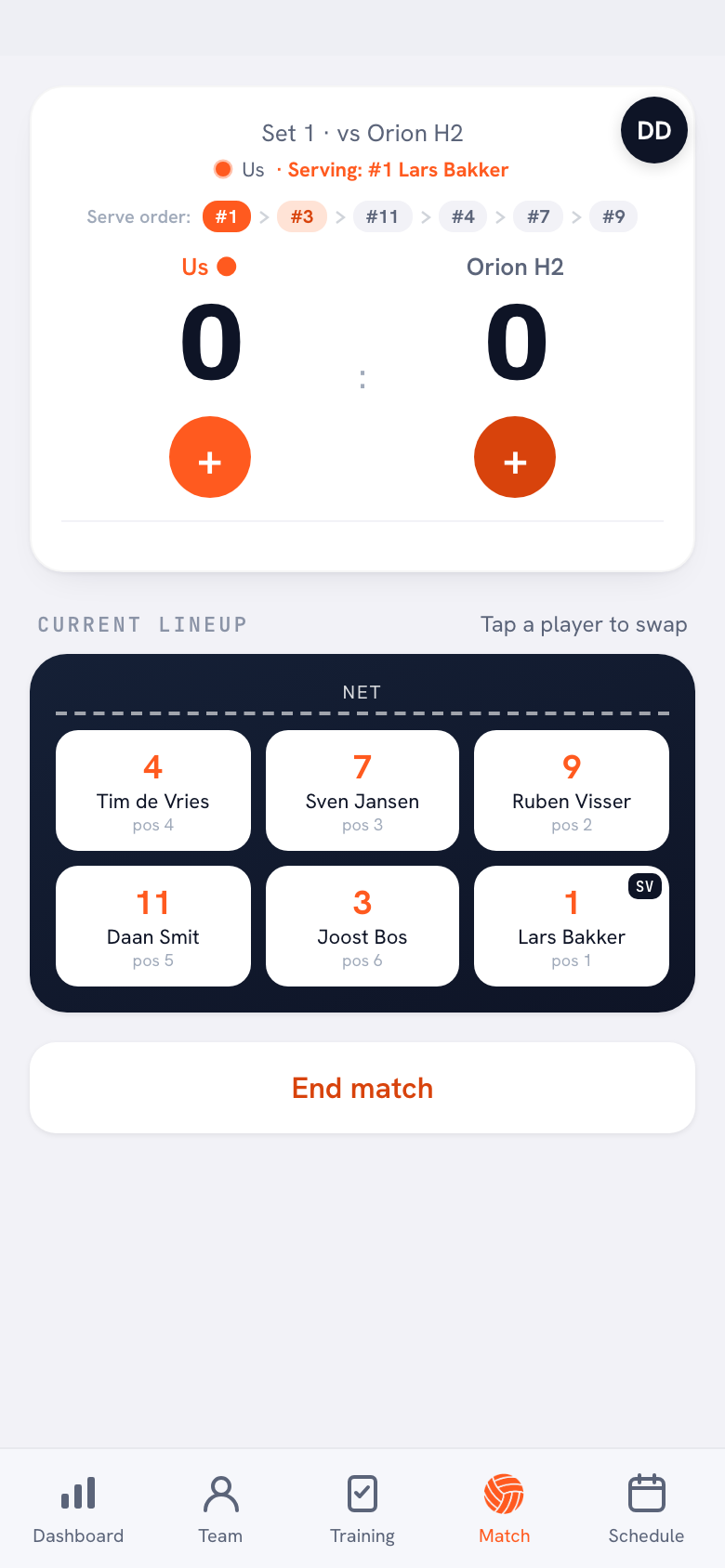
The biggest fear coaches have: that keeping statistics comes at the expense of the coaching itself. Rightly so — with pen and paper you easily lose ten seconds per point. In Koach the score is displayed large and you simply tap the plus next to your team or the opponent. The app tracks the set scores, the serving turn and the rotation for you.
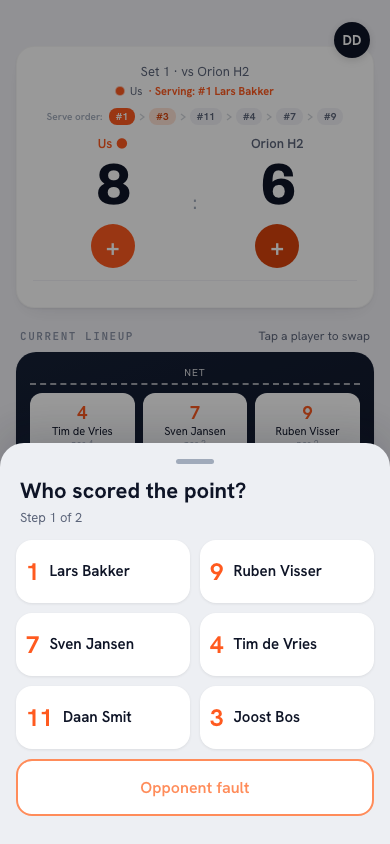
Who scored the point?
After each plus, the app asks in a single screen who made the point. You only see the six players on the court at that moment, so choosing takes half a second. Was it not a scoring action of your own but an opponent error? There is one button for that too — keeping your attack numbers clean.
Tip: you do not have to do it yourself. Hand your phone to a substitute or a parent on the sideline. The input is so simple that anyone gets it after one set — and you keep your head in the match.
Right after the final point: statistics per player
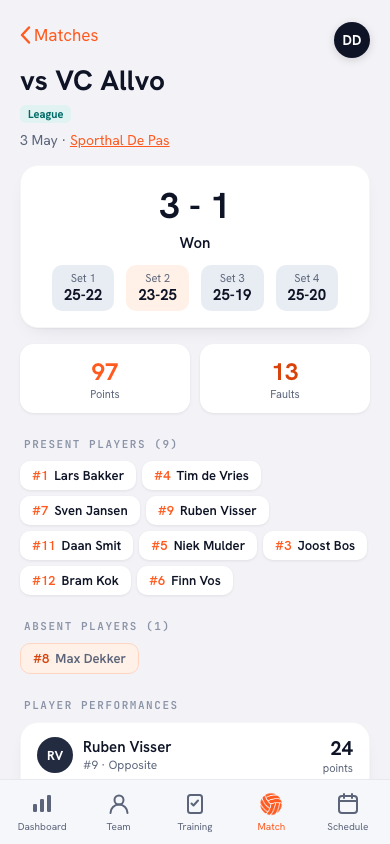
The moment you close out the match, the overview is ready. For each player you see the total number of points, broken down into attack, block and serve, plus their error count. No spreadsheet, no retyping — the debrief can start in the locker room. Every player reads their own numbers back later in their profile.
How to read the numbers as a coach
- Look at the ratio first, not the total. A middle blocker with 17 points, 8 of them from blocks, tells a different story than an opposite with 28 attack points.
- Weigh in the errors. 25 points with 1 error is often worth more than 28 points with a lot of risk.
- Compare across matches, not within one evening. One off night says little; three in a row is a signal.
Frequently asked questions
Can I track a match without a dedicated stats volunteer?
Yes. Because a point only takes two taps, it can be done from the sideline by the coach, a substitute or a parent. You will not miss a rally.
Which statistics are the most important to track?
Start simple: points per player broken down into attack, block and serve, plus own errors. That is enough to see who makes the difference and where points leak away. More detail can always come later.
What do I do with the statistics after the match?
Use them as conversation material, not as a report card. Discuss one strength and one development point per player, and focus on the trend across multiple matches.