
Volleyball rules: all the rules of the game at a glance (2026)
Volleyball looks simple — ball over the net, three touches, score a point. But anyone watching from the sideline soon discovers a whole rulebook behind it: rotations, positional faults, libero replacements, net contact. This overview lines up all the rules of the game, with a deep-dive on each topic.
How a volleyball match works in brief
Two teams of six players face each other, separated by a net. The goal: get the ball onto the opponent's floor, or force them into an error. A team may touch the ball a maximum of three times before it has to go back over the net (a block touch does not count), and no single player may play the ball twice in a row. Every rally scores a point for the team that wins it — the so-called rally-point system. If the receiving team wins the rally, it earns not only the point but also the serve, and rotates one position.
The court and the net
A volleyball court measures 18 by 9 meters, split into two halves of 9 by 9. Three meters from the center line, on both sides, lies the attack line, better known as the three-meter line — the boundary between front-row and back-row players. All the measurements and zones are in the dimensions of a volleyball court. The net hangs at 2.43 meters for men and 2.24 meters for women; youth and mini volleyball use lower heights — see all net heights.
Scoring and sets
A set is played to 25 points with at least a two-point margin; a match is best-of-five, with the decisive fifth set played to 15 points. In the Dutch regional league, incidentally, four sets are played as standard, with each set won worth a match point. Exactly how the counting works is in scoring in volleyball, and we cover the set format in detail in how many sets does a volleyball match have.
Rotation and positions
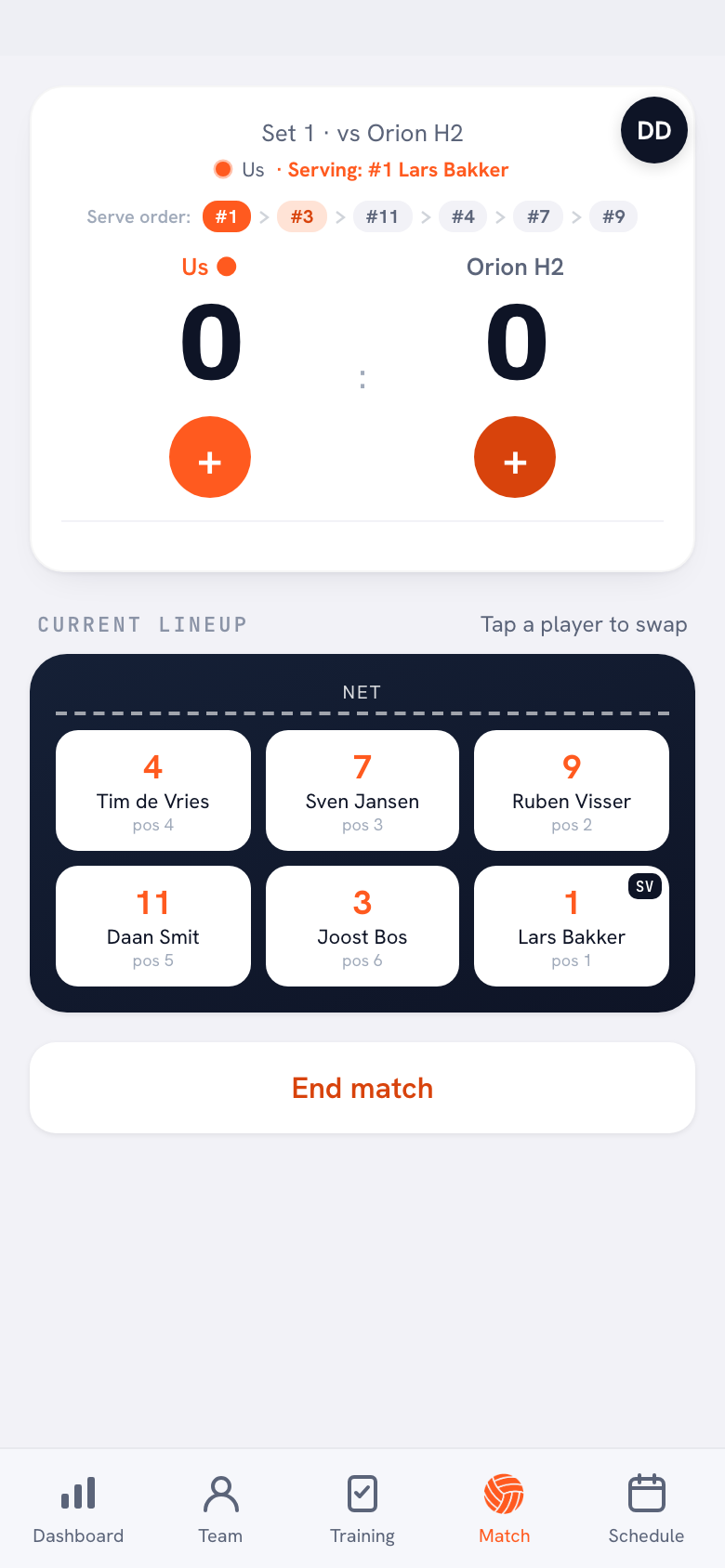
The six court positions are numbered 1 through 6: position 1 is back-right (where the serve is played), and the numbering runs counterclockwise to position 2 front-right. Who stands where is in position numbers 1 to 6. As soon as a team wins the serve, it rotates one position clockwise — the rotation order. At the moment of the serve, everyone must be in the correct relative order; whoever is not commits a positional fault and loses the point immediately.
The most important faults
- Net fault: touching the net between the antennas while playing the ball — all the nuances are in the net-fault rules.
- Technical faults: double contact, carried ball and four touches — explained in double contact and other technical faults.
- Back-row attack fault: a back-row player who takes off in front of the three-meter line and attacks the ball above net height — see may a back-row player attack?
- Serving faults: stepping on or over the end line while serving, or not serving within eight seconds of the whistle.
- Positional and rotation fault: standing in the wrong order or serving out of order.
Substitutions, the libero and time-outs
Each team may make six regular substitutions per set; the exact conditions are in the substitution rules. In addition there is the libero: the defensive specialist in the contrasting shirt who may replace back-row players an unlimited number of times, but may not serve, block or attack above net height — the full story is in the libero rules. On top of that, each coach has two time-outs of thirty seconds per set.
The referee and the hand signals
The first referee runs the match from the stand by the net; at official matches a second referee stands on the other side, watching positional faults and net contact on their side, among other things. Every decision is indicated with a fixed hand signal — whoever knows them understands every whistle. We have collected them in all the referee hand signals.
Indoor and beach: same sport, different rules
Beach volleyball shares its basics with the indoor game, but differs on major points: two players per team, a smaller court without a three-meter line, sets to 21 and a block that does count as a team touch. The full comparison is in indoor volleyball vs beach volleyball.
Adapted rules for youth and mini volleyball
For youth players the regular rules apply, but with a lower net and sometimes an adapted match format per class. For the very youngest, the Dutch federation (Nevobo) developed CMV volleyball (Cool Moves Volley, the Dutch youth format) with six progressive levels, each with its own small courts, catch rules and scoring — so a child grows toward the full game step by step. The details are in the mini-volleyball rules.
Good to know: the official rules are set each Olympic cycle — the current FIVB rules apply for 2024-2026, and the Dutch federation adopts them almost one-to-one. Major changes are rare; the basic rules above have been fixed for decades.
Frequently asked questions
How many times may a team touch the ball?
A maximum of three times before the ball must go back over the net, with a block touch not counting. One player may never play the ball twice in a row, unless their first contact was a block.
May the ball touch the net?
Yes, in play and on the serve the ball may touch the net and roll over it. It is only a fault if the ball crosses the net outside the antennas or does not cross within three team touches.
What happens if both teams commit a fault at the same time?
Then the referee calls a double fault and the rally is replayed, with no point for either team. You see this, for example, on a ball simultaneously held above the net.
Are the rules the same for youth players?
The basic rules are, but net height, court size and sometimes the number of sets differ per age category. In CMV mini volleyball, each level has its own strongly simplified rules.


Knowing the rules is one thing, applying them live is another
With Koach you score matches live while the app keeps track of set scores, rotation and lineup.
Get started with Koach