
Coach smarter, with less admin
Practical guides for volleyball coaches. From live scoring on the sideline to tracking player development — written from real coaching practice, with examples from the Koach app.

Managing a volleyball team as a coach: the complete overview
Managing a volleyball team without scattered lists and group chats? Here is how to keep your roster, roles, attendance and development in one place — the way experienced coaches work.
Read article →
Volleyball roster template (free PDF, Excel and Word)
Free volleyball roster template in PDF, Excel and Word with jersey numbers, positions and emergency contacts.
Read article →- Creating player profiles with position and jersey number
- The volleyball team app: everything for your team in one place, not five separate apps
- Team availability app: who can make the next match?
- Team availability tracker template for Excel and Google Sheets
- Assigning and managing jersey numbers in your roster
- Volleyball positions explained: from setter to libero
- Keeping notes per player (and why every coach should)
- Inviting players to your team with a link
- Team manager app for volleyball: taking the admin off your hands
- Setting a team goal for the season
- Building your roster: how many players do you need per position?
- The libero: rules, role and registration in your team
- The setter: role and assigning them in your lineup
- Second positions: using players flexibly
- Volleyball depth chart template: who covers every position
- From paper membership list to digital team management
- Managing your own profile and details as a player
- Emergency action plan for volleyball: free template for your team
- The playing coach: add yourself as a player
- Assistant volleyball coach duties and how to share the work
- Leaving your team or switching teams as a player
- Team communication in your volleyball app: announcements, polls & tasks
- Volleyball coach introduction letter to parents: 5 free templates
- Team snack schedule template: snacks, jerseys and the ball bag
- One player short: a fill-in at a session, match or tournament
- Appointing a team parent to arrange the transport
- Volleyball carpool: spreadsheet, group chat or a rota app?

Running a volleyball practice: from preparation to evaluation
Running a volleyball practice that actually makes your team better: how to prepare, structure, track attendance and evaluate — the complete approach for coaches.
Read article →
Tracking attendance at volleyball practice without the hassle
"Who was missing last Tuesday again?" If you have to guess the answer, you are also guessing when you hand out playing time.
Read article →- Planning a practice in three steps
- Volleyball practice app: plan sessions, track attendance and drills
- Setting the focus of your practice (and writing it down)
- Practice blocks: building your session like a programme
- Building your own drill library
- Creating drills with the drill editor
- Volleyball drill designer: paper, PowerPoint or an app?
- Drill app for volleyball: your own drill library in your pocket
- Volleyball drill videos, diagrams or animations: what works?
- Categorising drills: attack, defence, serving, blocking
- Sharing drills between coaches
- Scoring effort after practice: why and how
- Logging late arrivals (and making them discussable)
- Attendance app for volleyball: attendance and effort in one tap
- Volleyball attendance sheet: free template in Excel and PDF
- Increasing practice attendance: 7 tactics that work
- Warm-up drills for volleyball
- Passing and attacking drills for your practice
- Serving drills: building pressure zone by zone
- Blocking drills for your middle blockers
- Practising with a small group: drills for 6 or fewer players
- Evaluating the practice season with attendance and effort data
- Marking your own attendance for volleyball practice
- Reusing your practice plan with templates: never start over
- Volleyball practice plan template: blank sheet for one session
- Volleyball reception drills: from technique to game speed
- Queen of the Court Volleyball Drill: Rules and Variations
- What Is a Wash Drill in Volleyball? Rules and Scoring
- Volleyball Drills for Liberos: Receive, Dig and Distribute
- Volleyball Drills Without a Net: Training in a Bare Gym
- How to Get More Reps in Volleyball Practice: Seven Fixes
- Volleyball Drills for Adult Beginners Who Have Never Played
- Volleyball Drills to Assess Skill Level: First Practice
- Game-Like Volleyball Drills That Actually Transfer
- How to Coach a Volleyball Team With Different Skill Levels
- Volleyball Drills for Large Groups: One Court, No Queues
- Setter Hitter Connection Drills: Training the Timing
- Volleyball Drills for 2 People: A Full Partner Session
- What Is Pepper in Volleyball? How to Do It Properly
- Volleyball Drills Against a Wall: Passing, Setting, Serving
- Volleyball Setting Drills for Beginners: Hands, Feet, Spin
- Volleyball Digging Drills: Getting Defenders Low and Early
- Volleyball Drills for Outside Hitters: Approach and Timing
- Volleyball Transition Drills: Turning a Dig Into a Kill
- Youth volleyball drills: coaching 12- to 14-year-olds
- How long should a volleyball practice be? Times per group
- Your team says nothing: volleyball communication drills
- Beach volleyball drills for your indoor team
- Volleyball drills for recreational players: fun without slack
- The whole series or just this evening? Editing a recurring volleyball practice
- Ready-made volleyball drills in the app: filtering by who turns up
- Giving players homework: sending a volleyball drill home
- Volleyball drills PDF: why that free collection never gets used
- Volleyball spiking drills: from a toss to attacking under pressure
- Middle blocker drills: five forms for the busiest player on court
- How to train a setter in volleyball: a plan for the position, not just setting drills
- Volleyball IQ drills: how to train decision making, not just technique
- Late to Volleyball Practice: What the Player and the Coach Do
- The practice report: what you record after a session
- Volleyball coach binder: what to keep, on paper or in an app

Creating a volleyball lineup: the 5-1 and 4-2 systems explained
A good lineup is half the game plan.
Read article →
The 5-1 system in detail: rotations, strengths and pitfalls
The 5-1 volleyball system fully explained: all six rotations, the strong and weak rotation positions, and the pitfalls that sink beginning 5-1 teams.
Read article →- The 4-2 system in detail: when and how
- Volleyball lineup app: 5-1, 4-2 and 6-2 rotations, subs and libero on your phone
- Rotation order in volleyball: how it works
- Preventing positional faults: the rules per rotation
- Rotation app: track rotation order and libero without mistakes
- Volleyball rotation wheel: free printable and an app that rotates
- Choosing your starting lineup: 3 considerations
- How many substitutions in volleyball? 6 per set: the rules
- Volleyball rotation with 8 players: a fair sub plan
- Entering a substitution during the match
- Volleyball substitution tracker: app or free sub sheet (PDF)
- Who can the libero replace? Libero exchange rules explained
- Preparing your lineup before match day
- Players on two positions: flexible lineups
- Lining up against a strong attacker: organising the block
- Positioning the beginning setter
- From paper lineup card to digital lineup
- Volleyball court template for coaches: free printable PDF
- Save and reuse a lineup: ready in one tap
- Volleyball playbook app and free PDF template
- The 6-2 system in volleyball: two setters, three attackers
- Rotation check: run through your six rotations before the match
- Volleyball 4 vs 4 formation: roles and serving order
- Volleyball 5-1 or 4-2: is your team ready to switch?
- How to teach volleyball rotations when your players keep getting lost
- Rotational Fault in Volleyball: Finding Where the Order Broke
- Volleyball Overlap Rules: Which Two Neighbours Stood Wrong?

Tracking a volleyball match live: scores and per-player statistics
Every coach knows the feeling: after the match you roughly remember the set scores, but who actually made the points? That memory fades fast.
Read article →
Scoring in volleyball: the rally point system explained
How does scoring work in volleyball? The rally point system, sets to 25, how it differs from the old rules and what happens at 24-24 — fully explained.
Read article →- Volleyball match app: live scoring plus statistics per player
- Who scored the point? Point tracking per player
- Recording point types: attack, block or serve
- Volleyball scoreboard app: keep score, set scores and serve order on your phone
- Volleyball score card template to print, or score in an app
- Tracking opponent errors separately
- Tracking set scores and sets won
- Following the serving turn during the rally
- Live scoring at 2-2 in sets: the deciding set
- Finishing a match and seeing the report instantly
- Delegating live scoring: putting parents and substitutes to work
- Using time-outs: when and how
- Reading back the score progression: what happened in set 3?
- Creating a friendly or tournament match
- Live scoring without wifi in the sports hall
- Share your match result on social media — in your team's style
- Tracking reception quality: pass ratings per player
- Scorer authorization: a player keeps score on their own phone
- Serving runs: points in a row on your own serve
- The share package: your match as shareable content
- How long is the break between sets in volleyball?
- The set break in your volleyball app: the numbers and your lineup for the next set
- Volleyball time-out: what do you say? The stats in those thirty seconds
- Two liberos in the app: the role follows who is on court
Match analysis
Statistics, results and reviews: coach with data instead of gut feeling.
Understanding and using volleyball statistics as a coach
Understanding volleyball statistics: which numbers matter, how to read them without drowning in data, and how to turn them into lineups and practices.
Read article →
Volleyball stat sheet explained: how to read a box score
Volleyball stat sheet explained: what K, E, TA, A, SA, SE, RE, DIG, BS and BA mean in a box score, and which columns Koach fills in when you score live.
Read article →- The match overview: all results in one place
- Volleyball stats app: live stats per player, connected to your lineup and practices
- Best way to track volleyball stats: paper, spreadsheet or app?
- Reading per-player statistics after the match
- Your team's top scorers: attack, block and serve
- Preparing the match debrief with data
- Free volleyball statistics app: what you get for free (and when you want more)
- Calculating and improving your attack percentage
- Serving statistics: measuring aces and serve pressure
- Measuring block points: the undervalued statistic
- Error load per player: risk versus return
- Planning a tournament and tracking every match
- Match attendance: who was (not) there?
- Season analysis: trends across all your matches
- Reading your own match statistics as a player
- Follow the league table in your volleyball app
- Side-out percentage: the most important team stat explained
- Player of the Match: let your team vote after the game
- Volleyball score graphics: Canva template or made automatically
- The momentum line: see where the match turned
- Importing the match schedule from your pool
- Pre-season tournament: what are you really measuring?
- Volleyball scouting sheet: writing a rally on a single line
- Volleyball scouting report template: free PDF with game plan
- Printable volleyball stat sheets: free PDF, example included
- Defence as a statistic in volleyball: digs per set and what is good
- Volleyball match analysis: find what really cost you the sets
- Volleyball analysis app: what your scored points tell you
- My Volleyball Team Keeps Losing: Is It the Level or the Team?
Player development
Make growth visible with goals, form indicators and honest evaluations.

Tracking player development in volleyball: from gut feeling to insight
"I think he has really improved this season." Great — but in what, exactly?.
Read article →
Setting a personal goal for every player
Personal goals for volleyball players: how to set one measurable season goal per player, record it and keep it alive — with examples for every position.
Read article →- Volleyball goal setting worksheet: free PDF and Word template
- Achievements and badges: motivating players with milestones
- End of season volleyball awards: fair categories and stats
- The form indicator: the last three matches, weighed
- The strength analysis: where does the production come from?
- Determining a player's strongest role with data
- Holding the evaluation talk with a player
- Volleyball player report card: free end-of-season template
- Growing youth players: development over results
- The best app for youth volleyball: development over results
- Distributing playing time fairly with objective data
- Average effort per player: the season podium
- Match performance over time: reading the growth chart
- From season to season: long-term development
- Making a quiet player visible with statistics
- Backing up promotion advice: ready for a higher team?
- Viewing your own volleyball stats as a player
- Am I getting better? Tracking your own progress as a volleyball player
- All the badges in Koach: what they are and how to earn them
- Koach for parents: following your child's development
- Tracking playing time: the fairness meter in Koach
- The season card: your season as a shareable player card
- Volleyball player card template: Canva or automatic
- Building confidence in sport: the player who has lost it
- Volleyball player evaluation form: nine skills on a scale of 1 to 5
- Volleyball skills checklist: free PDF and Excel by level
- Volleyball tryout app: score tryout day, then build your teams
- The Bench Player: What to Do With Someone Who Barely Plays
Organising the volleyball season: the complete checklist
How to organise a volleyball season as a coach: from roster and team goal to calendar, evaluations and handover — the complete checklist from August to June.
Read article →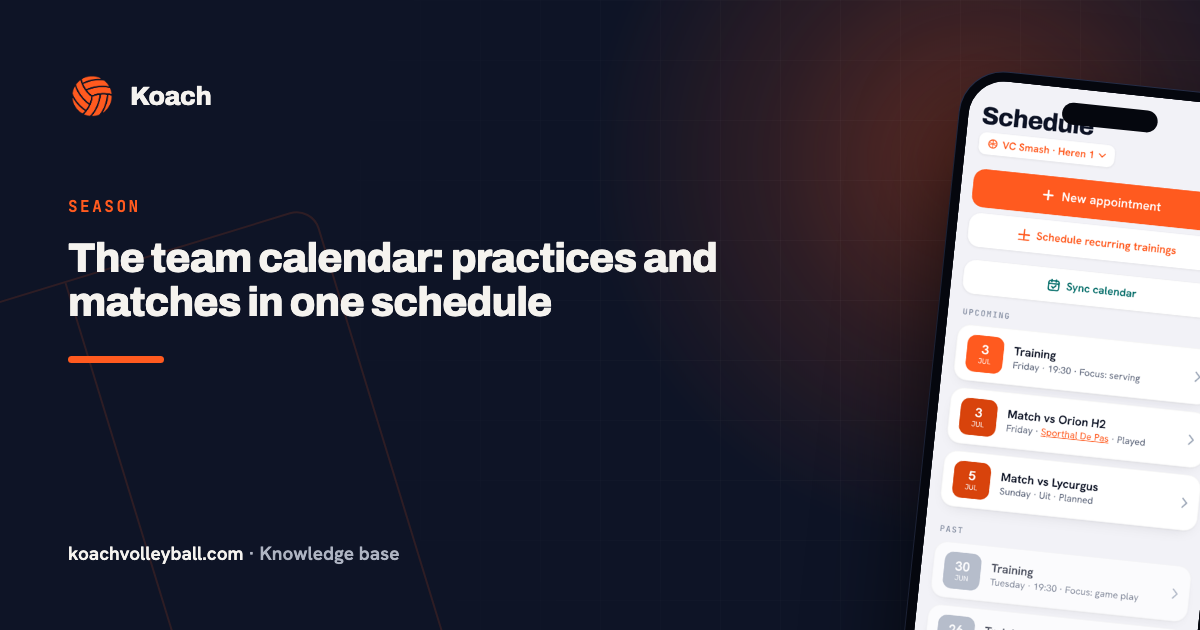
The team calendar: practices and matches in one schedule
One team calendar for practices, matches and tournaments: how to keep your volleyball team's schedule up to date without scattered messages and double bookings.
Read article →- Volleyball season schedule template: free PDF and Excel
- Volleyball scheduling app: plan practices and matches all season
- An app for your volleyball club: from one team to the whole club
- Referee scheduling app: spreadsheet, software or club app
- Volleyball team website: what goes on it, what stays in the app
- Sports club newsletter: a template and a simple channel plan
- How to start a volleyball club: the steps and what it costs
- How to run a volleyball club: the club year, step by step
- Sports club digitalisation: where to start and what to combine
- The coach dashboard: your season at a glance
- Setting and tracking season goals with your team
- The first team meeting: expectations and agreements
- Volleyball team handbook: free template in PDF and Word
- Running a season evaluation with data
- Sports club survey questions: a template and the data you have
- Making the most of the winter break: analyse and adjust
- Handing over to a new coach: everything is already in place
- The team calendar in your own calendar app on your phone
- Managing multiple teams as a coach with the club report
- Sports club annual report: a template with team stats
- Season plan for volleyball training: 34 weeks, five blocks
- Volleyball season plan template: free Excel and PDF
- Volleyball technical committee: who decides what, and when
- Volleyball curriculum: free club template, and how to track it
- Sports club development plan: free template and how to track it
- Coaches meeting agenda template: 5 items and team-by-team prep
- Sports club structure chart: free example and PDF/Word template
- Sports club committee roles and responsibilities: who does what
- Splitting a youth squad: 26 children, how many teams?
- When does the volleyball season start? The full calendar
- Recruiting volunteer coaches: how to find ones who stay
- Volunteer hours tracker for your club: template or app?
- Volleyball coach handbook: what to include, with a free template
- Volunteer rota template: free Excel and PDF for your club
- Youth coordinator duties: eight teams you never see
- Filling in: can a player play for two volleyball teams?
- Volleyball membership fees: per team or per player?
- Practice reminders: the nudge your sports app sends two days ahead
- A match rescheduled by the Nevobo: the alert that keeps your schedule right
- Round robin schedule for 8 teams — and for every number from 5 to 12
- Family calendar app: two children in sport, three group chats, one calendar
- Recruiting new members for a sports club: what works and what does not
- Volleyball interest form: free template and what comes next
- Finding a sponsor for your sports club: packages, what you give back and the first letter
- Social media for sports clubs: a weekly plan for volleyball clubs
- Volleyball preseason training: what to give players before summer and how to restart without starting from zero
- Everything Lands on the Coach: Handing Over Team Tasks
- The technical manager: the club role that reads along
- Coach development plan: free template for your club
- Sports club member retention: the signs before members quit
- Coach evaluation form: free template in PDF, Word and Excel
- Club welfare officer: role, who to appoint, what they see
- Safeguarding policy for sports clubs: free Word and PDF template
- Sports club code of conduct: free template in Word and PDF
- Volleyball coach code of conduct: free Word and PDF template
- A camp, a meeting or a parents evening in the calendar
- Volleyball training camp plan: schedule and checklist
- Volleyball parent meeting agenda: free template and letter
Getting started
Everything about Koach itself: pricing, devices, privacy and switching.

The best volleyball app for coaches: what to look for
Choosing a volleyball coaching app? A 7-point checklist to run through during a free trial, from live scoring and rotations to practice planning and price, plus where to compare the apps.
Read article →
Sports team apps for volleyball: the complete overview (2026)
An overview of the apps volleyball coaches and teams use: from broad team organisers like TeamSnap, SportEasy, Spond, Heja and Teamy to volleyball tools like SoloStats, Rotate123 and Koach.
Read article →- TeamLinkt alternative for volleyball: club platform or coach app?
- Sports attendance app: TeamSnap, Spond, Heja and more compared
- Best sports team communication apps: six compared honestly
- BAND vs TeamSnap: which app fits your volleyball team?
- WhatsApp for sports teams: keep the group or add a team app?
- Spond vs TeamSnap: which is better for a volleyball team?
- Spond vs Heja: which team app works for a volleyball team?
- Team app cost comparison: Spond, TeamSnap, Heja, SportEasy
- The best volleyball apps for coaches (2026): an honest comparison
- Best volleyball rotation apps: six options, honestly compared
- Best volleyball score keeping app: 5 scoreboard apps compared
- Getting started with Koach: your team set up in 10 minutes
- Koach on iPhone: installing and setting up the app
- Volleyball app for Android: install it and use it courtside
- Volleyball apps for iPhone: alerts, widget, live scoring
- Your account and data: how Koach handles privacy
- Statistiekie alternative: when you want more than statistics alone
- Heja alternative for volleyball: more than communication alone
- Stack Team App alternative for volleyball: club app or coach app?
- Teamer app closing down: where to move your volleyball team
- Pitchero alternative for volleyball: club site or coaching app?
- Using Koach in English (and 5 other languages)
- SportEasy alternative for volleyball: general versus volleyball-smart
- Spond alternative for volleyball: from communication to coaching
- TeamPlus alternative for volleyball: lineups and live scoring
- What does Koach cost? Start free and upgrade
- Free volleyball apps for coaches: what is really free?
- Volleyball coaching resources: free drills, plans and rotations
- Volleyball coach essentials: from whistle to app
- Volleyball coaching software: why an app on your phone usually wins
- Volleyball stats app for Windows and Mac: program or web app?
- Earning a Coach Month: 30 extra trial days per fellow coach
- Working with multiple coaches on one team
- TeamSnap alternative for volleyball coaches
- GameChanger volleyball app: free scoring, but is it enough?
- GameChanger vs TeamSnap: which app fits a volleyball team?
- SoloStats alternative: stat depth versus a full team app
- Easy volleyball stat app: keep stats solo from the bench
- iStatVball alternative: deep stats or your whole team?
- Volleyball scouting app: six scouting apps and Koach compared
- Volleyball Scout Pro: Premium, prices and how Koach compares
- A VolleyStation alternative for the everyday coach
- Hudl alternative for volleyball: live stats without a camera
- Hudl vs GameChanger for volleyball: video or free scoring?
- Balltime alternative: volleyball stats without filming
- AI volleyball stats app: the options, and stats without a camera
- Data Volley alternative: what a club coach actually needs
- Click and Scout: price, iPad and when a lighter app is enough
- Teamy alternative for volleyball: organising versus volleyball-smart coaching
- From Excel to Koach: migrating your team administration
- What does a player see in Koach? The player account explained
- The volleyball app for players: your own stats, schedule and attendance
- Got a Koach invite? How to link your player account
- Logging in without a password: code, Google or Apple
- Need help? How Support works in the Koach app
- Rotation check: test your lineup before the first serve
- Notifications in Koach: push notifications and reminders on your device
- Plan faster: a full season in one go, duplicating matches and 'All present'
- New for players: your own goal, absences with a reason and badges on your dashboard
- New insights for coaches: serve pressure, opponent history and growth per season
- Koach is live in the App Store: announcement and an honest first impression
- Bar duty roster for your whole club: one tap, a year sorted
- Adding parents to your team: how parent accounts work in Koach
- Volleyball parent app: what parents see and do in Koach
- Youth sports team apps: 5 compared for parents and coaches
- Managing your volleyball club: club managers, logo and sponsors
- SportsEngine alternatives for volleyball: replace it or keep it?
- Linking your team to the right club: club name, city and club code
- New in Koach: a vice-captain for your volleyball team and more
- Driving rota for away matches: sharing the driving out fairly
- Who drives on Saturday? The driving rota for players and parents
- Match availability: who is coming on Saturday, and who is not?
- Opponents the app remembers: never three spellings of one club again
- Editing without detours: matches, tournaments and calendar items
- Coming to watch: being there on Saturday without playing
- Google Maps sending you to the wrong venue? Fill in the address
- Your season has ended — setting up a new season
- Entering match stats afterwards without live scoring
- Cancel a match or practice instead of deleting it
- The tactics board: explaining a situation in the time-out
- Volleyball tactics board app: phone, tablet or online
- Training-only players: in your session, not in your squad
- Two parents per player: an account each
- Club announcements: one message to every team in the club
- CourtsideView alternative: match day or the whole season
- Assistant Coach Volleyball alternative: own it or subscribe?
- VolleyballXL alternative: a drill library or an app for your whole team?
- Practice Pro Volleyball app alternative: practice and match day
- How many club duties have I still got left? Your own total in the app
- The volleyball widget on your home screen: iPhone and Android
- Cancelling or switching your Koach subscription in the App Store and Play Store
- Attendance history: who tapped which button, and when
- Koach on the iPad: what a bigger screen changes
- Best tablet for coaching volleyball: iPad or Android?
- Best volleyball stats app for iPad: six apps compared
Technique
Serving, passing, setting, attacking and blocking: learn every skill step by step.

Learning volleyball technique: all the fundamentals at a glance
Learning volleyball technique? An overview of every fundamental skill: serving, passing, setting, spiking, blocking and defense — with the right learning order and practice tips.
Read article →
How do you learn to spike a volleyball? The technique in 5 steps
Learning to spike a volleyball takes 5 steps: approach, takeoff, arm swing, ball contact and landing.
Read article →- Learning the overhand serve: technique and progression
- The underhand serve: proper technique for beginners
- Learning the jump serve: from toss to contact
- The float serve: why the ball floats and how to hit it
- The forearm pass: the platform that starts every rally
- Overhead setting: the setter's technique
- Blocking in volleyball: footwork, timing and hands
- Defense in volleyball: posture, positioning and diving technique
- The spike approach: the three-step rhythm for a higher jump
- Poke, tip and roll shot: scoring smart without a hard spike
- Why You Keep Hitting the Volleyball Into the Net
- Why Your Volleyball Serve Goes Into the Net (and the Fix)
- How High Should You Toss the Ball When Serving Volleyball?
- How to Wipe the Block in Volleyball: Technique and Drills
- How to Spike If You Are Short in Volleyball: Angles
- How to Do a Setter Dump in Volleyball Without Tells
- How to Set a Bad Pass in Volleyball: Giving a Hittable Ball
- How to Play a Ball Off the Net in Volleyball
- How to Pass a Float Serve in Volleyball: Reading the Ball
- How to Hit Cross-Court vs Line in Volleyball
- How to Hit a Back-Row Attack in Volleyball: The Pipe
- How to Read the Hitter in Volleyball Defense: What to Watch
- How to Angle Your Platform When Passing a Volleyball
- How to Hit a Volleyball Harder: The Arm Swing, Step by Step
- How to Pancake in Volleyball: The Last-Second Save
- Volleyball terms A to Z: what are they shouting out there?
- The jump float serve: more pressure, less risk
- Volleyball footwork: split step, shuffle and crossover
- The slide attack in volleyball: behind the setter, off one foot
- Overhand Serve Suddenly Not Working: What Changed?
Rules of the game
Net heights, court dimensions, faults and referee signals: the rules explained.

Volleyball rules: all the rules of the game at a glance (2026)
All the volleyball rules in one place: scoring, sets, rotation, positions, net faults, substitutions and the libero.
Read article →
How high does a volleyball net hang? All net heights
How high does a volleyball net hang? All the official net heights in one place: men 2.43 m, women 2.24 m, plus the USA Volleyball and NFHS youth heights and beach volleyball.
Read article →- Dimensions of a volleyball court: all the lines and zones
- How many sets does a volleyball match have (and to how many points)?
- Position numbers 1 to 6 in volleyball: who stands where?
- May a back-row player attack? The three-meter-line rules
- Net fault in volleyball: when is touching the net a fault?
- Double contact, carried ball and more technical faults explained
- Referee hand signals in volleyball: all the signals explained
- Indoor volleyball vs beach volleyball: the most important differences
- How Many Seconds Do You Have to Serve in Volleyball?
- Can You Step on the Line When Serving in Volleyball?
- Can a Libero Be Team Captain? How That Rule Works Now
- What If the Ball Goes Outside the Antenna in Volleyball?
- Can a Back Row Player Block in Volleyball? The Setter's Trap
- What Happens If You Serve Out of Order in Volleyball?
- Can You Play Volleyball With 5 Players? What the Rules Say
- What Happens If the Ball Hits the Ceiling in Volleyball?
- What Is a Joust in Volleyball? The Ball Above the Net
- What Happens If a Volleyball Player Gets Injured Mid-Match?
- Can a Libero Set the Ball Overhand? The Front-Zone Rule
- Does a Block Count as a Hit in Volleyball?
- Can You Block a Serve in Volleyball? And Can You Spike It?
- Does a Serve That Hits the Net Count in Volleyball?
- Can You Kick the Ball in Volleyball? The Feet Rule
- Is the Line In or Out in Volleyball? The Ball on the Line
- Can You Reach Over the Net in Volleyball? Block vs Attack
- What Does a Yellow Card Mean in Volleyball? Card Sanctions
- Can the Libero Serve in Volleyball? The League Decides
- Can a Libero Spike the Ball or Block in Volleyball?
- How long does a volleyball match last? Plan your day
- Refereeing volleyball: your first match, step by step
- Becoming a volleyball referee: the three routes
- New volleyball rules 2026: what has actually changed
- How many times can you touch the ball in volleyball?
- How many challenges in volleyball, and when to use one
- The coaching zone: what are you allowed to do?
- 4v4 beach volleyball rules: what changes on the sand
- Second referee duties in volleyball: step by step
- Mixed volleyball rules: three men and three women, alternating
- Illegal Libero Replacement: the Four Mistakes That Get Whistled
- Illegal Substitution in Volleyball: How the Mistake Happens
Tactics
Serving strategy, reception formations and defensive systems for smarter volleyball.

Volleyball tactics: from serve pressure to defensive system
Volleyball tactics for coaches: serve pressure, serve-receive formations, attack tempos and defensive systems — what to pick when and how to train it.
Read article →
Running the 6-2 system: penetration, rotations and pitfalls
The 6-2 system in practice: how setter penetration works, the rotations and pitfalls, and which teams benefit from two setters who also attack.
Read article →- Serving strategy: where do you serve and why?
- Serve-receive formations: passing with 3, 4 or 5 players?
- Defensive systems: perimeter and rotation defense explained
- Attack tempos: from high ball to first tempo
- Out of system: scoring when the pass isn't perfect
- Free ball and down ball: the underrated moments
- The 5-2 Volleyball Rotation: Two Front-Row Setters
- The 6-6 Volleyball Rotation for Beginners Explained
- What Does the Off Blocker Do in Volleyball? Three Jobs
- Why Do Middle Blockers Get Subbed Out in the Back Row?
- Who Takes the Ball Between Two Passers in Serve Receive?
- How to Read the Setter in Volleyball: Five Tells
- How to Find Your Weakest Rotation in Volleyball
- Should You Serve or Receive First in Volleyball?
- Volleyball Double Substitution: How and When to Use It
- Stacking: How to Hide the Setter in Serve Receive
- Read Blocking vs Commit Blocking: Which System Fits You?
- What Does an Opposite Hitter Do in Volleyball?
- What Does a Middle Blocker Do in Volleyball? Six Moments
- What Does an Outside Hitter Do in Volleyball? Four Jobs
- How to Cover Your Hitter in Volleyball: Where to Stand
- What Is a Pipe in Volleyball? The Back-Row Attack
- Setter hand signals: volleyball attack codes explained
- Volleyball coaching board: buy one, or just use your phone?
- How to improve serve receive in volleyball when it falls apart in matches
- Point scoring percentage in volleyball: why your team doesn't score on its own serve, and what to train
Youth volleyball
Age-appropriate training, mini volleyball levels and guiding young players.

Coaching youth volleyball: what works for each age group?
Coaching youth volleyball by age group: what works at ages 6-9, 10-12 and 13+? Concrete guidelines for practices that make kids better and happier.
Read article →
CMV volleyball: the 6 levels of Dutch mini volleyball explained
CMV volleyball explained: the 6 levels of Dutch mini volleyball, from throwing and catching to 4-on-4 — which level fits which child, and what the American equivalent is.
Read article →- Mini volleyball rules: court, net and scoring per level
- Your first practice with a youth team: structure and a sample plan
- Parents on the sideline: agreements that work
- From the small court to the full court: guiding the transition
- Teaching Kids to Set a Volleyball Without Jammed Fingers
- How to Help a Kid Who Is Afraid of the Volleyball
- Why a Volleyball Player Gets Worse After a Growth Spurt
- How Many Times a Week Should a 12-Year-Old Play Volleyball?
- Should a 12-Year-Old Specialize in One Volleyball Position?
- What Does My Child Need for a First Volleyball Practice?
- My Child Wants to Quit Volleyball Mid-Season
- What Age Can My Child Start Playing Volleyball?
- What Size Volleyball for a 10-Year-Old? Sizes by Age
- 12 Fun Volleyball Games for 8-Year-Olds Kids Ask For
- How to Get Kids to Serve Over the Net in Volleyball
- Mini volleyball drills by level: from catching to spiking
- Relative age effect: the youngest player in your youth team
- When a child can't stand losing: what to do in the hall
- ADHD and sport: setting up a volleyball practice
- Osgood-Schlatter: can this player jump tonight?
- Coaching teenagers: a team that does nothing
- Retaining youth players: the jump to senior volleyball
- What does volleyball cost per month? The bill for a season
Coaching craft
From tryouts to injury prevention: the skills around the volleyball itself.

Starting as a volleyball coach: your first season step by step
Starting as a volleyball coach? This step-by-step plan guides you through your first season: from selection and practice structure to match coaching and your own growth.
Read article →
Running volleyball tryouts: choosing fairly without chaos
Running volleyball tryouts: how to choose fairly with predetermined criteria, a tight program and clear communication afterward.
Read article →- Choosing a captain: criteria and pitfalls
- Building a good warm-up (the RAMP method)
- Cool-down and recovery after practice and matches
- Injury prevention in volleyball: ankles, knees and shoulders
- Conditioning for volleyball players: jump power and speed
- Strength training for volleyball players: what to do and what not
- Mental training: handling pressure and serving stress
- Team-building exercises that actually work for your team
- Scouting the opponent: what to look for?
- Match coaching: time-outs, substitutions and your role on the sideline
- How to tell a player they didn't make the team: what to say
- How to keep bench players engaged: give them a real job
- How to break a losing streak with your volleyball team
- What to say to your team after a bad loss
- What makes a good libero: seven signs on the court
- How to land properly in volleyball to protect your knees
- What does a volleyball team manager do? The task list
- What information should a coach collect from players?
- Coaching your own child in volleyball: the rules that help
- How to correct a player without yelling: better feedback
- How to coach a player with a bad attitude
- Spotting overtraining: team trains hard, gets slower
- Fear of failure in sport: the player who plays it safe
- Taping fingers in volleyball: when to tape and when not to
- Shoulder problems in volleyball: spotting and tackling them
- Bullying in sport: spotting and stopping exclusion
- Sleep and sport: the recovery dial every coach has
- Volleyball pre-match warm-up: the plan from arrival
- Ball to the head: concussion in volleyball
- An angry parent at your club: getting the conversation right
- Ankle sprain in volleyball: 5 return-to-play tests
- Knee pain in volleyball: managing jumper's knee
- Volleyball while pregnant: what still works and what doesn't
- Ankle brace for volleyball: brace, tape or nothing?
- What to eat before a volleyball match: timing by start time
- Jumping higher in volleyball: jump technique and plyometrics
- Back pain in volleyball: taking the load off your hitter's lower back
- Pep talk before volleyball games: what to say to your team in five minutes
- How to motivate your volleyball team when effort drops: what works over a whole season
- Dealing With Difficult Parents as a Coach: What to Do Courtside
- Good in Practice, Bad in Games: Drills or Nerves?
Tools & admin
Software, tracking statistics and the paperwork behind a volleyball club.

Why a WhatsApp Group Doesn't Work for a Volleyball Team
A group chat is fine for banter and quick questions, but it breaks down on availability and planning.
Read article →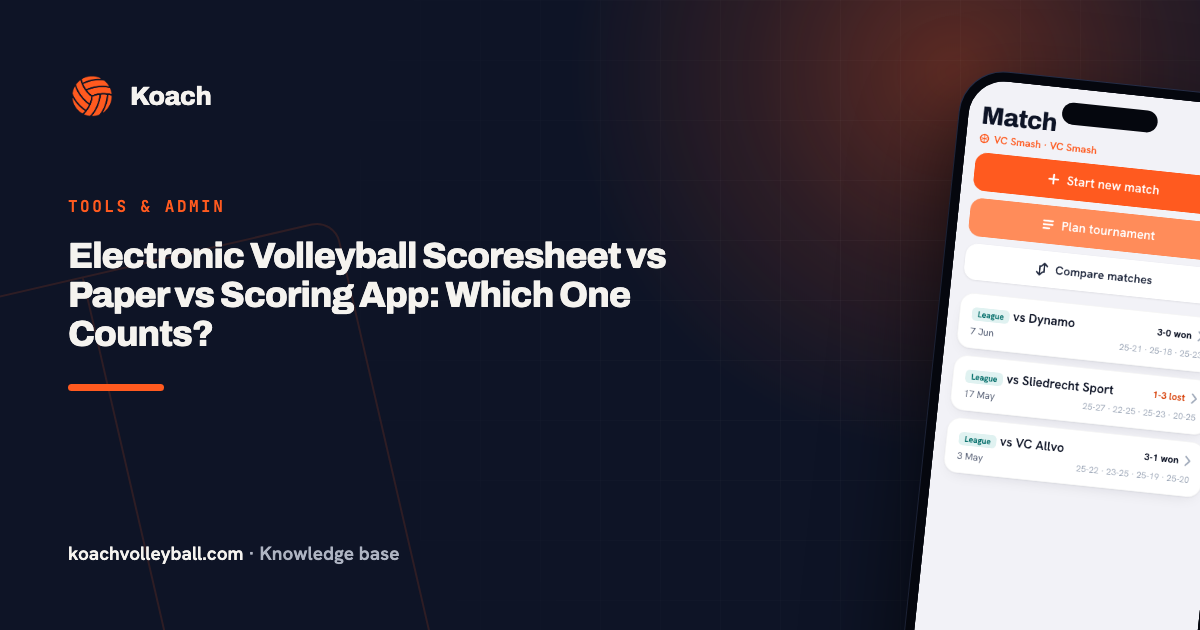
Electronic Volleyball Scoresheet vs Paper: Which Counts?
The official scoresheet, an electronic scoresheet and your own scoring app are three different records.
Read article →- How to Switch Team Management Apps Mid-Season Safely
- How to Get Your Team to Actually Use the Team App
- How to Keep Volleyball Stats on Paper: A Simple System
- Can AI Track Volleyball Stats Automatically from Video?
- How to Fill Out a Volleyball Score Sheet Step by Step
- Where to Put the Camera to Film a Volleyball Game
- How to Livestream a Volleyball Match With Your Phone
- Volleyball club handbook: what goes in and who keeps it current
- GDPR for a sports club: which member data do you keep?
- Club volunteers: do the job or buy it off?
- The club dashboard for your volleyball club: everything in one place
- Volleyball club membership list: every team on one screen
- Team selection for the new season: a draft in Koach where nothing moves yet
- Moving players to the new volleyball season: making the allocation final
- Tracking club duties: who has actually done their shifts?
- Referee and scorer rota for home matches: the Match day tab
- Volleyball club venue schedule: your fixed weekly slots in one place
- Recording committees at a sports club: the club behind the teams
- Tracking membership fees at a volleyball club, without accounting software
- Sending an email to all the members of your sports club
- Setting up your own email domain for a sports club
- Adding club admins: the five roles and what each one is for
- Digital volleyball scoreboard: on the wall, portable or run from a phone
- Club membership software: five questions that make the choice for you
- Tracking volleyball stats in Excel: where a spreadsheet gives out
- Club registration form: from a completed form to a place in a team
- Collecting membership fees at a sports club: direct debit, payment link or bank transfer
- Photos of youth members: asking for consent and recording it
- Club export: all your club's data in a single ZIP
- Club signals: which teams need your attention now